Which breeds are suitable for goat farming?
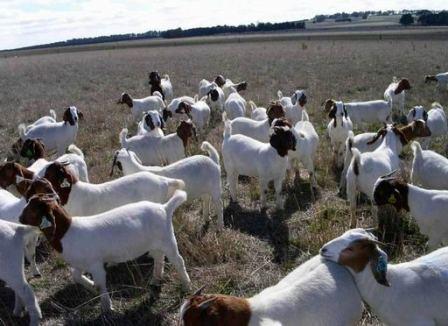
Boer goat
Answer:
1. Liaoning cashmere goat is a cashmere goat breed with high cashmere yield and good quality in China. Liaoning cashmere goats have a robust constitution. The cashmere is white and of good quality, with a high combing yield and strong adaptability, making it suitable for grazing.
2. Inner Mongolia cashmere goat has excellent down quality and is a local fine breed of the dual-purpose cashmere-meat type among cashmere goats. According to the length of the coarse hair, Inner Mongolia cashmere goats are further divided into two types: long-hair type and short-hair type. The long-hair type has long, white hair with few impurities, good luster and a high pure cashmere rate. The short-hair type has short, coarse hair and short, relatively dense down. The mutton produced by Inner Mongolia cashmere goats is tender. This goat has strong stress resistance and is adapted to grazing on semi-desert grasslands and mountainous areas.
3. Chengde polled goat has a gentle temperament, strong flocking behavior, good meat performance, little damage to forests and trees, and is easy to manage. Chengde polled goats have a robust constitution, well-proportioned structure, full muscles and a deep, broad body, appearing oblong when viewed from the side. Due to the natural conditions and extensive feeding management in the breeding area, the growth and production performance of Chengde polled goats have not been fully developed, and their hindquarters development appears slightly insufficient. Improving feeding and management conditions is the main measure for enhancing the meat performance and economic benefits of this breed in the future.
4. The Boer goat is an excellent meat goat breed developed in South Africa. Boer goats have a gentle temperament, good adaptability, strong flocking behavior, can graze over long distances, and can adapt to various feeding and management conditions such as scrubland and semi-desert, as well as hot and humid environments. China first introduced them in 1995 from Shaanxi, Jiangsu and other provinces, and now more than 20 provinces, municipalities and autonomous regions have introduced them for pure breeding or crossbreeding improvement using them as sires, achieving good results and playing a positive role in the development of the domestic meat goat industry.