Growing Habits of Golden Finger Citron and Key Points for Field Planting
Habits of Golden Finger Citron and Key Points for Field Planting
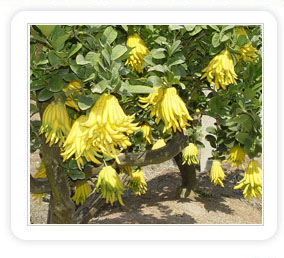
Golden Finger Citron
Golden Finger Citron is generally grown in pots, small and exquisite, full of charm. However, to meet the demands of the sales market (wide medicinal range, high price), it can be planted as part of the development of the western region. Here is a cultivation method: field planting. Field-planted Golden Finger Citron yields more than potted plants, saves time and labor, and reduces costs.
The greatest advantages of field-planted Golden Finger Citron are: well-developed root system, robust tree body, clustered flower buds, high fruit-setting rate, extremely large fruits (the largest single fruit reaches 5.2 jin), extremely high yield, very strong resistance to pests and diseases, excellent economic benefits, and extensive cultivation techniques with low technical requirements and simple management. Areas with an annual minimum temperature of 3°C or places with spring-like weather all year round are more suitable for field cultivation and development of Golden Finger Citron. It overwinters conveniently, requires no cold protection or frost resistance, saves labor, materials and costs, achieving multiple benefits at once; if the winter minimum temperature drops below zero, a greenhouse must be built for overwintering. The management of field-planted Finger Citron is basically similar to that of potted plants, but special attention should be paid to the following aspects:
(I) Soil and Location
Soil is the basic condition for the growth of Golden Finger Citron. However, potted Golden Finger Citron requires sandy soil, while field-planted Golden Finger Citron has different soil requirements. Regardless of loess, black soil, sandy soil, or clay soil (improved by mixing sand), all can be used for planting. Of course, plots containing sandy soil are better, with higher yields.
For field planting locations, the Jiangnan region of China and some parts of the western region are generally most suitable, where the year-round temperature is not too low, which is favorable for the growth of Golden Finger Citron. In addition, in colder regions such as Northeast China, if a greenhouse is available and the temperature inside the greenhouse is not lower than 0°C, cultivation is also possible. The cultivation site should be flat land or gentle slopes. Following the principle of intensification and full utilization of land, light energy, and space, comprehensive planning should be carried out to facilitate management and operation. Practice has proven that only by basing decisions on the living habits of Golden Finger Citron and its requirements for environmental conditions, while also fully exerting human initiative and committing to transforming nature, can an orchard suitable for the growth and development of Golden Finger Citron be established. The pH range of seedling soil: pH 5.5-7.5. Ferrous sulfate can be used to improve alkaline soil, and lime powder to improve acidic soil.
(II) Field Planting Time and Saplings
Field planting time for Golden Finger Citron is basically the same as for potted Golden Finger Citron, and can be carried out in spring, summer, and autumn. As for field-planted saplings, generally when the tree body is not robust, the root system is not well-developed, and the tree age is relatively old, they are transferred from pots to the field; secondly, to save labor, materials, and costs, field-planted saplings can be planted in the field from one-year-old seedlings, cultivated from a young age. The latter is especially suitable for the Jiangnan region and some parts of the western region. (Cultivation can begin from small seedlings, and the benefits are even more considerable.)
(III) Field Planting Spacing
The general field planting spacing is 1.2 m or 1.3 m. Seedbeds with a width of 1.2 m or 1.3 m can be planted at a spacing of 100×100 (cm) or 120×120 (cm) (as shown in Figure 7). Alternatively, small seedlings can be planted at a appropriately closer spacing, and after the trees grow larger, thinning and transplanting can be carried out, adapting to the trees and exercising flexibility. Generally, 400 to 600 saplings per mu is appropriate.
(IV) Reasonable Intercropping. Reasonable intercropping in a Golden Finger Citron orchard can fully utilize land and light energy, develop three-dimensional agriculture, increase orchard income, and achieve the goal of "nourishing trees with the land, supporting the long-term with the short-term, and maintaining the orchard with the orchard." Especially in young Golden Finger Citron orchards where the row spacing is large and orchard income is low, reasonable intercropping of fruit with grain or fruit with medicinal herbs is the main source of increasing early-stage orchard economic income. Intercropping between rows in the orchard is beneficial for maturing the soil, increasing soil fertility, preventing weed overgrowth, maintaining humidity, and promoting the growth and development of Golden Finger Citron.