To eat Southeast Asian food authentically, this plant is indispensable.
I wanted to write about this plant two years ago. After all, Shaoyao is often teased by friends as a "Thai native," but I don't know if it was because of Mercury retrograde (fine, blame it on that), my mind was always drawn to other things, so it kept getting delayed again and again.
Then, as the days got hotter and hotter, my urge to make Thai food grew stronger and stronger. Wasn't it all because I missed that one unique aroma?
If you're also a Southeast Asian food lover, you should know what I'm talking about. It's late at night, so let's talk about something with real impact~ (a Thai song for everyone)
{ Shaoyao Guniang Vol.819 }
x
A must-have for Nyonya cuisine
One day I got carried away and made a bold claim that I would cook a Southeast Asian meal for my friends. Everything else was easy to handle, but lemongrass and pandan leaves were not easy to buy. Fortunately, a shop on JD.com offered them, so I quickly placed an order. It was only about ten yuan, and they didn't deliver, so I added a bunch of random things to reach the minimum.
A few days later it arrived at home. I emptied the box and found that everything I'd added to make up the order was there, but the spices had been left out. ┓( ′?` )┏
The seller asked me: "Dear, would you like a refund or a reshipment?" ... I was so annoyed that my indecision kicked in. How am I supposed to choose?
Thai people are no less laborious than Chinese people when cooking. First they spend half a day chopping vegetables, chopping a pile of all kinds of spices, some with names you can call and some you can't, chopping them finely, and a unique aroma drifts through the air. This kind of complex combination scheme and portion calculation could probably only be handled accurately by them.
This kind of cuisine, which requires mixing more than ten kinds of tropical spices and has a sweet, sour, and spicy taste, is generally called "Nyonya cuisine," and it is widely popular in Malaysia, Singapore, and Indonesia.
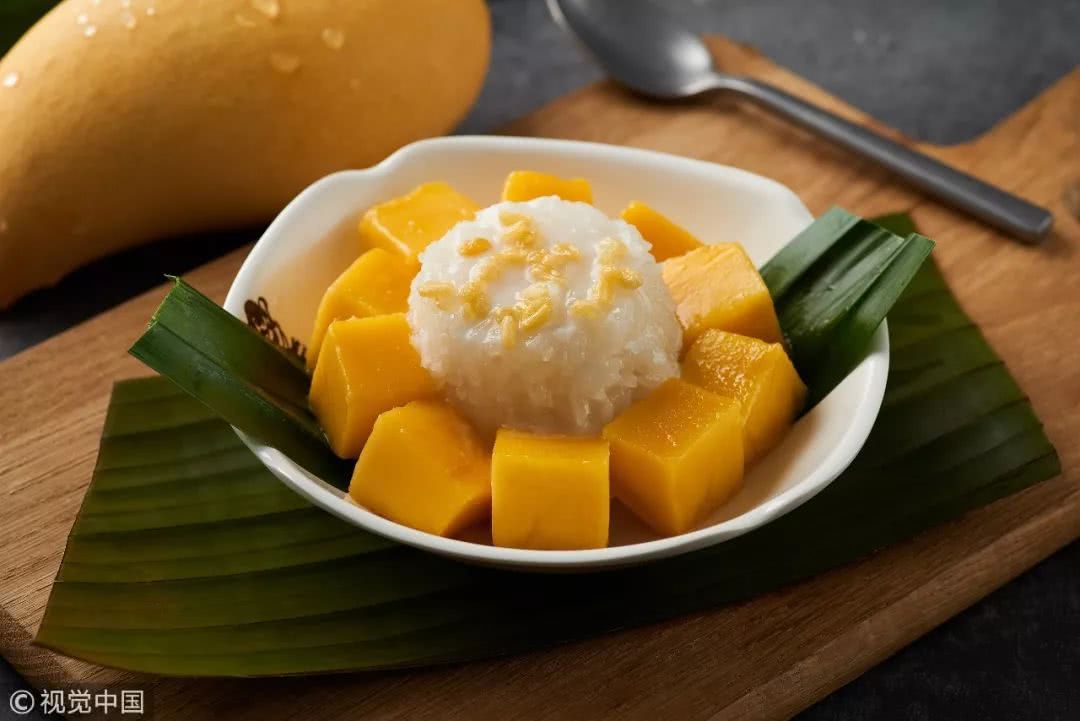
To put it without exaggeration, it doesn't matter if you have no time for a vacation. As long as there is a meal and a cup of tea, home can be Phuket. Shaoyao likes to brew tea with lemongrass (also called citronella), and also loves making mango sticky rice. When cooking it, you need to add a little pandan leaf. Once you get used to the aroma of this plant, both your mouth and your memory become picky.
Of course, mango sticky rice without pandan leaf is also delicious, but it is only sweet and sticky, losing its layers. This gradual progression, blending yet seemingly with different layers, is the essence of Nyonya cuisine.
It's this little green grass~
Take fresh pandan leaves,
garnish or lay them on the rice,
no matter how you look at it, it's a visual killer.
(Image from Xiachufang user @Shanpangpang)
Thai people really love wrapping things in pandan leaves. I remember the first time I saw them at the Chiang Mai night market, row after row of them. I was still thinking: are these leaves meant to be eaten or not?
We like to use string; Thai people use toothpicks to skewer them,
which is also a kind of peculiar wisdom.
Pandan leaf has many alternative names. It is also called "seven-leaf pandan," "bān lán yè," "xiāng lín tóu," "bì xuè shù," and "xiāng lù dōu." In Indonesia it is called "Pandan." If pronounced inaccurately, it sounds a lot like "Panda," which easily leaves people completely confused.
"Pandan" in Indonesian broadly refers toPandanusplants. Their leaves are long and narrow, often clustered at the top of branches, with sharp spines along the edges, and they are mostly distributed in tropical regions of the Eastern Hemisphere.
Wild Pandanus plants
Pandanus rarely blooms, but it produces very brightly colored fruit,
some call it "lín tóu guǒ," and some call it "wild pineapple."yes,
It can be bought at local markets to eat, and surprisingly it can also be made into bracelets.
Because the leaves are tough,Pandanus leaves are often used for weaving mats or baskets.Pandan leaf is a special variety among them. Its leaves have almost no serrated edges, and it is mainly cultivated artificially. With its unique aroma, it climbed onto the dining table and became the "white moonlight" in diners' hearts.
Tying knots, cutting into pieces, shredding, or wrapping food whole are all ways for pandan leaf to combine intimately with food. Among the many strong-flavored spices of Southeast Asia, pandan leaf is absolutely a breath of fresh air. And precisely because of this,regulation and balance are the main roles nature has given it.After the spiciness, there should be a hint of freshness and a bit of lingering aftertaste, yet you cannot find it anywhere. That is thanks to pandan leaf.
Let me mention a few dishes you all know where it appears. For example, every time I go to a Thai restaurant, the dessert I must order after the meal is "coconut sago cake." That ring of green leaves around the outside is pandan leaf, no mistake.
Every time I eat this dessert, I smell a fresh rice aroma.
At first I would sigh that the glutinous rice with coconut milk smelled incredibly good,
butthat faint, barely-there rice fragranceis actually the scent of pandan leaf.
Another dish you can often eat is "pandan leaf wrapped chicken." The outside of the pandan leaf is fried until crisp, while inside there is still a grassy toughness with clearly defined fibers. You can choose to unwrap it and eat the chicken directly, or eat the whole pandan leaf, savoring a light "toasted rice aroma."
If you want to make "pandan leaf wrapped chicken" at home, the Chinese-style braised chicken method is no problem. The difficulty lies in where to get such complete and emerald-green pandan leaves~
A small tutorial image offered as a friendly bonus
Another method similar to "pandan leaf wrapped chicken," with a bit of rice and a bit of meat. Let's just call it "Southeast Asian zongzi"~
Singapore's famous dish "laksa" also includes pandan leaf. It is used to cook curry and has a very good aroma-enhancing effect.
Besides enhancing aroma, it can also be blended into juice for coloring, and works for both sweet and savory dishes. In Indonesia there is a kind of "sweet stuffed pancake" called Kueh Dadar. The wrapper is mixed with egg liquid and pandan leaf juice and pan-fried, then filled with salty shredded coconut and cream, full of Southeast Asian flavor.
Another Indonesian soup dumpling coated in shredded coconut is also made by mixing in pandan leaf juice, and it tastes very much like glutinous rice balls.
And the "pandan cake" that has gradually become popular in recent years is also made with pandan leaf blended into juice. (A little reminder: a slight green tint is normal; if it is too green, it must be due to food coloring~)
Malaysia, Indonesia, Thailand, and Singapore love pandan leaf to the point that it has become habitual and unconscious. They not only regard it as a good friend of food, but also use it for other purposes, such as folding it into containers to hold sauces, or mixing it into floral offerings presented to deities.
All because it is fragrant enough and unique enough.
In Shaoyao's memory there is also a Singaporean dish that must be mentioned: "kaya." Although it is also called coconut jam, it has pandan leaf in it!
The first time I heard this word was in a movie, "When Hainan Meets Teochew》。
." The accents are a bit scary,
and although the three main characters' looks are worrisome, they are quite interesting.
It tells a love story of a man who is not quite a man and a woman who is not quite a woman.
After watching it, you are still willing to savor it many times. It is a good movie.
Chen Hongcai and Li Zhaomin are part-time actors. They normally have their own jobs, and the movie was filmed in their spare time over weekends. Yang Yanyan is a film queen, and her acting is really good.
Near the end of the movie, the female lead's ex-girlfriend chooses to leave completely on her birthday. The remaining pair, a man and a woman with mismatched gender roles, oddballs who thought they would be lonely until death, unexpectedly gain a certain complementarity and comfort, and in a warm posture, together complete a jar of kaya jam.
Beat the eggs and strain them.
Pour into a pot, slowly add granulated sugar and coconut milk,
and simmer slowly by steaming, stirring constantly.
Wash the pandan leaves, tie them into a knot, and drop them into the pot.
Stir in one direction every 10 minutes,
until the foam disappears and it cooks to a thick consistency.
Jar it and it is ready to spread on bread.
Stored in the refrigerator, it can be eaten for a long time.
Because of this, I remembered "kaya" for many years,
wondering what on earth it tasted like.
Years later, when I saw it in a Hainanese chicken rice shop in Shanghai,
I immediately ordered it. I knew myself too,
what I was eating was not kaya,
but that little sprout long planted in my heart,
the sense of hope that had finally grown and sprouted.
END