A wild delicacy that grows only on nanmu trees, shaped like a pig's brain, a rare thing few people have ever eaten
Our country has a vast territory, and correspondingly its natural resources are quite rich, especially resources such as wild plants, which are even more diverse. From northern China to southern China, there are thousands of species of wild plants. Of course, these wild plants are not all distributed in every province and city; some wild plants exist only in a few certain provinces and cities, and they also grow in the deep mountains and old forests of rural areas, which makes them seem even rarer. Below, the author will introduce one such wild plant to everyone; it is very special and is also a rare thing.
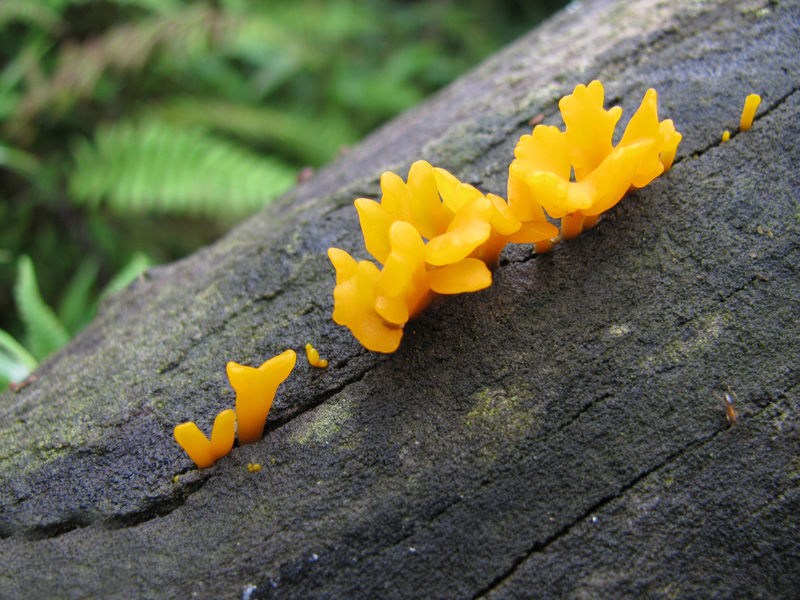
Summer is a season for eating wild delicacies. In the mountains of rural areas, many wild delicacies grow, such as wild mushrooms and wild fruits, and these are fairly common. But in the rural mountains of Yunnan and Tibet in our country, there is a particularly rare wild delicacy. This wild delicacy grows only on nanmu trees, and its overall shape looks like a "pig's brain," though it is actually quite attractive, appearing golden yellow. This wild delicacy is "golden ear," also called yellow wood ear, nao'er, pig brain ear, or yellow ear.
Presumably everyone is familiar with silver ear and black wood ear, and eats them often, so this golden ear may be something few people have seen or eaten, because this golden ear basically grows only in high-mountain oak forest belts, and it also has a symbiotic relationship with fungi, such as Stereum hirsutum and Stereum subtomentosum, which makes it even harder to see.
So does this rarely seen golden ear have any value?
Actually, when talking about the value of golden ear, one cannot help but compare it with silver ear and black wood ear. Everyone knows that silver ear and black wood ear both have high nutritional value, especially silver ear, which is often used as a tonic, so its price is also very high. But compared with golden ear, silver ear is far inferior; golden ear's tonic and nutritional value is even better than silver ear's. In ancient times, golden ear was listed as a delicacy for high-class banquets, and at that time only high officials and nobles could afford to eat it.
As for just how rich golden ear's nutritional value is, the author also consulted relevant materials. According to records, golden ear contains rich fat, protein, potassium, calcium, magnesium and various other trace elements, which makes its tonic and health-care value extremely high, and thus in modern times it is increasingly loved by people. The author also specifically asked a farmer friend in Yunnan about the price of golden ear. Generally, wild golden ear, because it grows only on nanmu trees in high mountains and is scarce in quantity, is therefore expensive, with wild dried goods reaching 800 yuan per jin.
Of course, where there is wild, there is cultivated. Cultivated golden ear generally does not grow on nanmu trees, but on trees such as oak and basswood, which also makes its price relatively lower, with dried goods generally around 95 yuan per jin. So if everyone wants to buy golden ear, be sure to identify it carefully, after all, the price gap between cultivated and wild is too large.
Dear friends, have you ever seen golden ear? Have you ever eaten golden ear? You are welcome to leave a message and exchange ideas!