How advanced is American agriculture? Take a look at how American farms grow their crops
From the current impression among Chinese people, the perception of American agriculture is basically highly mechanized and genetically modified. So specifically, is American agriculture really as described above? Science Xingnong can clearly say here that it is indeed so! Below is a brief discussion from the above two aspects.
Replace with high-definition large image
Genetically modified corn
According to a report by Science and Technology Daily, over the past 22 years (counting from the commercialization of GM planting in 1996), the area of GM crops in the United States has grown larger and larger, and they are widely welcomed by farmers. From initial lack of recognition to gradual full acceptance took only a few years. Today, the penetration rate of GM soybeans, corn, cotton, and rapeseed in the United States has reached over 90%, and this momentum has not stopped at all.
In the future, the planted area of GM crops and the variety of crop types in the United States are expected to further increase. As for the degree of acceptance of GM crops in the United States, various countries also show considerable inconsistency, but for the United States alone, people have already diluted this view of GM, because it is already difficult to see agricultural products in supermarkets that are not labeled GMO (genetically modified).
The advantages of GM crops are obvious, for example, easier weeding and higher yields. In China, weeding in corn fields is a major problem. Basically, pre-emergence closed herbicides are used to kill weeds about to emerge. However, a problem that cannot be ignored is that post-emergence weeds are also a major factor causing corn yield reduction.
Because American farmers plant GM corn, this problem is greatly simplified. Herbicide-resistant GM corn can efficiently control weeds at any stage of corn growth.
Replace with high-definition large image
Mechanization
This kind of mechanization is different from the small-scale mechanization mentioned in China. Here we can look at a set of data: 2.2 million people in the United States farm, with 2.2 million farms, equivalent to one person per farm, with an average planting area of over 1,000 mu per person. With such a large amount of farmland, how could cultivation and harvesting be satisfied without highly mechanized farming? Therefore, this kind of mechanization can be seen everywhere in the United States.
For example, at the harvest stage, China plants late-maturing varieties because a long growth period can achieve higher yields. However, what Americans pursue is not late maturity but early maturity, because early-maturing corn dehydrates quickly and is more suitable for mechanized harvesting. At the same time, planting GM corn over large areas simplifies weeding and farm operations.
This mechanization does not stop there. For example, straw return to the field, fertilization, pesticide spraying, and watering are all completed by mechanization. What is expensive in the United States is actually not machinery but labor. Sometimes even if you spend money, you may not necessarily be able to find labor. This is the current situation in the United States, the current situation of American agriculture!
Replace with high-definition large image
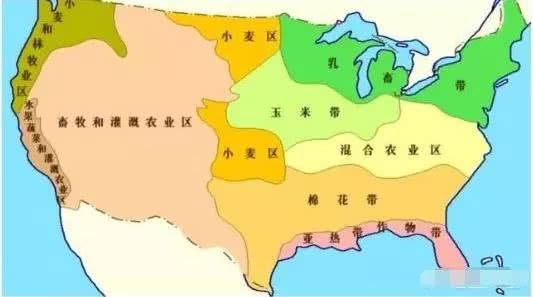
There are still many differences between American agriculture and China's agriculture. For example, in summer the United States basically has only two crops, corn and soybeans, and when planting, the two are basically rotated. This farming method avoids the continuous cropping phenomenon that often occurs in Chinese agriculture.
What the United States leads in is actually not only industry; agriculture is also at the forefront of the world. Looking at American agriculture, sometimes one really cannot help but sigh: the United States is truly a "major agricultural country."
This is Science Xingnong. You are welcome to add a follow and learn together.