These 20 key points from orchid-growing notes are all important
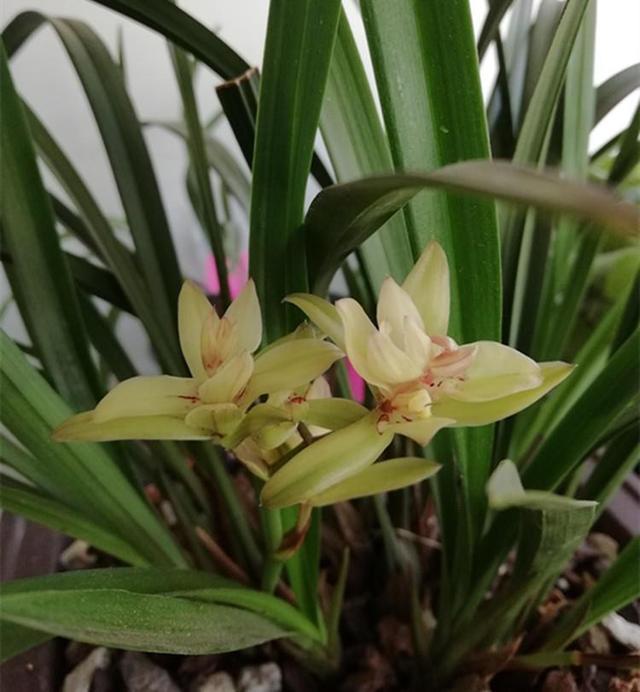
In the practice of growing orchids, hobbyists always run into problems and often do not know how to handle them. Today, the editor shares with you some "notes" on the problems and experiences an old horticulturist discovered while growing orchids. The 20 key points in them are all important, so commit them to memory.
1. In Sichuan and southern China, orchid growers often use rice husks as a growing medium, but be careful that they must be fully decomposed and disinfected, otherwise white silk disease easily occurs, and the fertilizer effect is too strong. Decomposed rice husks should also be mixed with an appropriate amount of river sand or other fertilizer-free growing medium.
If hobbyists use decomposed rice husks as a growing medium for orchids, they can mix in sun-dried pig manure, decomposed leaves and river sand. For most orchid varieties this may be too rich; only Shui Bai, Zhu Sha and a small number of clustered Chun Jian adapt to it.
2. When repotting orchids, the pseudobulbs must never be completely buried in the soil. Otherwise, the young shoots easily rot in summer. It is best to use some dry moss around the pseudobulbs to keep more air spaces.
3. Orchids must not be grown entirely in peat soil, because it is too rich and the roots easily turn black. It can be used in a certain proportion in a mix. If hobbyists mix the soil but the orchid lacks fertilizer, it does not matter; later, top-dress with an organic liquid fertilizer specially made for orchids, generally once a week, diluted 500 times, and the orchid will grow without problems.
4. When buying orchids, be sure to choose connected two- or three-generation mature plants and strong plants; do not buy old plants or weak plants, and pay even more attention to diseased plants. When buying stock, also pay attention to the roots.
5. When choosing orchid pots, it is best to use the same kind of orchid pot; if there are too many kinds of orchid pots, troubles will arise in later orchid care. For example, sand pots easily absorb water and also easily evaporate it, clay pots absorb water less readily, and plastic pots neither easily absorb nor easily evaporate water, which makes watering difficult, so they should be treated differently.
6. In summer, if the air humidity exceeds 80%, it is not suitable to spray water, otherwise the humidity becomes too high and the shoots easily rot. You can sprinkle water around the orchid with a watering can to raise the air humidity of the orchid's care environment, which can also have a cooling effect.
7. If the humidity in the pot is insufficient in autumn, autumn shoots easily become stunted, do not grow leaves and do not develop roots.
8. Mastering humidity and watering is a skill that takes years. Different seasons, different orchid pots, different orchid varieties, different growing media and different plant sizes all have different humidity requirements, so they must be treated differently.
9. So-called air permeability and good drainage in the pot mainly depend on the growing medium. The growing medium must be coarse-grained, long-fibered, and use a combination of soft and hard materials.
10. Single plants and weak plants of Chun Lan, Chun Jian and Lian Ban Lan have difficulty surviving above 35°C, with an extremely high mortality rate.
11. Mo Lan and Lian Ban Lan exposed to strong light in summer easily develop black spots, and also easily get scorched tips and pitted leaves; in severe cases they may even collapse.
12. If the surface of the potting soil stays moist for a long time in summer and autumn and white spots appear on the sheaths of the orchid, this is a precursor to soft rot. The growing medium at the base of the orchid should be spread open in time, the pot placed in a ventilated place to dry, and then a pesticide sprayed. Otherwise, soft rot will soon occur.
13. All wild-collected orchids, because of long-distance trafficking, must have their lower leaves and rotten roots trimmed clean. Otherwise they may carry pathogens. Externally purchased orchids should first be checked for disease; diseased orchids must never be bought.
14. For striped-pattern orchids, more humidity and shading are needed in summer and autumn, especially for crystal types, otherwise scorched tips and withered leaves easily occur.
15. Orchids like stability and dislike disturbance; frequently moving or changing the position of orchid pots will affect the growth of the orchids.
16. Frequently repotting orchids and changing the soil is not good for growth. Experience has shown that repotting once a year or once every two years is more suitable.
17. Some orchids are not easy to lift out and repot, so the method of dividing the clump in the original pot can be used, that is, find the connected separation point of the orchid clump (also called the "road") and gently insert thin scissors to cut it apart. After dividing the clump in the original pot, never water immediately, otherwise infection easily occurs.
18. When buying orchids on the market, except for a few traditional varieties with obvious characteristics, be sure to look at the flowers, otherwise you are easily cheated.
19. In orchid cultivation, withered yellow old leaves and diseased or insect-damaged leaves should be constantly cut off to help ventilation. After the flower buds emerge, keep one flower bud per plant and cut off the rest, so as to avoid consuming too many nutrients and affecting the next year's flowering.
20. When growing orchids, ferrous sulfate can be applied once at intervals to increase soil acidity. In addition, watering orchids with fermented rice-washing water can also keep the soil in a slightly acidic state.