The flowers of the peacock flower are so lifelike, they look just like a phoenix in flight.
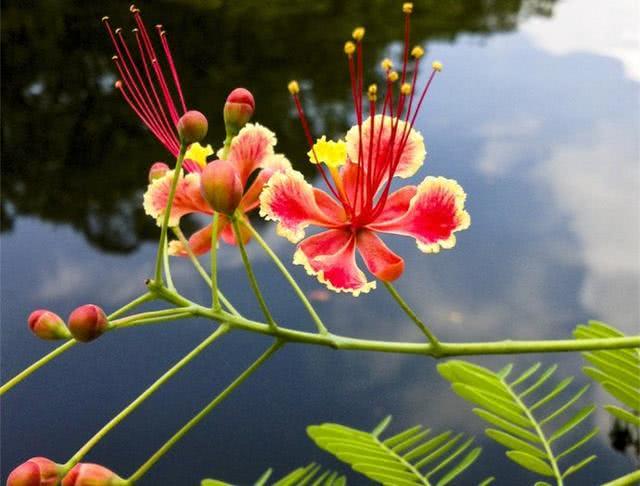
Peacock flower (a plant of the genus Caesalpinia)
Peacock flower (scientific name: Caesalpinia pulcherrima (L.) Sw.): large shrub or small tree; up to 3 m tall, branches green or pinkish-green, with scattered prickles.
Bipinnate compound leaves in 4 to 8 pairs, opposite; leaflets in 7 to 11 pairs, oblong-elliptic or obovate, base oblique, apex notched, leaflet stalks very short.
Racemes terminal or axillary; petals round and stalked, orange or yellow; pedicels up to 7 cm long. Pods black. Seeds 6 to 9. Flowering and fruiting almost year-round.
Native to the West Indies; cultivated in Yunnan, Guangxi, Guangdong and Taiwan, China. One of the valuable ornamental trees of tropical regions.
Morphological characteristics
Peacock flower is a large shrub or small tree; branches smooth, green or pinkish-green, with scattered prickles. Bipinnate compound leaves 12-26 cm long; pinnae 4-8 pairs, opposite, 6-12 cm long; leaflets 7-11 pairs, oblong or obovate, 1-2 cm long, 4-8 mm wide, apex notched, sometimes with a short mucro, base oblique; leaflet stalks short.
Racemes nearly corymbose, terminal or axillary, lax, up to 25 cm long; pedicels of varying length, 4.5-7 cm long; receptacle concave and top-shaped, hairless; sepals 5, hairless, the lowest about 14 mm long, the rest about 10 mm long; petals orange-red or yellow, round, 1-2.5 cm long, margin wrinkled and wavy, the stalk almost as long as the petal blade; filaments red, extending far beyond the petals, 5-6 cm long, thick at the base, hairy; ovary hairless, style long, orange-yellow.
Pods narrow and thin, oblanceolate-oblong, 6-10 cm long, 1.5-2 cm wide, wingless, with a long beak at the tip, hairless, indehiscent, dark brown when mature; seeds 6-9. Flowering and fruiting almost year-round.
Origin and habitat
Cultivated in Yunnan, Guangxi, Guangdong and Taiwan, China. Probably native to the West Indies. One of the valuable ornamental trees of tropical regions.
Growth habits
The peacock flower is a tropical tree species. It prefers a climate with high temperatures and high humidity, and has low cold resistance; with prolonged low temperatures of 5-8°C, the branches suffer cold damage, and it is intolerant of frost. In Guangzhou, Nanning and other places in southern South China, it can overwinter safely outdoors in normal years, but suffers frost damage in cold years. In the vast areas from northern South China to North China, the peacock flower can only be grown in pots, moved into a warm shed or indoors in winter, and the room temperature should not be lower than 10°C. It likes light and is not tolerant of shade; it withstands blazing sun and high temperatures and is best planted in a sunny spot. It is not demanding about soil and does well in both sandy and heavy clay soils; it prefers acidic soil, is fairly drought-tolerant, and also slightly tolerant of waterlogging.
Propagation methods
The peacock flower is propagated from seed. From mid-June to mid-December, the pods mature successively, with September-October being the peak ripening period. Collect the pods that ripen at the peak, spread them in the sun, and after they split open, remove the seeds. They can be sown as soon as collected, with the seedlings protected from cold to overwinter, or the seeds can be stored and sown in spring the following year. The thousand-seed weight is about 132 g. For germination, the air temperature must be above 20°C. Sowing in mid-to-late March in spring is preferable. Before sowing, soak the seeds in 60°C warm water, then continue soaking for 12 hours after it cools; germination is rapid, generally beginning three days after sowing and finishing within a week, with a germination rate of about 60%.
Use the drill sowing method. Seedlings grow at a moderate rate. During the seedling stage, apply nitrogen fertilizer 2-3 times to boost the seedlings. After October, stop applying nitrogen fertilizer and apply potassium fertilizer consistently to promote early lignification. In winter, cover them to prevent frost. One-year-old seedlings can be lifted from the nursery and planted out; two-year-old young trees can already flower for ornamental display. If leaf spot disease occurs, it can be controlled with a 500-fold dilution of 50% carbendazim wettable powder.
Cultivation techniques
Its demand for fertility is not very high. Generally, in soil of medium fertility with fairly high phosphorus and potassium, it flowers abundantly and the colors are also vivid; in soil with ample moisture and fairly high nitrogen, the branches and leaves are lush and it also flowers more, but the colors are less vivid. When planting, it is advisable to apply decomposed cake fertilizer or compost as a base fertilizer, and top-dress with phosphorus and potassium fertilizer before flowering and at peak flowering. Its tree shape is not very attractive, but it has strong sprouting ability; in management, trunk cutting or pruning and shaping can be used to encourage a fuller crown, and 3-5 plants can also be planted together to improve the ornamental effect.
Pest and disease control
Powdery mildew
Symptoms: This disease mainly occurs on leaves and tender shoots. It generally begins in June, and after July the leaf surface is covered with a white powdery layer. Subsequently, small yellow granules form within the powdery layer, the color gradually deepens, and finally turns dark brown. Transmission route: The pathogen overwinters in diseased plant residues and seeds. The following year, when environmental conditions are suitable, the pathogen spreads by wind and rain. August-September is the peak period of the disease.
Control methods:
Do not plant too densely, ensure proper ventilation, strengthen fertilizer and water management, and enhance the disease resistance of the plants. Remove diseased leaves and diseased plants and destroy them in a centralized manner to reduce sources of infection.
During the disease period, control with a 1000-1200-fold dilution of 15% triadimefon wettable powder, or a 1000-fold dilution of 70% thiophanate-methyl wettable powder. Avoid spraying at high temperatures above 32°C to prevent phytotoxicity.
Brown spot disease
Peacock flower brown spot disease, also known as balsam leaf spot disease, occurs throughout China, north and south. Symptoms: The disease mainly occurs on leaves. Leaf spots are initially small light yellowish-brown dots, then expand into round or oval shapes, after which the center turns light brown and the edges brown, with inconspicuous concentric rings. On severely affected leaves, the spots merge into patches, causing the leaves to become withered and yellow, until the plant dies. Transmission route: The pathogen overwinters on diseased balsam residues and on plant debris in the soil. The following year, when environmental conditions are suitable, the pathogen spreads by wind and rain. It is prone to occur in hot, rainy seasons.
Control methods:
The peacock flower likes fertile sandy loam and is not tolerant of waterlogging. Therefore, planting in sandy loam is preferable to facilitate drainage; for potted peacock flowers, the pots should be tipped promptly after rain. In late autumn, diseased leaves and diseased plants should be collected and destroyed in a centralized manner to reduce sources of infection for the coming year.
In the early stage of the disease, control with a 300-600-fold dilution of 25% carbendazim wettable powder, or a 100-fold dilution of 50% thiophanate-methyl, or a 1000-fold dilution of 75% chlorothalonil.
Damping-off
Symptoms: The pathogen mainly infects the root and stem base, causing the affected part to turn black or constrict; when moist, white mold-like growth appears on it. After the plant is infected, the leaves wilt and dry up within a few days, and then the entire plant dies.
Transmission routes: It mainly overwinters in the soil or in diseased residues in the form of mycelium or sclerotia. The mycelium in the soil lives saprophytically and does not dormancy. In the field, it spreads mainly through contact, that is, when the roots, stems and leaves of the plant come into contact with diseased soil, they are infected by the mycelium in the soil; under conditions with a water film, healthy leaves in contact with diseased parts become infected. In addition, seeds, farm tools and contaminated compost can all spread and expand the disease.
Control methods: In the early stage of the disease, after removing the diseased plants, spray with a 600-fold dilution of 75% chlorothalonil wettable powder, or a 500-fold dilution of 60% carbendazim-thiram wettable powder, or a 1200-fold dilution of 20% tolclofos-methyl emulsifiable concentrate.
Main value
Ornamental
The peacock flower is an upright evergreen shrub of the genus Caesalpinia in the Fabaceae family. Up to 3 m tall, with an orange-red corolla and golden-yellow edges, it blooms on the branches almost year-round like fiery butterflies, and is one of the valuable ornamental trees of tropical regions.
Among flowers, the peacock flower does not attract people by color or fragrance, but wins mainly by its posture and form. Its flower shape is especially ingenious: the flower looks like a flying phoenix, with a head, a tail, wings and feet, vivid and lifelike, just like a phoenix in flight, making people marvel at the wondrous marvels of nature's creation.
Medicinal
The peacock flower is a well-known Chinese medicine. The seeds are used as medicine and have the effect of invigorating blood and promoting menstruation. The stems are squeezed for juice and taken with yellow rice wine,
Plant culture
Birthday flower
In the sixteenth century, the flower of Saint Clarus, a prince of the Frankish Kingdom.
Since ancient times, Christianity has had the custom of linking saints with specific flowers, following the practice of the church decorating the altar with blooming flowers when commemorating saints! And in medieval Catholic monasteries, all kinds of flowers were planted almost like gardening centers.
Over time, the church paired the saints of the 366 days with different flowers, forming the so-called flower calendar.
At that time, most monasteries were located in Southern Europe, and Southern Europe has a Mediterranean climate, which is extremely suitable for planting flowers and plants.
The peacock flower, which belongs to the Asteraceae family, was chosen as the flower to honor Saint Clarus, a prince of the Frankish Kingdom. It is said that Saint Clarus gave up the right of succession to the throne, preferring to be a monk. He not only helped the weak and supported those in need, caring for the suffering, but also performed many miracles.
Flower language
Escape
The peacock flower was chosen and dedicated to the Frankish prince Saint Clarus. After his father the king died, he was pursued by the uncle who wanted to seize the throne. In order to save his life, he gave up his right of succession and became a clergyman, and therefore its flower language is "escape." People born blessed by this flower language are low in spirits; although they are in settings such as balls, they seem more often to hide in a corner and watch coldly from the sidelines. However, when the person they love appears, their character may suddenly change, and they will carry through their belief in love.
City flower
The peacock flower is the city flower of Shantou, Guangdong Province, China, the city flower of Zhanjiang, Guangdong Province, China during the Republic of China period, and the school flower of Shantou University and Xiamen University.
In December 1982, through a direct vote by the citizens of Shantou and approval by the mayor's office meeting, the peacock flower was determined to be the city flower of Shantou.
In June 1983, the city flower naming conference was held at the Shantou City Library. The peacock flower, scientific name Delonix regia, belongs to the Fabaceae family. It is a deciduous tree used as a garden tree and street tree. It blooms in summer, delicate and eye-catching, and is widely planted in the urban area.
In 1996, it was decided to select one more city flower. Through a citizen vote, orchid was chosen from the two candidate flower species, orchid and butterfly pea, as the other city flower.
In January 1997, the municipal government confirmed orchid and peacock flower as joint city flowers of Shantou.
Shantou has a long history of growing orchids. Orchids have tenacious vitality, noble forms and profound cultural connotations, represent the spiritual outlook of the people of the special economic zone, and are also a Chaoshan specialty; they are shade-loving and have many varieties, setting each other off beautifully with the peacock flower.