Why are the pothos leaves turning yellow and thin?
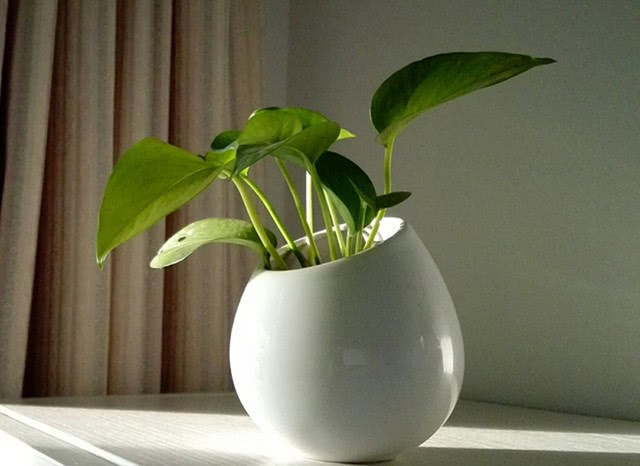
Pothos, also known as golden pothos and devil's ivy, is a perennial evergreen climbing plant of the genus Epipremnum in the Araceae family. It is native to the tropical rainforests of the Malay Peninsula in Asia and the Brazil region of South America. As a shade-tolerant foliage plant, pothos is very suitable for indoor cultivation and viewing, and is a rare indoor potted foliage plant.
Potting soil and potting method
For cultivating pothos, the potting soil should preferably be a culture soil mixed evenly from 3 parts leaf mold, 3 parts garden soil, 3 parts river sand, and 1 part barnyard manure. When the underground root system of pothos seedlings propagated by cuttings has grown to about 5 cm and the above-ground young shoots have grown to 5-7 cm, they can be directly potted. Use glazed pots with a diameter of 33 cm, planting 3 small seedlings per pot in a triangular arrangement, which easily forms a good plant shape.
After potting, place them in a ventilated shade shed, avoiding direct sunlight; spray water 3-4 times a day to increase air humidity and keep the potting soil moist. Once the seedlings resume growth, they can be transferred to normal care and management. Young plants should be repotted once a year, while mature plants can be repotted once every 1-2 years.
Watering method
Pothos likes moisture. In spring, summer, and autumn, the potting soil should be kept moist; if the soil is too dry, the leaves tend to turn yellow. However, too much watering that causes waterlogging will lead to root rot and withered leaves. Generally, in spring and late autumn, water once every 2-3 days; in summer, water once a day, and frequently spray water on the leaf surfaces and the surrounding ground to increase air humidity and keep the leaves bright green. In winter, watering should be controlled, watering only after the surface of the potting soil has dried; otherwise, too much watering and overly wet soil will reduce cold resistance and cause yellow leaves and root rot. In winter, the leaves can be sprayed and washed with warm water once every 3-5 days to keep them glossy and emerald green.
Fertilizing method
Pothos grows relatively fast, so topdressing should be strengthened during the growing season. Topdressing should be mainly nitrogen, applied in combination with nitrogen, phosphorus, and potassium fertilizers. You can use 0.1% urea and 0.3%-0.5% diammonium phosphate, or apply 0.1%-0.2% urea solution and 0.1% potassium dihydrogen phosphate liquid fertilizer. You can also apply 15%-20% decomposed cake fertilizer liquid. From spring to early summer, apply topdressing once every 10-15 days or so; from summer to early autumn, apply once every 20 days or so; in autumn, apply once every 10-15 days; in winter, do not apply fertilizer to the potting soil, only spray the leaves with 0.1%-0.2% urea solution once every 20-30 days to keep the leaves green and glossy.
Light requirements
Pothos dislikes direct sunlight and should be cared for under semi-shade or scattered light conditions. It is suitable for indoor cultivation. Generally, in spring, summer, and autumn, pothos can be placed at a north- or east-facing window, and in winter at a south-facing window. When cultivating pothos outdoors, direct sunlight must be avoided, especially in summer, otherwise it will scorch the leaf edges, make new leaves smaller, and cause the leaf color to become dull and lusterless. Outdoor care can be placed in a well-ventilated shade shed, with a light transmittance of about 50% being appropriate.
Propagation method
Pothos is mostly propagated by cuttings. There are two types: stem cuttings and leaf cuttings.
1. Pothos stem cutting method
Generally carried out in spring and autumn. Select one-year-old branches with bright leaf color, thick leaves, and robust growth, and cut stem sections about 15 cm long with 2-3 nodes as cuttings. When cutting the cuttings, do not damage the aerial roots. After cutting, insert them promptly into plain sand at a depth of 1/3 of the cutting, water thoroughly, and place in a shaded place, or shade the cutting bed. Spray water on the leaves twice a day, and always keep the soil and air moist. At a temperature above 25°C and in a semi-shaded environment, they will root and grow leaves in about 15-20 days.
2. Pothos leaf cutting method
The leaf cutting method is to use pothos leaves for cuttings. Its advantage is that it does not damage the plant shape. The method is to select robust leaves from the middle and upper parts of the branches, cut them from the base of the petiole with a small knife, and then insert them into water or a substrate. Water propagation roots quickly and is suitable for small-scale household propagation. When inserting, the petiole should be submerged in water to a depth of 1-1.5 cm. If too shallow, the leaves will wilt if water evaporates and is not replenished in time; if too deep, the petiole is prone to rot. After insertion, change the water once every 5-7 days, and they can be planted in about 50 days. The cutting substrate should preferably be a mixture of fine sand and furnace slag; before planting, disinfect the substrate by sun exposure or scalding with boiling water. When inserting, poke holes with a bamboo stick to avoid damaging the petiole, water thoroughly after insertion, and pay attention to humidity and ventilation. Leaf cuttings sprout relatively slowly, taking about 6-7 months.
Cuttings can also be propagated by water propagation. Insert the cuttings into water and plant them after they root.
Precautions
1. Leaves turn yellow and fall off, and the stems rot: mainly due to too much watering, especially in winter. Pothos requires good drainage in the potting soil and dislikes water accumulation in the pot. If this situation is found, repot promptly.
2. Leaf tips curl and turn withered brown: mainly due to air that is too dry, so spray water on the leaves frequently.
3. Leaf edges turn brown, and withered yellow spots appear on the leaves: insufficient watering during the growing season; water only when the potting soil has not completely dried. For totem pole plants, note that when watering, the pole should also be moistened, because some roots grow on the pole.
4. Leaves become smaller: when cultivating pothos, the growing tip must always be kept growing upward; as soon as it bends downward, the leaves gradually become smaller; also caused by insufficient fertilizer or light.
5. Leaves become soft and curved, and the stems rot: caused by too low a temperature; pothos is very sensitive to low temperatures below 10°C.