The Allium giganteum inflorescence is unique and brightly colored, with a blooming period that can last nearly 20 days.
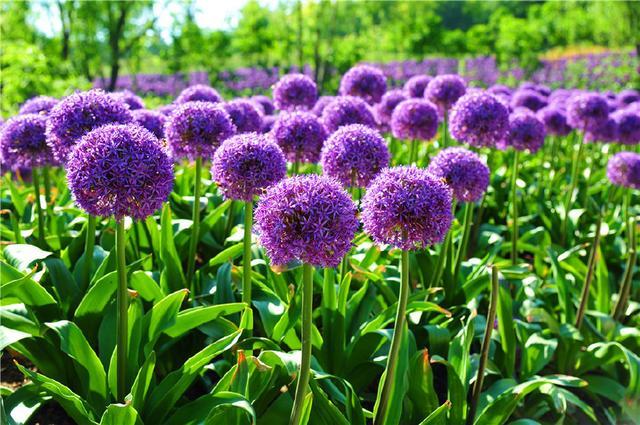
Allium giganteum
Giant onion generally refers to Allium giganteum.
Allium giganteum (scientific name: Allium giganteum Regel) is a perennial bulbous flower in the Liliaceae family, Allium genus. Its root bulb is fleshy and has an onion scent. The leaves grow in clusters, are gray-green, and long lanceolate. The umbel inflorescence is head-shaped, with flowers, fruits, and seeds densely borne at the top of the scape. The florets are purplish-red with long stalks, and the seeds are round and black.
Native to central Asia, it is widely planted in gardens around the world. The Netherlands is the main exporting country of its bulbs. The Beijing Botanical Garden of the Institute of Botany, Chinese Academy of Sciences introduced bulbs from the Netherlands in 1979.
This species is a variety used for decoration and beautification in flower borders, rock gardens, or beside lawns. The Allium giganteum inflorescence is huge like a head, hence its name. Its flowers are purplish-red and brilliantly colored, making it the most ornamental species in the same genus.
Morphological characteristics
Perennial herb. The scape grows from the base of the bulb, and the part exposed above ground is covered by leaf sheaths or bare; the leaves grow in clusters, are gray-green, long lanceolate, entire, 60 cm long, 12 cm wide, 7-12 leaves, arranged in 3-4 whorls.
The flowering bulb weighs about 30 grams, with a diameter of about 3 cm, and grows 80-90 fibrous roots. The densely arranged umbel inflorescence of flowers, fruits, and seeds is head-shaped and borne at the top of the scape. The scape is drawn out from the leaf cluster and reaches up to 12.5 cm; the inflorescence is composed of 2000-3000 star-shaped spreading florets, and the inflorescence is huge like a head, with a diameter of up to 18 cm, hence the name. Its flowers are purplish-red and brilliantly colored. The florets are purplish-red with long stalks and 6 petals arranged in two whorls.
It bears capsule fruits. The seeds are round, black, with a 1000-seed weight of 4.18 grams. A single inflorescence can produce more than 80 mature seeds under natural pollination conditions. The flowering period is spring and summer.
Growing environment
It prefers a cool environment with ample sunlight, and avoids damp heat and excessive rain, continuous cropping, and semi-shade. The suitable temperature is 15-25°C. It requires loose, fertile sandy loam and avoids waterlogging.
Distribution range
Native to central Asia and the Mediterranean region, it is widely planted in gardens around the world. The Netherlands is the main exporting country of its bulbs. The Beijing Botanical Garden of the Institute of Botany, Chinese Academy of Sciences introduced bulbs from the Netherlands in 1979.
Propagation methods
Seed propagation: After the seeds of Allium giganteum mature in early July, collect them and dry them in the shade, store them at a low temperature of 5-7°C, sow in autumn from September to October, and they will germinate and emerge in March of the following year. In summer, the aboveground part also withers, forming small bulbs. Seedling plants generally require about 5 years of cultivation before they can flower.
Division propagation: Bulb division propagation is carried out in summer and autumn. Peel off the daughter bulbs around the main bulb, and choose a cultivation site with a low groundwater level, good drainage, and loose, fertile sandy loam. Each mother bulb can be divided into 1-3 small bulbs, among which the larger bulbs can flower in the second year after planting.
Cultivation techniques
Allium giganteum is a flower with an extremely low natural bulb multiplication rate, but if the scape is removed as early as possible after it appears, so that nutrients are concentrated on the development of renewal bulbs and daughter bulbs, the number of small bulbs can be appropriately increased. In summer, the aboveground part dies. The bulbs can be dug out, separated by size, and placed in a ventilated place to overwinter in summer.
Allium giganteum is planted after autumn. Bulbs reaching more than 3 cm can flower after planting, while those smaller than 3 cm need to be grown for one more year before they can flower. Bulb multiplication rate: Allium giganteum prefers a cool environment with ample sunlight, requires loose, fertile sandy loam, and avoids waterlogging. It is suitable for cultivation in northern China.
For open-field cultivation of Allium giganteum, choose a cultivation site with a low groundwater level, good drainage, and loose, fertile sandy loam. The best time to plant the bulbs is from mid-to-late September to early October, with a plant spacing of 20 x 30 cm. The planting depth is such that the soil covering the bulb is 2-3 times the height of the fresh bulb.
After planting Allium giganteum, slightly press the surface of the hole flat, then water it. In winter, there is no need to cover it for cold protection. When the leaves emerge in March of the following year, loosen the soil and water in time. Combined with liquid topdressing, water once every 10-15 days. Pay attention to intertillage, soil loosening, and weeding. In places with dry air, appropriately increase a small amount of artificial misting or shading, which can ease the yellowing of leaves in early summer.
After flowering, the stems and leaves of Allium giganteum wither. Dig out the bulbs as early as possible before the rainy season to avoid rot after rain. Dry them in a ventilated and dry place, then store them spread out in a ventilated indoor place. Wait until September-October to plant. The planting site should not be continuously cropped. Pay attention to applying decomposed organic fertilizer. Summer is rainy, so drainage should be timely.
Pest and disease control
During storage of Allium giganteum bulbs, prevent high temperature and high humidity, otherwise rot is likely to occur. Keep them ventilated and dry. Before planting, they can be soaked for sterilization with a 600-fold dilution of 60% zineb wettable powder. At the same time, continuous cropping is not allowed.
Main value
The flower ball of Allium giganteum gradually increases as the florets open, and the diameter of the fully bloomed inflorescence can reach 20 cm. The inflorescence of Allium giganteum is large and unique, with bright and lively colors. In addition, its blooming period can last nearly 20 days, giving it ornamental value.
Allium giganteum can be planted in clusters in flower borders, beside rocks, or in lawns as a decorative accent. It can also be used as a cut flower material with a unique flower shape in floral art works.