How to admire lotus flowers? This is the correct way to admire lotus flowers
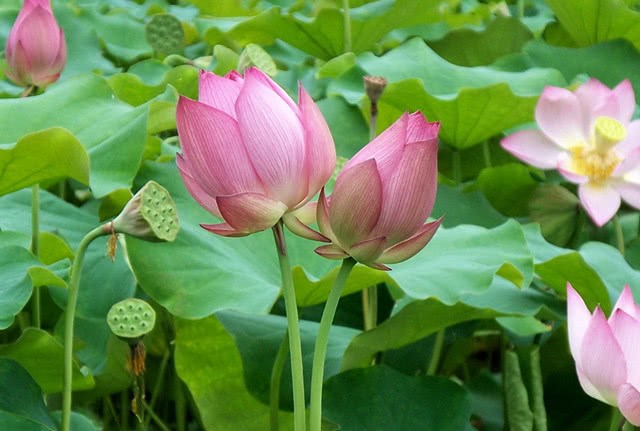
In the scorching summer, lotus flowers bloom. She blooms in the passionate summer, touching the softness within our hearts. Lotus leaves so lush and green, by the green willow embankment asking about lotus flowers, raindrops shattering the sound of lotus...
"Lotus emerging from clear water, natural and free of adornment." In traditional Chinese culture, the lotus (also known as the water lily) is often used as a symbol of peace, harmony, cooperation, synergy, unity, and union; the purity of the lotus symbolizes the nobility of the cause of peace and a harmonious world. Therefore, in a sense, admiring lotus flowers is also a way of promoting Chinese "he" (harmony) culture. Lotus varieties are rich and diverse, embodying "harmony in diversity," yet together they form a world of pure and noble lotus flowers, embodying "harmony is precious." I sincerely hope that lotus culture, in the process of promoting peace culture and harmonious culture, can also be understood and known by more people. Promoting Chinese "he" culture is of special and significant importance for our cause of promoting national reunification, safeguarding world peace, and building a harmonious society.
On March 31, 1993, the Basic Law of the Macao Special Administrative Region of the People's Republic of China, reviewed and approved by the First Session of the Eighth National People's Congress, also used the lotus as a pattern for Macao's regional flag and emblem, expressing the local people's particular reverence for the lotus as a symbol of purity and nobility. As a distinguished member of the floral kingdom, the lotus was selected by popular vote as one of China's top ten traditional famous flowers. In 1989, the China Lotus Association was specially established in Beijing to promote its spread across the Chinese land in vast expanses of green waves, with fragrance drifting without end.
In the Suzhou area of Jiangnan, the 24th day of the sixth lunar month is the Lotus Viewing Festival, called the lotus's birthday. At that time people gather in groups, joyfully admiring lotus flowers. Buddhists in particular revere it most, as Guanyin Bodhisattva sits upon a lotus.
In botany, lotus is also called water lily. India is the birthplace of Buddhism, and the lotus is a symbol and auspicious object often mentioned in Buddhist scriptures. The lotus emerges from mud unstained, keeping itself pure, which aligns with the personality advocated by Buddhism. Precisely because the lotus represents Buddhism, and Buddhism came from India, the lotus is regarded in India as a symbol of dignity and sanctity.
Lotus viewing: As early as the Song Dynasty, on every 24th day of the sixth lunar month, people would go boating on lotus ponds to admire lotus flowers and enjoy the summer cool. Rowing gently over light waves, picking lotus and digging lotus roots, enjoying the summer night charm of a bright moon veiled by clouds - utterly delightful.
Releasing lotus lanterns: On this night, natural long-stemmed lotus leaves are used as vessels, with candles lit inside, and children carry them around to play; or lotus seed pods are hollowed out, with candles lit as lanterns, placed indoors and in courtyards; or thousands of lotus lanterns are released along rivers, drifting with the waves, with twinkling starlight, shimmering ripples, and flickering candlelight - a truly beautiful sight.
Best places to admire lotus: The top recommendation is "Quyuan Fenghe" (Breeze-ruffled Lotus at Quyuan Garden), a famous garden for summer lotus viewing at West Lake in China. Legend has it that Quyuan was once a workshop for brewing official wine during the Southern Song Dynasty. The people in the workshop planted lotus extensively in the courtyard during their spare time, so when lotus flowers bloomed in summer, the lotus fragrance mixed with the rich aroma of wine, filling the entire garden with scent. Thus Quyuan Fenghe got its name and became one of the Ten Scenes of West Lake.
Located on Mashan Qianbo Road in Binhu District, Wuxi, China, is an unmissable great place to admire lotus flowers. Currently, along Qianbo Road, the entire stretch is filled with lotus ponds full of red lotus flowers and green leaves. Umbrella-shaped lotus leaves swaying in the wind cluster together, setting off the lotus flowers in all their varied beauty, making them appear especially delicate and charming. August flowering season is the best time to admire lotus flowers.
Weishan Lake is called "China's Lotus Capital," with one hundred thousand mu of lotus ponds. The beauty of Weishan Lake is rich and varied - its vastness stretches endlessly, its elegance lies in the clear rippling waves. As for its dazzling splendor, it is the lotus flowers covering the entire lake that stand out most. Every summer and autumn, the hundred-li lake surface is a profusion of blooms, with lotus fragrance filling the air. The flowers come in red and white - the red ones as radiant as rosy clouds, the white ones as coldly beautiful as snow. A lotus marsh of such a large area is rarely seen anywhere in the country, and can be called a great wonder.
The lotus flowers at Ritan Park in the capital have large flowers and beautiful leaves, with a fragrance that drifts far, standing gracefully and attracting many visitors to admire them. The flowering period can last until September. At the Summer Palace, one can enjoy the magnificent scene of "lotus red adorned with rain" after rain clears. Standing on the West Causeway looking westward, Zhijingge Lake and Zaojiantang Lake are truly a world of lotus. Drifting lotus leaves cover the entire lake surface, and the raindrops remaining on the leaves are crystal clear in the morning light. One after another gracefully standing lotus flowers, with morning dew, become even more enchanting. After a breeze passes, the fresh fragrance of lotus rushes to the face. Sunlight pours down, gathering into a dewdrop on the tip of a lotus leaf, then sliding into the lake.