Orchid white roots turn into small shoots, strong and green again; an old flower farmer demonstrates boiling first, then soaking, then potting up
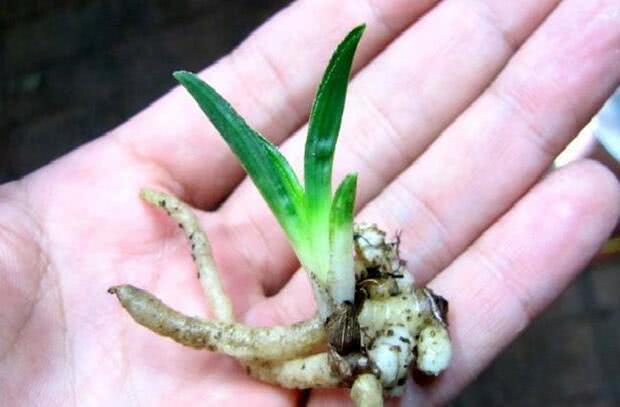
Orchids hold a very high status in our country. Our country's laws clearly stipulate that wild orchids cannot be sold on one's own, which shows the place orchids hold in people's hearts. Since ancient times they have had the elegant title of "gentleman among flowers." As people's living standards improve, people's quality of life gets higher and higher, and many literati and refined scholars like to keep a pot of orchids at home. But many people also like orchids yet cannot grow them well, feeling that orchids grow too slowly - a whole year passes and they do not see it grow at all. Moreover, some plants, because their old leaves wither, do not send out new shoots, and the more they are grown the fewer they become. However, if you want orchids to grow fast and send out many side shoots, there are also little tricks. Today I will share a small method: boil this one thing, soak it, throw it in the pot, and the orchid's "white roots" turn into "small shoots," strong and green!
So what is this one thing mentioned here?
No rush on that. Let us first look at the habits of orchids! Orchids originally grow in hilly areas or by the flowing water of mountain springs amid towering peaks and continuous mountain ranges. Some grow in valleys and deep ravines with dense trees and sloping hillsides, or grow in crevices with rocks and relatively deep soil layers.
The root system of orchids is distributed on the surface layer of the soil. The soil layer is required to be rich in humus, and to have good texture that is loose, permeable, and good at retaining fertilizer and water. The soil is acidic, with a pH value between 5.5 and 6.5.
Because, according to the habits of orchids, the one thing we chose for them is willow bark. So why willow bark?
I believe flower lovers all know an old saying: "With all your care you plant a flower and it will not bloom; without even trying you stick in a willow and it grows into shade." This saying well reflects that the willow is a potted plant that roots and sprouts very quickly and easily. So why exactly is that?
In fact, this is mainly because the chemical substance contained in the bark and leaves of the willow - salicin - promotes root formation, sprouting, and leaf photosynthesis in plants. So we make use of this characteristic of willow bark, using it to grow orchids, which can prompt orchids to root quickly, root abundantly, sprout abundantly, and be rich in chlorophyll, with the orchid plants growing vigorously.
So how do we use it?
We can break the collected willow bark into small pieces, put them into a plastic bag or pile them together, then mix them evenly with distillers' grains and seal them up, and finally place them in a warm place (best in the sun), taking care to keep them moist in between. After about half a year it is ready. Willow bark that has been decomposed in this way can be mixed into the orchid's potting soil for growing orchids. Generally, in orchid growing medium the willow bark should not exceed 20%, as an excess will also inhibit the growth of orchid fungi.
Some flower lovers, after collecting willow bark, do not compost it but cut it short, boil it in water to kill insects, then soak it in clean water for a few days; it can also be mixed into the orchid's potting soil for planting orchids, and the effect is also very good.
Using willow bark can promote the growth of orchids, but we must not neglect other aspects of care either. For example, when watering orchids, for home cultivation it is best to use natural rainwater, stream water, well water, or river water. If using tap water, first store it in a vat and expose it to the sun to remove the bleaching powder before use. If tap water is used to water flowers over the long term, it will gradually make the growing medium alkaline.
Light should also be appropriate in amount. For growing orchids at home, in order to control the amount of light, it is best to place them on a balcony windowsill or under the eaves with a bamboo curtain for shade. Generally, shade from 9 a.m. to before 6 p.m., and in the morning and after 6 p.m. pull the curtain open so they receive scattered sunlight. In winter they should be moved indoors to a place with visible scattered light, but direct sunlight should also be avoided. Among orchids, Cymbidium sinense has the strongest shade tolerance, followed by Cymbidium ensifolium, while Cymbidium goeringii and Cymbidium faberi have weaker shade tolerance.
That is all for today's sharing