This strange weed pulls up its roots and runs when the dry season comes; Americans are plagued by it yet know nothing of its true value
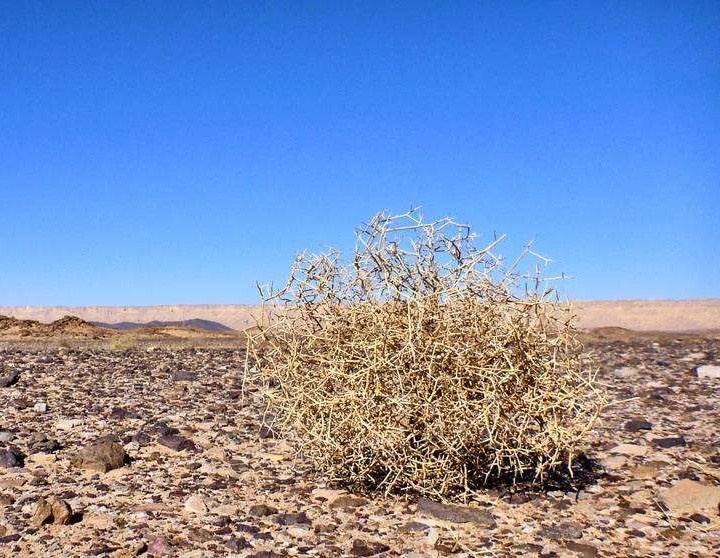
When it comes to the desert, what most people immediately picture is that boundless stretch of yellow sand, a dead silence with no sign of life, but right in this dead silence grows such a maverick plant, the tumbleweed.
Tumbleweed, also called Russian thistle (Salsola tragus), is a very strange wild grass abroad; it is thorny, restless and wanders everywhere. A tumbleweed starts out as a small seedling; it sprouts in late winter, and by summer it has grown into a round ball. Its flowers grow among the thorny leaves, and each flower becomes a fruit containing a single seed. This fruit looks like a cherry but does not taste as good as a cherry. The cherry tree is very lucky, because birds eat its fruit, carry it away and help spread its seeds along the way. Tumbleweed is different: it does not rely on animals to spread its seeds, it has its own unique solution.
Whenever drought comes, the tumbleweed dries up and dies, but its seeds remain, and a light breeze can easily snap the dead tumbleweed off at the root. At the base of this plant there is a special layer of cells, so unlike the roots of most plants it is not tough, which means even a gentle breeze can snap it off with ease.
The tumbleweed's skeleton gradually breaks free in the wind, and as it rolls along, thousands upon thousands of seeds are shaken loose and dropped. Tumbleweed is in fact also an invasive species, found in our country as well as in the United States and other countries. Every autumn you can see them in the northwest of our country and in the western United States, rolling along in groups like cowboys of the Old West, gradually spreading across open ground. Tumbleweed uses natural wind power to spread its seeds, which is why its fruit tastes bad yet it can still grow rampantly.
Unfortunately, however, it is precisely this powerful reproductive ability that makes it regarded as a weed in the United States. They stroll freely along highways with the wind, making passing vehicles swerve to avoid them, and they often become tangled with irrigation systems, causing confusion for farmers; some can even roll into communities and pile up, becoming a fire hazard, which is why Americans are so plagued by them. Tumbleweed does not take root in lush green lawns, because it cannot outcompete plants with strong reproductive ability like grass.
Yet many people do not know that although tumbleweed is a great nuisance, it actually has very good value. According to records, the whole plant of tumbleweed can be used as medicine, with the effect of relieving cough and reducing phlegm, and the results are very good too.
So whether or not these wild grasses are annoying, they all have their own unique value.
Dear friends, have you ever seen a tumbleweed? You are welcome to leave a comment and share!