Shellflower's white flowers resemble seashells, with small opposite leaves, elegant and beautiful as a potted plant
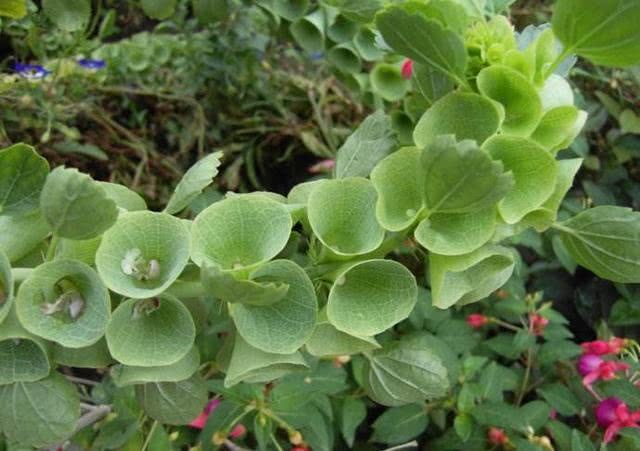
Shellflower (Lamiaceae plant)
Shellflower (scientific name: Moluccella laevis Linn.) is an annual or biennial herbaceous plant in the genus Moluccella, family Lamiaceae. Plant height 50-60 cm, stems four-angled, unbranched. Leaves opposite, heart-shaped to round, with sparse teeth along the margins; petioles nearly as long as the leaves. Flowers white, corolla bilabiate; nutlets smooth. Flowering period June-July.
Shellflower has a peculiar flower shape, small opposite leaves, and white flowers resembling seashells. Elegant and beautiful, it is often used as a filler flower in floral arrangements, and can also be used as a dried flower or grown as a potted ornamental. After drying it turns white, making it an excellent material for both dried and fresh flowers. Each pot of shellflower can absorb 150g of carbon dioxide and release 56g of oxygen per year, making it a very green and eco-friendly plant.
Morphological characteristics
Height is 40-100cm, heart-shaped leaves opposite, with blunt teeth. The seeds of shellflower are triangular; seedlings emerge about 1 week after sowing, and the seedlings grow slowly, only developing true leaves after 20 days, and still being small seedlings after more than 1 month. It takes about 2 months to look like anything, and flowers can be seen at around 3 months.
The small trumpet-like parts are its sepals, the small flowers are white, borne in whorls of six, fragrant, with calyces resembling seashells; flowering period June-July, and the green color is quite beautiful. The corolla is bilabiate, and the calyx is green and seashell-like, hence the name. The stems are upright, four-angled, with weak branching ability.
Growing environment
A foliage and flowering ornamental plant, it prefers sunlight and well-drained soil.
Distribution range
Western Asia and Syria.
Propagation methods
Propagation: by sowing, can be sown in autumn, winter, or early spring.
Propagate by sowing, possible in spring, summer, and autumn; the suitable sowing temperature is 15-25°C, sprouting in about one week, and it can be transplanted once it has 5-6 true leaves. The growing medium is best as fertile, loose, well-drained loam; the soil should not be too clayey, otherwise the plant will not thrive and will grow slowly. Begin fertilizing after transplanting and establishment, once every half month, and stop fertilizing after flowering. To encourage branching, pinching can be done. Shellflower is robust in growth and rarely affected by pests or diseases, but watch out for damage from leaf miners. For ornamental purposes, sowing can be done in stages and in different ratios.
Cultivation techniques
Sunlight: requires good sunlight.
Temperature: Shellflower prefers warmth, with an optimal growing temperature of 15-25°C.
Management: For shellflower cultivation, use fertile loam with good drainage. When shellflower seedlings are 10-15 cm tall, pinch once to encourage branching.
Fertilizing: apply topdressing once a month.
Planting tools/conditions
Tools: flower pot, sandy soil, shellflower seeds
Conditions: ample light, slightly moist soil (Note: do not water constantly, as it easily causes root rot. During seed germination, water once a day to ensure the seeds absorb water; at this stage they should not be exposed to light. After the seeds sprout, adjust watering time according to soil moisture; if the soil is moist, watering can be skipped. When watering, water thoroughly)
Planting steps
1. Planting shellflower generally requires a flower pot with a diameter of 15 cm, which can usually hold ten to fifteen seeds. You can also change the pot diameter according to your actual number of seeds.
2. Planting shellflower requires some sandy soil and small stones. First lay the small stones at the very bottom, then spread the sandy soil on top.
3. Scatter the seeds into the prepared potting soil. After placing them, cover with a 5 mm layer of sandy soil and keep it moist.
4. Under suitable conditions, it takes about one week to half a month for seedlings to emerge.
Pest and disease control
The land should be fertile and well-drained; transplant with soil when there are 5-6 leaves; after establishment, fertilize and water; to encourage more branching, pinch off the growing tips early. This flower is relatively easy to manage.
It grows robustly and rarely suffers from diseases, but leaf miners sometimes appear, so attention should be paid to their control.
Main value
Shellflower has a peculiar flower shape and is elegant and beautiful. It is a popular filler material for floral arrangements worldwide, and can also be used as a dried flower or grown as a potted ornamental.
There are various horticultural varieties available, but most have green calyces, with white, yellow, and other types as well.
Each pot of shellflower can absorb 150g of carbon dioxide and release 56g of oxygen per year, making it a very green and eco-friendly plant.
Plant culture
Charming, delicate.
Only love.