Everyone loves a pot-topping plant like this; even a dozen of them would not be too many.
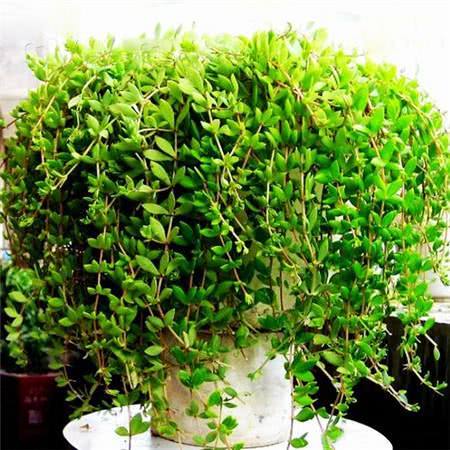
Pot-topping plants are generally used to set off succulents, spread over the surface of the pot as a top dressing, and quite a few succulents are used as pot-topping varieties. For example, small-ball rose and golden sedum have rich colors and do not easily grow tall. In fact, simply growing a pot of pot-topping plants is also very beautiful. If you do not believe it, come along with the editor below to take a look at these stunning pot-topping plants.
1. Stringy stonecrop
Stringy stonecrop often grows in a trailing manner, blooms with golden-yellow flowers, and grows very fast, with no particular requirements for soil. Grown outdoors in full sun, it has no problems at all, has great medicinal value, and in summer can lower indoor temperatures. Water by "dry-wet cycle"; propagation is mostly by stem cuttings.
2. Japanese stonecrop
Japanese stonecrop, also known as wan nian cao, fo zhi jia, ban zhi lian, etc., is a perennial herbaceous plant of the genus Sedum in the Crassulaceae family. Japanese stonecrop has strong growth adaptability, is cold-resistant, drought-resistant, salt-alkali-resistant, and barren-resistant, and resists pests and diseases. Its stems are fleshy and juicy, and its emerald-green small leaves are like jade, neat and beautiful. It can be appreciated as a potted plant or planted as an open-air ornamental ground cover.
Because the stem nodes of Japanese stonecrop root when they touch the ground, propagation is very easy. Japanese stonecrop is often propagated by division and cuttings; there are currently three methods: sowing and transplanting, and cuttings.
3. Small-ball rose
Small-ball rose is usually mainly green; increased sunlight hours and huge temperature differences will turn the whole plant blood-red, and the plant shape will also remain very beautiful. Small-ball rose can be cultivated in the open air, and its vigorous growth period is mainly in early spring and late autumn. Because its root system is shallow, it can be planted in a shallow pot. In summer it can be slightly shaded; at other times it can be managed extensively. Propagation methods: division or cuttings. Small-ball rose has a "variegated" variety, called small-ball rose variegata or dragon's blood stonecrop variegata. The middle of the leaf is purplish-red, the edges are pink, or else there are green leaves, pink edges and a red blush.
4. Sedum anglicum
A succulent plant of the genus Sedum in the Crassulaceae family, with a plant height of 5-10 cm, much-branched stems, and enlarged alternate leaves, obovate, 2 cm long, green. The leaves are fleshy, dark green, like emerald; the dark green fleshy leaves are very bright and beautiful under sunlight. It blooms in spring, with pale pinkish-white flowers.
5. Hairy Sedum anglicum
Sedum pachyphyllum, which we habitually call hairy Sedum anglicum, has a hairy surface, somewhat like a miniature version of Sedum treleasei, a very peculiar kind of pot-topping plant.
6. Sedum hispanicum
Sedum hispanicum is a perennial herbaceous plant, with club-shaped leaves covered with white waxy powder on the surface. It blooms in summer, with 5-petaled star-shaped flowers, white with a slight pink tinge.
7. Golden sedum
Golden sedum is a perennial herbaceous plant of the genus Sedum in the Crassulaceae family, native to Europe and naturalized in North America. The plant is miniature and low, with leaves about 0.5 cm long and about 0.2 cm wide, elliptical, with crystalline protrusions on the leaf surface. The original species has dark green leaves; this species is a horticultural variety with yellowed leaves. The stems are creeping and easily grow adventitious roots when touching the ground. Because the leaf color is bright, it is used in mixed succulent potted plants, or cultivated on a large scale as a ground cover for thin-layer green roofs.
8. Round-leaf sedum
A succulent plant of the genus Sedum in the Crassulaceae family. It likes full-sun conditions; it can also grow in half sun, but the leaf arrangement will be looser. It has strong drought resistance; water again when the medium is slightly dry. It tolerates barren soil, so no fertilization is needed. With long-term growth, the basal leaves will fall off and expose the stems; pruning can be done to promote branching and growth again, and the cut stems can be used as propagation material for cuttings. In summer, place it outdoors and manage it extensively. Its color is emerald green, its leaves are very small, and the plant is mini and compact. Every leaf looks small and exquisite, crystal clear, very beautiful; it is a very common little pot-topping plant. Plant a cluster, and it will quickly fill the pot.
After seeing these beautiful pot-topping plants above, the urge to splurge has risen again. Boss, give me a dozen pot-topping plants like these!