A Christmas cactus kept for 10 years turns out to be fake - what flower is mother-in-law actually growing?
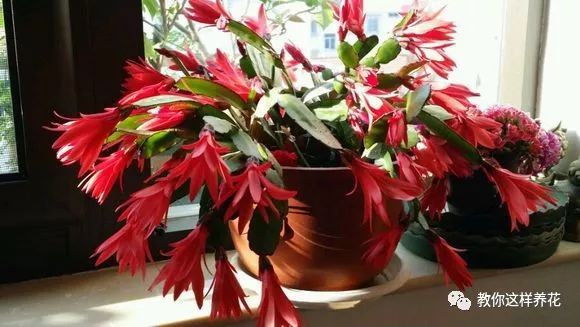
Flower enthusiast Granny Wu grew a "Christmas cactus" for 10 years, and every year it bloomed with over a hundred flowers, exceptionally beautiful! A while ago she sent photos of the blooming "Christmas cactus" to fellow flower lovers, but they all said it was a fake Christmas cactus, and some said it was called a false epiphyllum, which really made Granny Wu sad for a while. What exactly is going on? Let's take a look!
“
Flower identification
- Epiphytic cacti -
Granny Wu's "Christmas cactus" blooms abundantly every year, but its name is actually Rhipsalidopsis (false epiphyllum).
Many epiphytic cacti are native to the tropical rainforest regions of the Americas. Their stems are flat with fewer spines, but they often grow aerial roots. Compared with terrestrial cacti, they require a more humid environment.
Easily confused varieties include Christmas cactus (Schlumbergera), Rhipsalidopsis, Easter cactus (Hatiora), and Rhipsalis. Epiphyllum and Nopalxochia are even more easily confused.
Let's first talk about Christmas cactus, Rhipsalidopsis, Easter cactus, and Rhipsalis. Actually, they are easily confused abroad too. The commercial name of Christmas cactus is Thanksgiving cactus, the commercial name of Easter cactus is Christmas cactus, and the commercial name of Rhipsalidopsis is Easter cactus. These are mainly determined by different blooming times, and the ability to distinguish between varieties is also very poor. So how exactly do you tell these flowers apart?
- Christmas cactus and Easter cactus -
Christmas cactus is a plant of the genus Schlumbergera in the cactus family. The leaf tips of its stem segments have obvious tooth-like points, shaped like crab claws. Its blooming period is from October to February of the following year. The flowers are solitary at the top of the branches, double-layered flowers, slightly upturned.
Easter cactus is a plant of the genus Hatiora in the cactus family. The edges of its stem segments are smooth and slightly wavy. Its blooming period is from mid-January to early March. Easter cactus flowers are also double-layered and slightly drooping.
So both Christmas cactus and Easter cactus have double-layered flowers. Christmas cactus has spines on the edges of its leaves, while Easter cactus has smooth edges.
- Rhipsalidopsis and Rhipsalis -
Rhipsalidopsis is a plant of the genus Rhipsalidopsis in the cactus family. Its flowers open during the day, close at night, and open again the next day, generally blooming from March to May. The stem segments of Rhipsalidopsis are similar to those of Easter cactus, but wider and thicker, with new stem segments tinged with red. Rhipsalidopsis also blooms at the top of the stem segments, but with single-layered flowers.
Rhipsalis is a plant of the genus Rhipsalidopsis in the cactus family, fairly closely related to Rhipsalidopsis. Its stem segments are thick and fleshy, usually with 3-5 ribs, and can also be flat or irregularly angular, with purplish-red rib edges. The petals are also single-layered and extremely similar to those of Rhipsalidopsis, not easy to distinguish. It is generally more accurate to identify them by the stem segments.
- Nopalxochia and Epiphyllum -
Nopalxochia is a plant of the genus Nopalxochia in the cactus family. It resembles an arrow and its flowers resemble water lilies, hence the name Nopalxochia. Its leaves are much larger than those of Christmas cactus and others, making the difference obvious, though it is somewhat similar to Epiphyllum. Nopalxochia's flat branches are relatively narrow, thick, and hard, with rounded serrated edges.
The blooming time of Nopalxochia differs greatly from that of Epiphyllum. Nopalxochia generally blooms around April, and a single flower can last 1-2 days. Nopalxochia comes in many colors, with gorgeous blooms in deep red, purple, pink, yellow, and more. The tube is slightly shorter than the petals.
Epiphyllum is a plant of the genus Epiphyllum in the cactus family. Its leaves are relatively wide, thin, and soft, with wavy shallow serrated edges, making them smoother.
Epiphyllum blooms at night around September each year, generally opening between 8-10 PM, and a single flower can only last about 8 hours. Epiphyllum flowers are mainly white, with the tube longer than the petals.
Put these flowers together, and doesn't it become very clear? Actually, Granny Wu needn't be sad at all. Plants are super beautiful when they bloom. It doesn't matter what the name is, as long as it looks good! Every flower has its own strengths and weaknesses. With careful care, every one of them will be stunningly beautiful!
How many kinds of flowers do you have at home?
Did you get the name wrong?
Share this with flower lovers who need it!