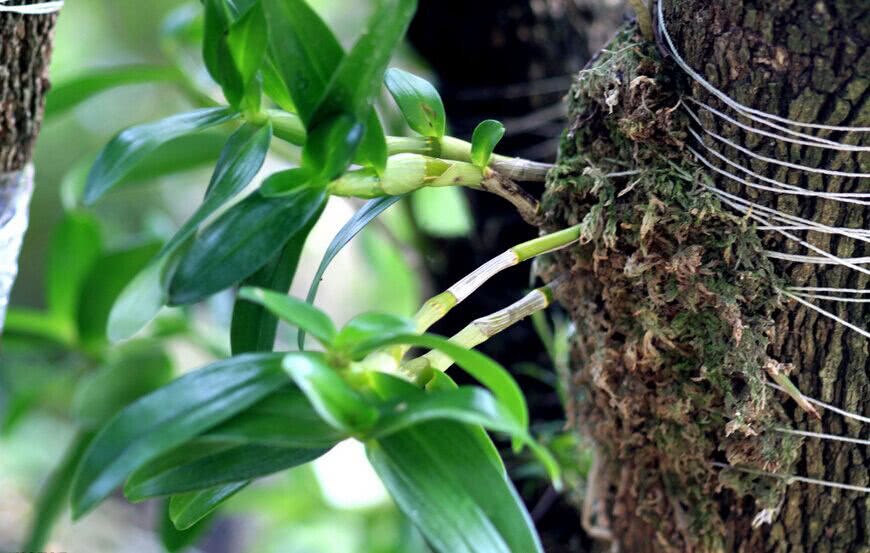
A rare treasure parasitic on pear trees, very seldom seen; those who do not know its worth treat it as a weed, and now one liang sells for 60 yuan
As the saying goes, the earth is so big that anything strange can happen. Decades ago people tried every possible way to squeeze into the big cities to make a living, but who would have thought that decades later, today, those city people would want to return to the countryside.
Maybe the city is too noisy, the pace of life is rather fast, and it may also be that along with progress the city pollution has become too serious, unlike our countryside, where life is more leisurely; after dinner you can go for a walk along the road with your family, and then listen to the aunts and older women in the village chat about some trivial matters.
And today's countryside is no longer the muddy little paths and old-style houses of the past; we also have multi-story buildings that look very beautiful, so now many city people want to come and live in the small countryside. They buy land in the countryside to build houses, so thinking about it this way, our countryside is still quite good.
Now some of the things city people eat are things country people would never eat, and there are also many wild vegetables that country people use to feed cattle and sheep, but once they reach the city they become extremely rare. The plant we are talking about today, although it is not used in the countryside to feed livestock, was not valued at all decades ago. It is Dendrobium officinale (ironbark dendrobium), the "psoriasis" on pear trees. In the past nobody would have needed this plant, but now it is actually sold on the market for 60 yuan per liang; truly, anyone without a bit of wealth would absolutely not dare to touch this thing.
It is also called heishu cao, and it is called "ironbark" entirely because its outer color is iron-green. This thing used to be very common in the countryside, and it would often grow parasitically on many pear trees, but at that time people still did not understand its value and it received no attention at all, so everyone regarded it as a kind of wild grass. As a result, the number of wild heishu cao has become very rare.
Now this heishu cao has also become a treasure, and its market value has become very high, actually reaching dozens of yuan per liang. Why does it have such high value? Because the value of heishu cao itself is very high, it has a very high medicinal function, and among this type of Chinese herbal medicine it counts as one of the better ones.
It has effects such as strengthening the spleen and benefiting the stomach, resisting aging, and preventing tumors; it belongs to natural health products and is of great help to the human body. Moreover, there is more than one way to consume heishu cao: it can not only be stewed together with soup, but can also be brewed as tea, and can also be cooked into porridge. There are many different ways to eat it, so it is by no means monotonous, but judging by its price, this writer estimates that many people cannot afford to eat it. Anyway, I have never eaten this "psoriasis," and I hope there will be a chance to taste it in the future!
Dear friends, have you ever eaten "heishu cao" or "Dendrobium officinale (ironbark dendrobium)"? You are welcome to leave a message and share!