Don't let mindless hobbies destroy these species and ecosystems
Foreword
Follow the Encyclopedia · Meet Beauty (WeChat ID: duoroubaike)
Main text begins:
Thanks to the author [The Stone of Lake Manasarovar] for theoriginal submissionsharing
Submission date: June 29, 2018
Edited and compiled by: Encyclopedia Jun
Coordinates: Beijing
I have been growing succulents for 4 years and have followed Encyclopedia Jun for several years too. Thanks to the Encyclopedia for its guidance and company during my succulent-growing journey, I have benefited greatly! After reading the earlier WeChat article "Care of the Thumb Fairy Cup Pachypodium Part One and Two," I had different views! I appreciate the author's spirit of research, exploration and sharing, but I strongly disagree with the author's understanding and views on the illegal harvesting of wild plants, ecological destruction, and the ethical relationship between humans and nature. Focusing on the issues themselves, I would like to share some different views with everyone on the above questions.
1. The illegal digging of California Fairy Cups has already formed a complete black smuggling industry chain!
"One day last December, a report came in. More than 60 packages mailed by a Chinese person looked suspicious. The California Department of Fish and Wildlife contacted US Customs and arranged for the packages to be X-ray scanned, and as a result they found wild succulents native to California, 'Fairy Cups,' inside.
(Image from TMN, copyright belongs to the original author)
A few days later, the department received another report and rushed to Point Arena in the North Bay. Once again they saw the Chinese man from the USPS post office surveillance footage, with more than 50 freshly dug wild Fairy Cups hidden in his backpack, caught red-handed.
(Image from TMN, copyright belongs to the original author)
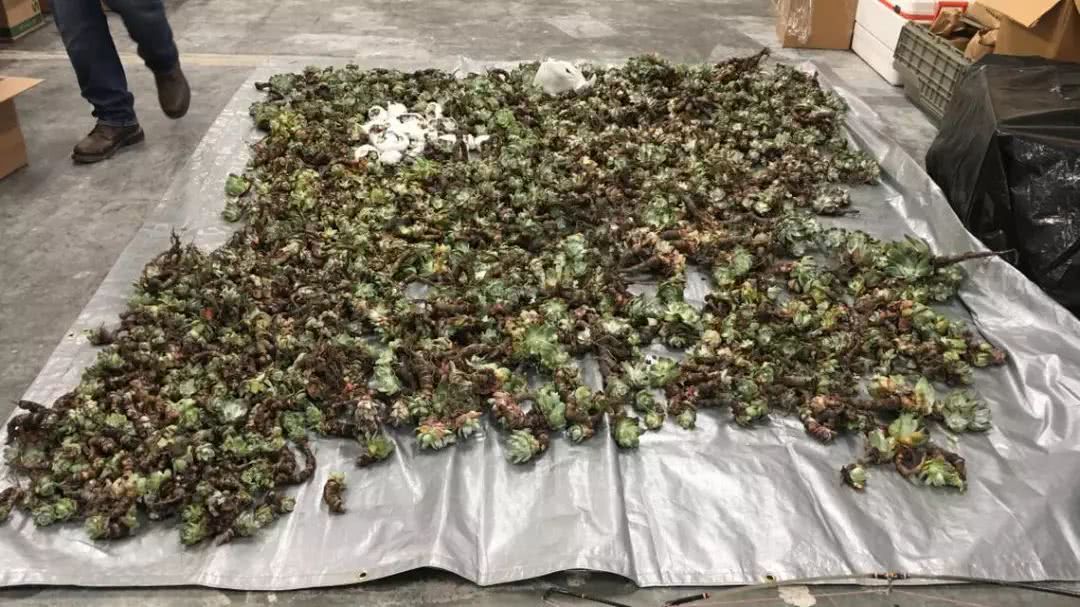
Not long after this case, another report came in about a suspicious RV parked by Highway 1 in Mendocino. When investigators from the department arrived at the scene, they found it full of wild Fairy Cups. 850 large ones and 1,450 small ones. The 2 people who had been illegally digging below the cliff could barely speak English and held South Korean passports.
(Image from TMN, copyright belongs to the original author)
The endless stream of illegal digging incidents drew great attention from the California Department of Fish and Wildlife. This April, with the help of USPS employees, the department tracked down another suspect who had illegally dug Fairy Cups and then mailed them to China. 1,334 Fairy Cups that were about to be mailed were seized. Subsequently, in the small wooden cabin in the mountains of Northern California where the suspect rented a place to stay, more than 1,000 more were found.
(Image from TMN, copyright belongs to the original author)
The person in the photo above is the South Korean caught at the scene. Forgive me for not wanting to blur the face of such a criminal.
In just 4 months, the California Department of Fish and Wildlife cracked a total of 3 cases of illegal Fairy Cup digging in Humboldt and Mendocino counties in California, recovered nearly 5,000 plants, and successfully exposed an illegal succulent supply chain stretching across the Pacific. A 37-year-old Chinese citizen, Liu Fengxia, and 52-year-old and 46-year-old South Korean citizens Taehun Kim and Taeyun Kim were arrested. The three will be formally prosecuted on May 16.
Article 1 of Section 384a of the California Constitution states: "No person shall intentionally cut, destroy, damage or remove plants growing on public land owned by the state or county or on highway rights-of-way. Violators may be punished by a fine of up to $1000 or 6 months' imprisonment."
The deeper the investigation went, the more the industry chain behind it alarmed the department. One investigator said: "We have only lifted the tip of the iceberg." Many botanists and environmental scientists in Northern California worry that increasingly frequent illegal digging will not only damage the local ecological environment, but may also loosen the cliff soil and cause landslides when the rainy season comes.
(Image from TMN, copyright belongs to the original author)
A black market thus emerged. First, dedicated people were responsible for "sourcing goods" in California, then they evaded inspection and quarantine approval by mailing through USPS or checking them in as luggage, bringing the illegally dug succulents back into the country for resale and huge profits.
(Image from TMN, copyright belongs to the original author)
After the 5,000 illegally dug succulents were recovered, the department's administrators together personally planted more than 2,000 of them back by the cliffside. The remaining 3,000, because their roots were rather severely damaged, could only be potted for a period of time first, and will be planted back in autumn."
——The above part is excerpted from the American media outlet "Los Angeles Consumption Guide." The full Chinese text can be found and read online.
2. What harm does illegal digging of wild plants cause?
Harm 1: Destroying the landforms of the native habitat.
The windbreak and sand-fixation role of plants is well known. We Chinese have suffered deeply from desertification caused by soil erosion. The destruction of large amounts of surface vegetation brings serious hidden dangers of geological disasters.
Harm 2: Destroying the ecological chain of the native habitat.
Nature is an ecosystem that can only be maintained by multiple species. Damage to one species indirectly affects the survival of multiple plant and animal species. For example, only when soil and water are not lost do plants bloom; bees feed on pollen and spread pollen; many small animals then feed on honey and the fruits and flowers after pollination; and large animals then feed on small animals. The disappearance of any one plant or animal species indirectly affects other species.
Harm 3: Leading to the extinction in the wild of the illegally dug species.
The 4 cases mentioned above alone seized more than 5,000 plants, and this is still only "the tip of the iceberg," and this is still in the United States, where the judicial system is complete and citizens' legal awareness is strong! At this rate, if enforcement is lax, or if it were a Third World country, wiping them all out would be a matter of a few years. This is not alarmist. The Ariocarpus and Aztekium that cactus enthusiasts all know, in their native habitats in Mexico, and the Aloe polyphylla that aloe enthusiasts know well, in its native habitat in South Africa, have all become endangered species because of illegal digging, and their native habitats have nearly disappeared. Like Fairy Cups, these plants that grow in extreme environments grow only a few millimeters a year. Once the native habitat disappears, it is almost impossible to restore it. There are also many plants in China that are nearly extinct because of illegal digging. To give a few especially beautiful examples: Saussurea medusa, Rheum nobile, Paphiopedilum purpuratum, Dendrobium officinale, and so on. Everyone can search online. What a pity it would be if such beautiful plants went extinct!
The picture below is Saussurea medusa:
Harm 4: Even if they go extinct in the wild, they can still be cultivated horticulturally. Is there a difference?
Even if we do not consider whether it is immoral that a fist-sized wild succulent may be as old as our grandfather and is destroyed just like that, the difference between growing in the wild and horticultural cultivation is still too great! First is the issue of genetic diversity: to give a simple example, everyone knows that mixed-race children are both beautiful and smart, yet the probability of disability from inbreeding is very high. For a species that has long lacked diverse genetic exchange, a single disease can wipe out the entire species. For example, the global banana blight of 1950 and the global coffee rust since 2010 both nearly deprived humanity of these two plants to eat because of single-species cultivation. The same applies to us humans. For example: although carrying the sickle-cell anemia gene is enormously harmful to health today, if some of our ancestors had not carried this gene, the entire human race might have died of malaria several hundred years ago. Therefore, species diversity is especially important for all plants and animals.
The picture below is the endangered plant Rheum nobile pulled up by the roots:
Harm 5: It may carry invasive species and viruses.
The role of national customs is not just collecting taxes; quarantine of foreign animals and plants is extremely important work. Do these illegally dug Fairy Cup plants and the soil on their roots contain insects and viruses against which our native plants and animals have no immunity? This can only be known after suffering widespread harm. Friends in rural areas, have you noticed whether a kind of big black mosquito that was never seen before has appeared in recent years, whose bites are extremely painful! This is not a species of our country; it mainly comes from timber smuggled from the Russian Far East.
3. Why"Care of the Thumb Fairy Cup Pachypodium and More (Part Two)"Many of the article author's views are wrong.
1. Where did those astonishingly large old specimens shown by the author come from?
The article repeatedly uses words such as "mining" and "native roots," and mentions that they "grow only a few millimeters a year." Then those large old specimens shown by the author that visibly exceed 200 mm certainly cannot be domestically grown. Since wild collection abroad is illegal, China would not permit their import. If the author purchased them through legal channels, and the author states that "I absolutely do not support the illegal collection of wild Fairy Cups that destroys the natural ecology," then could the author please ask the seller to provide the customs declaration form and the import plant quarantine certificate?
2. The "domestication and horticulturalization of wild Fairy Cups" mentioned in the article.
Our human ancestors domesticated some wild animals and turned them into livestock for our use. Mr. Yuan Longping domesticated wild rice so that more people could have enough to eat. I do not understand what use there is in the author domesticating a wild plant from the other side of the earth. I very much approve of horticulturalization, but horticulturalization can absolutely begin with collecting seeds and propagating them (this is not illegal). There is no need to buy illegally dug wild plants. From a technical point of view, the author's article is very well written, but the more people learn how to care for these illegally dug wild Fairy Cups, the more plants will be illegally dug! Would it not be better if the author wrote an article teaching everyone how to buy and grow Fairy Cup seeds?
3. The article mentions "the national treasure panda. Which nature lover would dare stand up and say, let them go, return to nature?"
Please let the author understand that the ultimate goal of any legitimate wildlife and plant conservation organization is to restore the wild population of the species, not to keep them in captivity. "Destroying a species takes only a few years, but restoring them may take hundreds of years." Our country has already achieved a great deal in the breeding and rewilding of giant pandas. The accidental capture in December 2017 of "Taotao," a giant panda with a cub that had been released into the wild for 5 years, is a very good example. In our country, it is not only the giant panda that has succeeded in endangered wildlife protection, artificial breeding and rewilding. As far as I know, there are also the crested ibis, red-crowned crane, and many, many more.
4. The article mentions "Do you have the ability to stop human cities from expanding, to stop their environment from being destroyed, to stop their numbers from declining? Think about these things for yourselves!"
Our country, like all countries, has caused severe damage to the natural environment in the process of economic development because of problems such as ignorance and profit, and this is a fact. But it is undeniable that these situations are changing and improving. Now all large-scale infrastructure construction must pass strict environmental impact assessments. Cases of construction being halted to protect wild animals and plants are everywhere. In Yunnan Province, where the author is located, there was one in recent years: the last wild habitat of our country's first-class protected animal, the green peafowl (a peafowl unique to our country; the blue peafowl commonly seen in zoos is an Indian species), somewhere in Yunnan, was facing destruction because of hydropower station and mine construction downstream. Thanks to the efforts of civilian animal protection organizations, the Yunnan government has already issued an official letter to handle the matter, and the hydropower station and mine construction have been stopped and are being prepared for demolition. A casual search online will turn up lots of news about this. (I strongly recommend everyone pay attention to this very beautiful and noble animal.)
The correct view of environmental protection should be exactly this: recognize mistakes, make up for mistakes, and actively improve! Not continue down the wrong path.
5.The article mentions"Why has there always been opposition, and yet in recent years illegal wild mining has become more and more rampant? The opponents want to preserve the original ecology of Fairy Cups, while the illegal diggers can also use it to play a psychological game with the growers who want to own them. A gamble! Just like the Yulin Dog Meat Festival, a topic stirred up because of animal lovers, and an outcome brought about because of opposition. Dog meat traders bring dogs onto the street..."
First, the author seems not to understand that you are already participating in the "hyping" of wild Fairy Cups. You bought a lot of this wild stock, and then on platforms with great influence (WeChat public accounts, livestreams) you promoted how to grow them. Is this not exactly the same approach as those "extreme animal protectionists" buying dogs from dog traders on the streets of Yulin? This kind of "positive attention" is precisely what drives the evil deeds of bad vendors!
The correct approach should be "reverse attention" - do not eat dog meat yourself, do not abandon pet dogs and cause an increase in stray dogs, do not promote anything about the dog meat festival, and spread this approach to the people you can influence. Extending this to wild Fairy Cups, that means do not buy or sell them, do not promote any positive news related to them, and as a gardening enthusiast teach everyone how to propagate them from seed, how to raise seedlings to maturity, and spread this approach to the people you can influence.
In addition, the author may have forgotten one point: whether or not to eat dog meat is at most a moral issue, not illegal, and does not affect the ecological environment. Illegally digging wild Fairy Cups is an illegal act in the United States, and in China it is the act of smuggling and trafficking smuggled goods. The two are fundamentally different.
4. Do "big propositions" like protecting the environment and protecting wild animals and plants have anything to do with ordinary people like us?
Mr. Tu Youyou won the Nobel Prize for discovering from a plant that "artemisinin" can fight malaria - a disease that kills hundreds of thousands to millions of people every year. From a selfish point of view, the plants humans use in this way still account for less than 5 per mille of the world's plants, and there is still huge usable potential in the future. From the perspective of the universe, there are countless animals and plants and their flourishing life, and this is precisely the fundamental difference between Earth and desolate Mars.
"What can we do?" - There is so much we can do. Let me share the words of a businessman I admire: "Everyone is born destined to change the world: if you do just one good thing in your whole life, then the world will become just a little bit better because of you; if you do not do a single good thing or a single bad thing in your whole life, then at least the world will not become a little bit worse because of you."
Let us encourage each other!
The night of June 29, 2018, in Chaoyang, Beijing
Encyclopedia Jun's rambling thoughts:
The author of this article is a friend passionate about wildlife and plant conservation. In emails and comments he repeatedly emphasized: "Tweets about Fairy Cups will certainly further aggravate the existence of the black industry chain of wild Fairy Cups (Encyclopedia Jun's influence can even, through certain uncommon succulents recommended in some articles, cause Taobao sellers to empty their inventory in a short time)." This also made me realize that the greater the influence, the greater the responsibility. Actions speak louder than words. I hope this short popular-science article can give me and everyone else some simple knowledge about wildlife and plant conservation.
Because the related succulent varieties mentioned in the article are rather expensive, I have never had contact with them, and it was also from everyone's comments that I learned about the illegal collection phenomenon that exists abroad. Like everyone else, I do not support illegal collection, but the current situation is that ordinary consumers have a very vague concept of whether the source of some plants is legal, and often have no way to verify it, feeling that it is far from us. But since illegal collection and trafficking exist, everyone should adopt a cautious attitude toward purchasing the related species that have been exposed from now on. Publishing this article is in an objective spirit. After all, one side hopes to let everyone treat the plants in their hands kindly and reduce the risk of plant death; the other side hopes to protect wild animals and plants. The starting points of each are good. I support everyone expressing different views for discussion, but I also ask everyone to pay attention to civilized expression when commenting.
Succulent culture needs you and me to promote it! Remember to share good articles more, so that more people fall in love with succulents! Use the power of plants to influence and heal the people around us!
This article has beenexclusively authorizedby the author to the WeChat public account: Succulent Plant Encyclopedia (ID: duoroubaike). The content of the article does not represent the views or position of the public account! The Encyclopedia has signed with a third-party internet copyright enforcement company and opened network-wide rights protection. Unauthorized private reproduction by other platforms is strictly prohibited! If unauthorized reproduction is found, infringing liability will be pursued! Netizens are welcome to report it!
Reward explanation
This article is purely for sharing. The author has not enabled rewards. After reading, do not forget to tap the little like in the lower right corner at the end of the article to encourage the author!
Advertisement ADVERTISEMENT