The Plant Evolutionary Tree: Reading the Plant Family Tree of Billions of Years
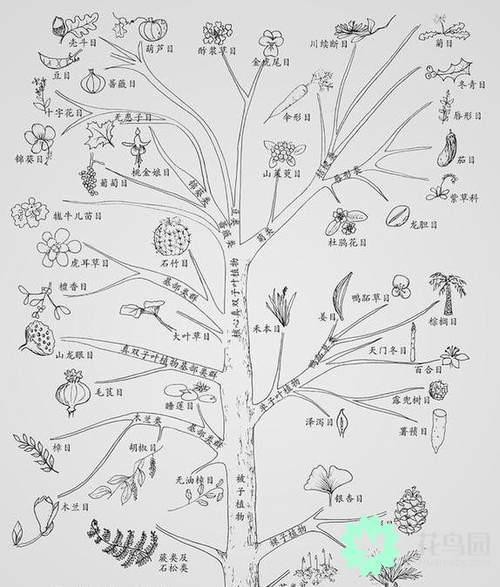
Human families have their own genealogies, and the great plant family has its own genealogy too. A human genealogy mainly records the generations of a family centered on blood relationships, along with important figures and deeds; the plant "genealogy," however, is an "evolutionary tree," mainly recording the various groups of the great plant family and the relationships that exist among them.
Understanding the Plant Evolutionary Tree What is a plant evolutionary tree? After studying and organizing fossil data, scientists combined the structural features of different plants to infer the kinship relationships among them, and then drew a tree diagram - this is the plant evolutionary tree.
About 4 billion years ago, the earliest living things appeared in the world; they were merely the simplest prokaryotes such as bacteria and blue-green algae. Some pigment-containing bacteria and blue-green algae used sunlight to make nutrients, then released large amounts of oxygen into the atmosphere, gradually changing the structure and properties of the atmosphere and laying the foundation for the flourishing development of life. About 1.5 billion to 1.4 billion years ago, organisms with eukaryotic cells appeared in the world; they were the flagellates living in water. Afterwards they evolved in three directions: first, the plant kingdom capable of photosynthesis; second, the animal kingdom that engulfs nutrients; third, the fungal kingdom that absorbs nutrients.
In biology, the plant evolutionary tree is used to show the evolutionary relationships among different plants. Based on how close or distant the kinship relationships of various plants are, biologists place them on a branched tree diagram, making it easy for people to see the evolutionary history of plants and their kinship relationships at a glance.
(Plant evolutionary tree)
The "Footprints" of Plant Evolution Plants are called the pioneers of the world's organisms because they have a very unique ability to photosynthesize, which is clearly different from other organisms. Today, more than 500,000 species of plants live on Earth. Where did these diverse plants come from?
Our Earth was born about 4.6 billion years ago. At that time the Earth was extremely hot and full of toxic gases, and living things could not survive. About 4 billion years ago, photosynthesis began to occur. From prokaryotes to eukaryotic organisms, green life forms gradually appeared on Earth, and at the same time provided a stable source of energy for the living world on Earth.
About 900 million to 700 million years ago, multicellular algae began to appear on Earth. The large amount of oxygen they released blocked ultraviolet radiation and formed the ozone layer, creating favorable conditions for plants to later colonize land. Until about 400 million years ago, a psilophyte successfully landed on land. Over the following 140 million years, the Earth was dominated by various ferns, and among these ferns the most primitive gymnosperms and angiosperms also evolved. In addition, mosses, which evolved from green algae, gradually adapted to the living environment on land. About 260 million to 136 million years ago, the dominance of ferns was gradually replaced by gymnosperms. By 100 million years ago, the climate on Earth changed, and afterwards several glacial periods appeared; most gymnosperms gradually disappeared and were replaced by angiosperms, which have flourished until now.
From the "footprints" of plant evolution, it can be seen that their evolution has been from lower to higher, from simple to complex, and from aquatic to terrestrial. We can also divide the "footprints" of plant evolution into five stages: the algae era, the moss era, the fern era, the gymnosperm era, and the angiosperm era.
(Eukaryotic organisms)
The Earliest Plants to "Swim Ashore" Do you know? The Earth 1.8 billion years ago was completely different from now. At that time there was no sign of life on land, but algae appeared in the ocean. In the long years that followed, they remained the only green plants on Earth, and in the history of plant evolution this is called the "era of algae."
About 600 million years ago, algae fully developed. Besides floating algae, there were also attached algae in shallow sea areas. These attached algae grew relatively tall, and their structures were mostly flat or branched, enabling them to carry out photosynthesis better. Because algae in shallow sea areas had to adapt to changes in water level, they gradually evolved into a new plant group - the psilophytes.
At that time, mountain-building movements in the Northern Hemisphere were very intense, the land gradually rose, and many shallow sea areas became land. The vast majority of algae went extinct because they could not adapt to the land environment, but psilophytes fortunately survived in moist places. Because there were no other competitors, they developed with unprecedented prosperity, and even became the rulers of land plants over the following 200 million years. This period is also called by biologists the "era of psilophytes."
After psilophytes successfully "swam ashore," the living domain of plants also expanded from the ocean to the land. This was a revolutionary leap, not only entering a completely new geographical period, but also creating good conditions for animals to later colonize land.
(Psilophyte)
Can Modern Ferns Still Evolve? Since living things appeared 4 billion years ago, the environment on Earth has been constantly changing. Sometimes it was unbearably hot, sometimes freezing cold, and even seas turned into mulberry fields and lakes turned into high mountains.
Under extremely cruel natural selection, most species were eliminated because they could not adapt to environmental changes. Only a very small number of species became highly adaptable through constant changes in body structure and became the few "survivors." So why have ferns, which appeared in ancient times, been able to survive to the present? Can modern ferns still evolve?
In fact, during the long process of evolution, lower-level organisms will not completely disappear, nor will they evolve to a more complex structural level. It is precisely because of this that structurally complex angiosperms and structurally simple single-celled algae exist in the world today. One point must be explained here: biological evolution is irreversible, and some plants that have already evolved cannot return to the form of their ancestors. Although modern ferns and the ferns of hundreds of millions of years ago belong to the same group, their structures and organs are not what they originally were, and the current natural conditions are no longer the same as when seed plants first appeared. Therefore, modern ferns cannot evolve into seed plants again.
(Modern ferns)