What is the difference between white rice, millet, japonica rice, purple rice and fragrant rice? One article explains all kinds of rice
Rice is one of the world's three major staple foods, especially in East Asia, where many people eat rice every day. Rice originated in China and spread throughout the world, and to date there are thousands upon thousands of different varieties. To improve quality, breeders are still continuously developing new varieties.
In supermarkets, we can see all kinds of rice, such as japonica rice, indica rice, brown rice, black rice, fragrant rice... These various kinds of rice, how do they differ?
In fact, these names come from different bases of classification, explained separately below.
Indica rice, japonica rice and glutinous rice
The main component of rice is starch. According to the way the glucose units in the starch molecule are linked, starch is divided into two types, "amylopectin" and "amylose":
Amylose is like a long thread, while amylopectin is like a big tree with branches on the trunk, forks on the branches, and yet smaller forks on the forks;
The molecules of amylose are smaller than those of amylopectin and can form tight structures, and the molecules are relatively less likely to tangle with one another, whereas amylopectin molecules are large and easily pull on each other.
The amylose content of different rices varies greatly, with the high end reaching more than 20% and the low end being almost zero.
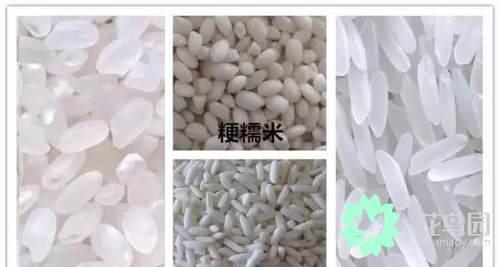
Generally speaking, indica rice is slender in shape and high in amylose content, and the cooked rice grains are distinct and do not stick together much. Because of the high amylose content, it digests more slowly and, relatively speaking, has a lower glycemic index. Abroad, it roughly corresponds to "long grain".
Japonica rice is shorter in shape and low in amylose content, and the cooked rice is more elastic than indica rice, with the grains sticking together somewhat. Abroad, it corresponds to "medium grain" and "short grain". Northeast China rice, and the rice used in Japan to make sushi, are generally japonica rice.
Glutinous rice is usually short and round, though some is long-grained. Its characteristic is an extremely low amylose content, being almost entirely amylopectin. The raw grains of indica and japonica rice are fairly translucent, while glutinous rice is milk-white, and after cooking it is very sticky and soft. In different places, glutinous rice is also called "sticky rice" or "jiangmi".
Brown rice and milled rice
Brown rice and milled rice are classified according to the degree of processing, and abroad they are called "brown rice" and "white rice" respectively.
Brown rice is the product after the husk is removed from paddy rice. The surface of brown rice still has a layer of skin that contains a lot of fiber, which greatly affects the texture. Remove this layer of fiber and you get milled rice, or white rice. The layer removed generally accounts for about 7% of the total weight of the brown rice and is called "rice bran".
Rice bran contains relatively more dietary fiber, vitamins and minerals, as well as abundant antioxidants, and in addition a not-insignificant amount of oil. This oil is mainly unsaturated fat and, compared with animal fat, counts as a "healthy" oil.
Because of the presence of this layer of bran, brown rice contains more nutrients that modern people tend to lack, and its glycemic index is also somewhat lower. So, generally speaking, brown rice is "healthier" than milled rice. Of course, brown rice also has a noticeably poorer texture than milled rice.
Early, middle and late rice
According to differences in sowing period, growing period and maturity period, rice can be divided into three types: early rice, middle rice and late rice. The shortest growing period of early rice is only 90 days, while the longest of late rice can reach 170 days. Different growing periods may have a certain influence on the taste of the rice. Generally speaking, the taste of early rice is not as good as that of middle and late rice.
Single-season, double-season, triple-season, and ratoon rice
Single-season rice, double-season rice and triple-season rice refer respectively to rice that can be planted for one, two and three seasons in a year. This depends not only on the rice variety but even more on the climate of the growing region. Ratoon rice, on the other hand, is rice that is planted once and, after one harvest, uses the remaining roots and stems to develop and be harvested once more. Ratoon rice is the result of the combined action of variety, climate and cultivation technique.
Overall, these classifications are mainly related to production and have a certain influence on the taste of the rice, but there is no nutritional difference worth fretting over.
How the rice tastes is also affected by many other factors (the next article will explain in detail what factors affect the taste, flavor and aroma of rice), so for consumers the most suitable thing is to buy based on direct comparison of the rice itself; there is no need to fret over exactly how it was produced.
Black rice and purple rice
Black rice and purple rice are named for their color. They themselves may be japonica rice or may be indica rice.
They are specially bred varieties, and the surface of the grain has a large amount of anthocyanins. Because the specific types and contents of anthocyanins differ, some appear black and some appear purple. Anthocyanins are water-soluble, so soaking them in water produces a "color loss" phenomenon. Depending on the acidity or alkalinity of the water, the color will also change somewhat.
Anthocyanins are a famous antioxidant, and many "health foods" use antioxidants as a selling point, so black rice and purple rice are also treated as "health foods" and thus sold at a higher price. There may be unscrupulous traders in the market who dye them with pigments, and many people take color loss in water as the criterion for identifying "fake black rice" and "fake purple rice". But as introduced above, real black rice and purple rice also lose color.
However, the color produced by dyeing is not quite the same as the way black and purple rice lose color. With real black and purple rice, the color grows lighter from the outer surface of the grain toward the inside, and rubbing them in water will cause color loss, but the color of the rice will only fade.
With dyed color, if a water-soluble pigment is also used, then after the color is lost the grains may turn white; if it is an oil-based pigment, then it will not easily lose color, and after vigorous rubbing causes color loss, uneven white spots may appear in the color on the grains.
Rice and millet
In plant taxonomy, all kinds of rice are "blood relatives" of the same genus and species, all placed under the rice species of the genus Oryza in the grass family.
Millet, however, belongs to the genus Setaria in the grass family, and at the "genus" level it is no longer under the same roof as rice. Millet has an even longer history of cultivation in China, and the ancients called it "su", while the plant was called "he".
In modern times, the north calls it "guizi", and the grain that comes from it is called millet. In Sichuan and other places, "guizi" refers to paddy rice and rice grain. Compared with rice, millet has a somewhat higher content of vitamins and minerals.
Fragrant rice
Fragrant rice is named for its flavor characteristics and is more a naming based on tradition and habit. Whether indica rice, japonica rice or glutinous rice, all have varieties called "fragrant rice".
Old rice and new rice
Everyone dislikes old rice and prefers new rice, and hopes for a way to "tell old rice apart". Theoretically, as storage time lengthens, the luster and aroma of rice decline somewhat, and the cooked rice is also somewhat inferior in texture and flavor.
But as long as it has not gone moldy and spoiled, then the starch, protein and minerals will not change much; some types of vitamins will decline, but rice itself is not really a major source of vitamins, so the impact on nutrition is not great either.
If old rice is stored under poor conditions and becomes moldy, then the content of aflatoxin may rise. So moldy old rice, even if you let it go moldy yourself, is best not eaten at all.
The luster and aroma of rice are affected not only by storage time but also have a great deal to do with the rice variety. If it is the same kind of rice, putting the fresh and the old together, then it may not be hard to tell them apart: the one with bright luster and a fresh scent is the new rice; the one with dim luster and no fragrance or even a moldy smell is the old rice.
If it is not such a "comparison", then based on sensory criteria such as appearance and aroma, it is very hard to judge how long it has been stored. Moreover, in the "aging" of rice during storage, time is only one aspect; storage conditions are also crucial. Even with the same storage time, under different storage conditions some rice will be "very old" while some may be "just like new rice".
For consumers, what matters is to look at whether the rice's appearance and aroma are satisfactory, rather than fretting over whether it is "new" or "old". Of course, if it is packaged rice bought through proper channels, the production date will be marked.
Although this production date refers to the date the rice was produced and packaged, not the date the paddy rice was harvested, rice with a relatively recent production date will generally still be "newer".