A detailed explanation of orchid leaf silver, understanding orchid practical knowledge in one article
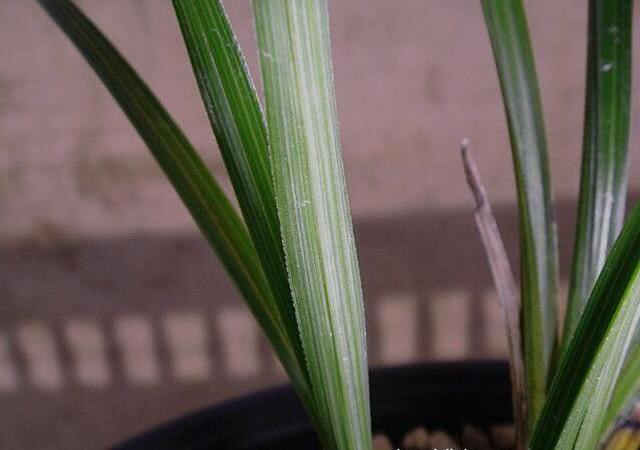
The probability of an orchid plant producing variegation is very low, unless your orchid itself has potential variegation traits, such as silver on the back of the leaves, especially dragon-root seedlings with abundant back silver. As long as good back silver appears, this plant will definitely evolve astonishing variegation patterns, but many friends new to growing orchids cannot distinguish what silver is. We will help everyone understand leaf silver in orchids!
1. The amount of powder silver. Powder silver generally refers to those things that have not yet reached the stage of forming silver threads. It appears as a layer of grayish-white material on the front or back of orchid leaves, like lime lightly dusted on them, but it is not surface dust or dirt; rather, it is a grayish substance growing inside the orchid leaf that cannot be washed off with water. If there is a lot of powder silver, it will form a layer like lard, and this will play an important role in the later formation of variegation.
2. Silver and the location of silver, surface silver and back silver. It is not enough simply to have silver; the silver must be fine, dense, and abundant. As for silver, the more the better, the denser the better, and the finer the better. The locations where silver is generally seen are mostly from 1-2 cm below the tip of the orchid leaf extending straight down to the base of the leaf. If a large amount of silver is seen in this area, then this plant should be kept. Good silver is not only surface silver; it will also show on the back silver. As long as surface silver and back silver appear at the same time, this kind of plant should be kept. It may have even more cultivation potential than an obvious line variegation!
3. Back silver: silver lines grow on the back of the leaf. Using direct viewing, the floating lines can be seen clearly at a glance. Each section of floating line seems to be composed of countless small dots arranged in order, and the dots do not connect to one another. They are lard-like white or pinkish-white dots, opaque. Usually silver lines should be powdery and float on the back of the leaf, but due to various factors, they form white silver, yellow-white silver, yellow silver, black silver (group silver), floating silver, sinking silver, and so on. The amount of back silver is an indicator for judging the evolution of leaf variegation. Some green-leaf varieties also show back silver. Good variegated plants have back silver, but back silver does not mean that a good variegated plant can definitely be evolved. When both the front and back of the leaf have it, it is called double-sided silver!
4. The distribution structure, flow, and gathering nature of silver. Just having silver in the orchid leaf does not necessarily mean it will evolve well. Some silver can never produce good variegation no matter how it is grown, while some silver can quickly produce variegation. The reason may be related to the distribution structure, flow, and gathering nature of the silver. Looking at stones in a river can give us inspiration. The larger the stones, because they cannot be moved by the water flow, always remain a rocky shoal. This situation may be what books refer to as ten-thousand-year silver. If the stones are very, very fine, fine enough to become river sand, then after being carried by the water flow they form a sand belt. The silver in orchid leaves may follow the same principle. If the silver is very, very fine, it can flow; if it can flow, it may gather; if it can gather, it can form a variegation belt, and leaf variegation can be cultivated. According to practical observation, this is indeed the case. Fine silver can flow, and when it flows together it can gather. Where multiple fine silver lines meet is the gathering place, gathering into small coarse silver forms of different shapes. This is how to observe the flow and gathering of silver.
If we find orchid plants with these characteristics on the mountain or among wild-collected orchids, please be sure not to let them go. Cultivate them well, and they will definitely give you unexpected results. Experienced orchid growers looking at the silver in orchid leaves often turn over the leaf to look at its back. If the silver mist on the back is relatively thick and the dull silver light is prominent, it can often produce thread-like white line variegation. And those with abundant and obvious thread-like white line variegation are of a higher grade than strip-like or block-like line variegation. For example, if individual leaves of a native species have broom-tail markings, partial silver edges, or some hidden white lines in the middle of the leaf, and the silver mist on the back of the leaf is thick and the leaf flesh is substantial, then the vast majority will evolve very well in line variegation, producing increasingly complex line variegation, mostly thread-like and line-like variegation, namely high-grade variegation. Their petals are also relatively thick and full, and the color is also relatively good. Conversely, if the leaf already has some line variegation, but there is very little "silver" on the back of the large leaves, and the leaves are thin, then it is difficult to produce high-grade variegation, and the direction of its variegation changes will not be great. Many plants do not show this situation in the first generation; seedlings that show it only in the second or even third generation can likewise have extraordinary performance. If you select such a plant from wild-collected orchids, you have won the grand prize. This is also the common hope of those of us who grow orchids. Author: Mei Fei, founder of the Orchid Bar Forum, secretary of the Orchid Association of Jingshan City, Hubei Province, and an orchid industry influencer on major self-media platforms! I publish orchid knowledge and pictures every day, taking you to understand orchids in depth and teaching you to grow orchids easily. If you have questions about orchids, you can ask me at any time or leave a message below. If you like it, you can follow me or save and forward it to help others!