Succulent plant terminology is just that professional
Many succulent enthusiasts may have been growing succulents for some time, but they still don't know some common succulent professional terms. I hope this article can help succulent enthusiasts understand the basic terminology related to succulents.
1. Succulent plant, also known as fleshy plant or juicy plant, is an ornamental plant with fleshy stems and leaves and thick water-storing tissue. Plants with fleshy, juicy stems include those in the Cactaceae family; plants with fleshy, juicy leaves include succulents in the Agavaceae, Crassulaceae, and Euphorbiaceae families. Succulent enthusiasts also like to call them "rou rou" for short.
2. Family name (family) is an academic term for a plant classification unit. Any one genus or several genera whose flower morphology and structure are close can form a family in the plant classification system. For example, the Crassulaceae family consists of 30 genera.
3. Genus name (genus) is an academic term for a plant classification unit. Every botanical name must consist of the genus name, species name, and the naming authority. Each genus can include one to several species.
4. Species name (species) is an academic term for a plant classification unit, also called the scientific name. Each plant has only one scientific name. It comes after the genus name and before the variety or cultivar name. For example, Aloe (Aloe vera var. chinensis), in which Aloe is the genus name, vera is the species name, and var. chinensis is the variety name.
5. Variety is a classification unit below species and subspecies. For example, among cacti, the class crested ball is a variety of the crested-spined Uebelmannia, and the fiercely spined golden ball is a variety of the golden ball, etc.
6. Caudex succulent: the fleshy part of the plant is mainly at the base of the stem, forming an enlarged fleshy mass or spherical body of varying shapes. Examples include Jing Wuji, Bombax ellipticum, and Guang Tang.
7. Heterothallism refers to unisexual flowers growing separately on different plants, resulting in the distinction between male and female plants.
8. Hermaphrodite flower: a single flower has both stamens and pistils. Most succulents have hermaphrodite flowers and can set seed normally after flowering.
9. Simple, solitary refers to a plant whose stem grows alone without branching or producing offsets. Examples include the cactus Cephalocereus senilis and the golden ball.
10. Clustering refers to many dense new branches or offsets growing together. Examples include the cactus Mammillaria decipiens and the succulent Crassula 'Coralita.'
11. Dormancy: the plant is in a state of suspended natural growth, and may also show leaf drop or aboveground death. It often occurs in winter and summer.
12. Summer type: succulents whose growth period is in summer and which are dormant in winter are called summer-type plants or winter-dormant plants. Mainly, their flowering time is in summer. The summer here refers to the summer climate in the succulent's place of origin. If the weather is too hot, the succulent will still go dormant.
13. Winter type: plants whose growth period is in winter and which are dormant in summer are called winter-type plants or summer-dormant plants. The winter here refers to the winter climate in the succulent's place of origin. If the weather is too cold, the succulent will still go dormant.
14. Climbing stem: a stem that grows upward by climbing other objects with the help of special structures. Examples include the Crassulaceae plant Strelitzia and the Dioscoreaceae plant Testudinaria elephantipes, etc.
15. Aerial roots: roots growing from the aboveground stem, often seen on mature plants of Sedum rubrotinctum and Senecio haworthii.
16. Soft leaf: among succulents, the leaves of some species are tender, juicy, and very easy to break or be damaged by pests and diseases. They are generally called the soft-leaf group, such as Haworthia cooperi in the genus Haworthia, etc.
17. Thick leaf refers to some succulent species with thick, hard leaves. They are generally called the hard-leaf group, such as Haworthia retusa and Haworthia fasciata in the genus Haworthia, etc.
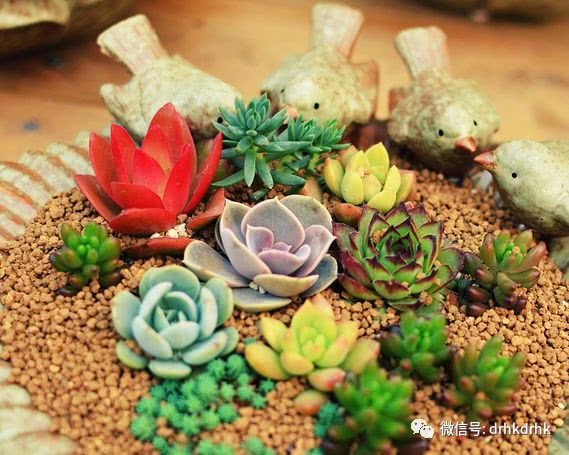
18. Rosette refers to a growth form with many leaves growing radially from a short stem close to the ground, with the leaves arranged in a way that resembles a lotus flower. Examples include the genera Echeveria and Graptopetalum in the Crassulaceae family, etc.
19. Leaf-teeth often refers to the fleshy spine-like structures on the edges of thick succulent leaves. They are commonly seen in Aloe plants in the Liliaceae family, such as Aloe nobilis, Aloe nobilis variegata, and Aloe nobilis 'Emerald,' etc.
20. Leaf thorn: a thorn-like structure transformed from part or all of a leaf. Leaf thorns can reduce transpiration and serve a protective function. For example, the spines of cacti are leaf thorns.
21. Window: in many succulents, such as Haworthia in the Liliaceae family, the leaf tip has a transparent or semi-transparent part called a "window." Changes in the window surface are also a basis for variety classification.
22. Absorptive bud, also called nie, is a bud-like body produced on the nodes of underground stems or in the axillary buds of aboveground stems. Examples include the small plants growing beside the mother plant of Sempervivum and Echeveria, etc.
23. Leaf scar: the broken petiole mark left on the stem or branch after a leaf falls off. The arrangement order and size of leaf scars can be used as a basis for identifying plant species.
24. Hybridization is the act of crossing two plants to obtain a new variety with the characteristics of both parents. For example, White Peony is an intergeneric hybrid between the genera Echeveria and Graptopetalum.
25. Grafting is a propagation method in which the stem or offset of the mother plant is attached to a rootstock so that they combine into a new plant. The stem, tubercle, or offset used for grafting is called the scion, and the plant receiving the scion is called the rootstock.
26. Stock, also called rootstock. The plant connected to the scion during plant grafting propagation. In cactus grafting, Hylocereus undatus is commonly used as the rootstock, while for succulents, Euphorbia nerifolia is often used as the rootstock.
27. Leaf cutting: a propagation method in which part of a succulent leaf is inserted into a substrate to encourage rooting and grow into a new plant.
28. Renewal: through pruning methods, including heavy pruning and cutting off old branches, new branch growth is encouraged.
29. Air-cured root: when soil that is too wet and root disease cause succulent root rot and yellow leaves, the plant can be taken out of the soil and the roots exposed to air to dry, which helps eliminate pathogens and restore vigor.
30. Variegation, also called color spots or spotted variegation. All or part of the stem loses the ability to produce chlorophyll, while other pigments remain relatively active, causing red, yellow, white, purple, orange, or other colors or color spots to appear on the stem surface. In cultivar names, f. variegata or 'Variegata' is often used.
31. Fasciation, also called cresting, is an irregular bud mutation phenomenon. This deformed fasciation is the result of abnormal development of certain meristem cells, and in scientific names f. cristata or 'Cristata' is often used.
32. Cristate: leaves, stems, or flowers growing in a cockscomb-like form, also called cockscomb-like, such as the cristate form of Gymnocalycium mihanovichii.
33. Bud mutation: a trait that appears in a vegetative part of a plant, differs from the original plant, can be inherited, and can be preserved by asexual propagation. Examples include many variegated and fasciated cultivars among succulents.
34. Mutation refers to the phenomenon in which the genetic tissue of a plant suddenly changes, causing the plant to show new characteristics, and these new characteristics can be inherited by offspring. Succulents can also fix new characteristics through grafting.
35. Yellowing refers to the phenomenon in which, due to lack of light, plant leaves fade and turn yellow and the stem grows excessively.