Sugarcane is crisp and sweet, but have you ever seen sugarcane flower or know how to grow it?
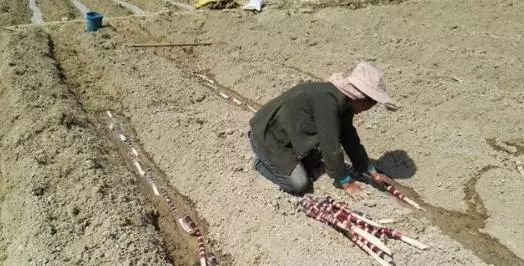
For friends in the north, growing sugarcane is a rare thing, but for friends in the south it should be quite common. How exactly is sugarcane grown? Let's talk about it here.
Sugarcane seeds
Sugarcane is actually not grown from seeds or from seedlings, but can be grown from the stalk of the sugarcane itself. Isn't that quite amazing? If you look carefully at the sugarcane you bought, you will notice that at each node of every section there is a small triangular bud, and this bud can actually sprout. However, because this part does not have much water, and using it as a seed bud would be too wasteful.
So farmers generally choose the head of the sugarcane, that is, the tender bud at the top, as the seed bud. This part is first of all a bit lower in sweetness, so it does not have much commercial value, and the bud in this part is relatively tender with plenty of water, so it sprouts more easily when planted in the ground. So the sugarcane we eat is generally grown from this part.
Speaking of this, some people may ask, "So does sugarcane actually flower and bear fruit?"
Sugarcane naturally does flower and bear fruit. However, because the place of origin of sugarcane is South Asia, that is, India, where the latitude is relatively low and the temperature is high, sugarcane flowers and bears fruit relatively easily in such an environment. In some parts of China, such as parts of Hainan and Yunnan, where the temperature is relatively high, sugarcane flowering occasionally occurs, but it is relatively rare for sugarcane to bear fruit.
The flowers of sugarcane are a bit like reed flowers, gray, with a slightly fuzzy feel.
However, sugarcane flowering is not a good thing. Because everyone knows that sugarcane is loved by people precisely because it is sweet, but once sugarcane flowers, the nutrients will be supplied to the sugarcane flowers, causing the sugarcane flowers to bear fruit, and in this way the sweetness of the sugarcane stalk will be greatly affected. So farmers generally harvest the sugarcane before it flowers, so under normal circumstances it is very difficult to see sugarcane flowering. Only some specialized sugarcane research institutes let sugarcane flower and bear fruit, in order to better research sugarcane varieties.
Having said so much about the issue of sugarcane flowering, let's now talk about how sugarcane is grown.
Time and seedlings
Sugarcane is generally planted in the two seasons of spring and autumn. Spring is generally from February to April, and autumn is generally from the end of August to the end of September.
As for sugarcane seed, it can generally be purchased, or you can keep your own seed at home, and in some places the local government will also distribute some sugarcane seed. Before planting, plow the land first, preferably with deep plowing, and then sun the land, as this is more conducive to the later growth of sugarcane.
Field management
In addition, during the sugarcane growing period, the most important things are fertilizer and water. First, let's talk about fertilizer. Fertilizer must be sufficient, so that sugarcane can grow well and the taste will be sweeter. The base fertilizer must be sufficient. Generally, one mu of land needs 1500 kg of organic fertilizer, and then about 20 kg of compound fertilizer is needed. In addition, during the growth process, sugarcane has a very large demand for phosphorus and potassium fertilizer, while the demand for nitrogen fertilizer is slightly smaller.
The water requirement pattern of sugarcane during the growing period is "more in the middle and less at both ends." That is to say, the water requirement is relatively small during the seedling stage and the late maturity stage of sugarcane, while the water requirement is relatively large during the elongation stage in the middle. So growers should grasp this reasonably.
Also pay attention to weeding in the field and the prevention and control of pests and diseases.