Keep these two problems in mind when growing succulents in summer, and they will be less prone to sunburn and grow stronger
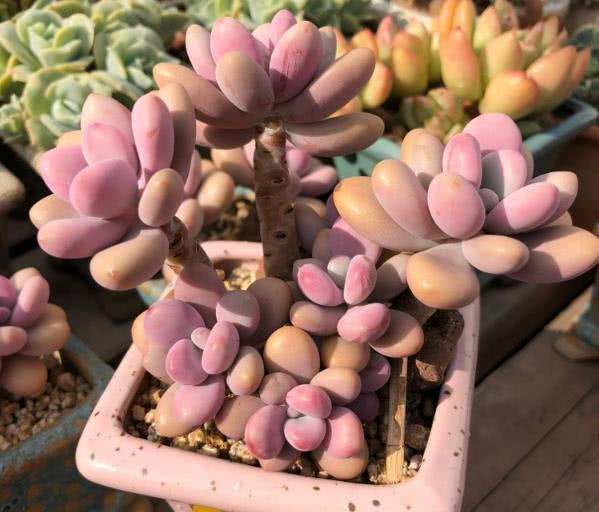
The first problem is watering. Succulents tend to suffer from water shortage in the hot summer, and many flower lovers panic and start frantically replenishing water for their succulents, but it is exactly this kind of watering that directly causes succulents to die. Because at high temperatures the water temperature is also relatively high, and having succulent roots soaked in warm water and "cooked" is a very dangerous thing. So the experts all choose to water in the evening, when the temperature is relatively lower and there is a long time until sunrise the next day, which not only lets the succulents drink their fill but also gives the soil enough time to drain. In summer, the amount of water given to succulents has a lot to do with the pot: red pottery, rattan-woven and sphagnum types with strong breathability can be watered heavily, and may even need the soak-pot method. Ceramic pots, however, let moisture evaporate extremely slowly, so the amount of water should be small and the interval between waterings should be lengthened.
Summer does not mean no sunlight at all. Without enough sunlight, succulents will still grow leggy even in dormancy. Artificial shading is meant to help them adapt better to the environment and reduce the battering from nature. Some varieties can take full sun and be kept outdoors all the time without any problem, such as Graptopetalum paraguayense and Sinocrassula yunnanensis. Summer is a period of high incidence of pests and diseases, and poor ventilation easily breeds bacteria. Black rot has a high incidence in summer; once it is found, immediately cut off the rotten part and apply Duojunling to the wound, because the rot will spread very quickly and after a few days of delay there is no saving it. When watering succulents, you must control the amount of water well. If you really cannot resist, you can water a small amount along the pot wall or soak the pot briefly (keep it to about 10 seconds), that is, put the pot in water and take it out after a moment, just enough to feel slightly moist.
Experienced flower lovers understand that succulents are not "drought-loving" but "drought-tolerant." Although there is only a one-character difference, the two meanings are far apart. Because the native habitats of succulents are regions with more drought and little rain for most of the year, "drought tolerance" is a biological mechanism they evolved out of necessity. Once there is rainwater, succulents will immediately eat and drink their fill, storing it in their bodies for times of need, and this is what forms their thick, juicy appearance. Therefore, succulents in their growing period can absolutely be watered boldly and generously. "Better dry than wet" is not wrong, and it can be said to be a safe plan, indeed a very safe one. If beginners cannot judge the water amount well, it is better to water a little less to be safe; beginners can choose this plan.
The second problem is sun protection. Once summer arrives, the scorching sun ruthlessly reaps a wave of succulent lives, and under intense sunlight succulents get sunburned within just a few days. So shading the little succulents in summer is very important. We only need to move the succulents away from their originally sunny spot and place them somewhere that receives only a little light in the morning and evening, which both satisfies the succulents' need for light and ensures they are not harmed by the sun. In summer, the times more suitable for succulents to receive light are in the morning and evening. Generally, at noon the light is intense and the temperature is the highest, which is a major taboo for succulents and can easily cause sunburn or even death by sun.
In summer, sunbathing succulents is quite particular. Summer is the dormant period for many succulents; at this time the plants stop growing, their demand for water and nutrients is very low, and their requirement for light is not high either. Under normal circumstances, not much sunlight is needed. Generally in summer you should note that summer-growing succulents can be exposed to light appropriately, but most succulents should not be exposed for long periods; place them indoors where they cannot get sunlight, or use a shade net to block the light. The reason succulents easily die in summer is the high temperature. Although wild succulents grow outdoors in South Africa and are not killed by the sun, the resistance of wild succulents is after all not comparable to that of succulents in a greenhouse, and besides, the temperatures in Africa really are not as high as those in southern China.
Generally in summer, although everyone takes measures, succulents are still very prone to sunburn. So what should you do if they get sunburned? If a succulent gets sunburned, it usually shows on the leaves, where yellow-brown spots appear, and the leaves become soft, wilt and may even die. When this happens, first put the succulent in a cool, ventilated place. Note that sunburned leaves generally will not recover; you have to wait for them to slowly fall off, after which new leaves can grow. In fact, as long as you pay attention to these two points, you can get your succulents through the summer safely.
This is a gathering place for succulent lovers, sharing succulent care tips. Welcome to follow and exchange ideas.