A Detailed Explanation of 17 Design Styles for Garden Landscape Paths
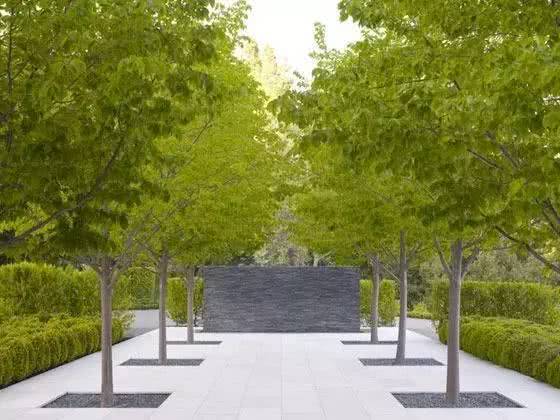
Modern garden landscape paths, by organizing the direction of movement, dividing space, and arranging spatial sequences, give the walking experience a variety of states and interest.
The 17 design styles for landscape paths:
1. Dignified guidance
A relatively wide straight line that draws people's attention toward the goal.
2. Branching paths
Multiple secondary paths in different directions are set along the main path, combined with favorable landscape views to inspire people to move forward.
3. Setting up distracting elements
Distracting elements are placed on both sides of the path, making the process of travel intermittent.
4. Concentration
There is an obvious main path, and other secondary paths converge toward the main path, with a clear distinction between primary and secondary.
5. Partly hidden, partly visible
The path merges with the ground or the environment, presenting a dotted-line feel.
6. Straight-line intersection
A free intersecting combination of a group of straight lines, with the parts cut by the straight lines forming multiple spaces.
7. Gathering and radiating
Multiple paths gather toward a single point, with a very strong emphasizing effect.
8. Offset paths
One or more paths are offset beside one path, forming a group of paths with an overall consistent trend.
9. Curved paths
Curved paths with gentle curvature are suitable for main roads, while those with large curvature are suitable for secondary paths.
10. Rising and falling
By treating the path with rises and falls, a walking experience rich in changing sensations is produced.
11. Winding and twisting
The path is given exaggerated bends and twists, achieving the feeling of a path turning at every peak and a "dazzling" sensation.
12. Concentric movement
Always moving around a center, forming a space with a very strong sense of centripetality.
13. Hidden within a surface
A path can also look like "not a path", but the trajectory of movement is hidden within the surface.
14. Detouring paths
Composed of multiple continuous large turns, a path style that can slow time down.
15. Zigzag paths
A path style with a very strong sense of force and adaptability, a universal path pattern.
16. Straight paths
The path form with the strongest sense of purpose, solving problems directly and straightforwardly.
17. Returning paths
First maintaining visual contact with the node for a period of time before actually arriving, similar to the "hiding and revealing" of traditional Chinese garden-making.