Succulents are said to be impossible to kill - how many of these eight varieties have you grown?
Succulents are admirable life forms in nature; even in poor soil with little water, they can live vibrantly and spread their offspring all over the world. Today, the editor rounds up the eight toughest succulent varieties.
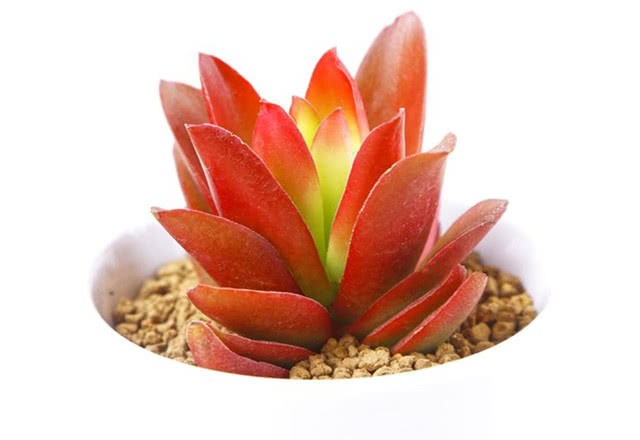
1. Firecracker (Crassula capitella 'Campfire')
The fiery red fleshy leaves of Firecracker are its uniqueness and charm; it is easy to care for and has high ornamental value. Like a burning flame, it gives a feeling of vigorous, uplifting passion and energy, with very strong appeal. In the cool season from late autumn to early spring, its leaf color is especially bright and very fitting for the season.
2. Echeveria 'Mebina' (Nüchu)
Echeveria 'Mebina' is a succulent plant in the Crassulaceae family, genus Echeveria. It is characterized by its small rosette form and orange-pink leaf margins. It readily produces side shoots, and over many years a plant can form a spectacular large colony.
3. Graptopetalum paraguayense (Pale Ghost Plant / Luoyue)
From the Qing dynasty, Gong Zizhen's ci poem "Yu Lian Huan Ying": "The moon shrouded in mist stands beside the flower shade, red tears leave traces, a spray of blossoms wet." Luoyue, also known as Baoshihua, Shilianhua, or Fengchecao, is the name of a succulent plant native to Hidalgo State, Mexico. It propagates extremely easily and is highly adaptable, with no strict environmental requirements. It is an easy-to-grow variety that rarely suffers disease and does not attract pests, and it does not lose its good looks even with insufficient light.
4. Kalanchoe daigremontiana (Mother of Thousands / Bu Si Niao)
Also called "falling to the ground and taking root," it truly lives up to its name - its leaves produce an abundance of tiny plantlets that root as soon as they drop into soil. Note that balcony growers should not keep this variety; its reproductive capacity is too powerful. If you like it, prepare a patch of land first before considering it. It is known as the succulent that cannot be killed.
5. Sedum rubrotinctum (Jelly Bean Plant / Hong Zhi Yu)
Sedum rubrotinctum is a succulent plant in the Crassulaceae family, genus Sedum, and a perennial fleshy herbaceous plant. It grows relatively fast, with spring and summer as the main growing seasons; in summer, when temperatures reach 35°C, it needs shading. It is cold-tolerant and also not afraid of blazing sun; the more sun its leaves receive, the redder they become, so in midsummer there is no need to shade it, while plants grown in partial shade have bright green, glossy leaves.
6. Sempervivum tectorum (Hens and Chicks / Guanyin Lian)
Guanyin Lian is exactly as its name suggests - its leaves are arranged in a rosette, with a form like a lotus pedestal. The leaves are flat and slender, with sharply pointed tips and small fine hairs along the margins. Under full light, the leaf tips and margins develop a very beautiful coffee or purplish-red color.
7. Graptopetalum mendozae (Ji Qiuli)
Graptopetalum mendozae belongs to the Crassulaceae family, genus Graptopetalum. It is a succulent that grows relatively fast, is easy to care for, and is as delicate and small as jade. It prefers cool, dry, sunny environments and well-drained sandy soil. Graptopetalum mendozae roots wherever it falls; succulent growers with small balconies are not advised to keep it, as it takes up too much space.
8. Crassula 'Pagoda Village' (Qian Zhi Ta)
Qian Zhi Ta is a perennial fleshy herbaceous plant in the Crassulaceae family, genus Crassula, with a short, clustered form only 5-8 cm tall. It grows upright, and older plants sprawl along the ground. The "qian" in its Chinese name refers to the deep red color of its leaves; the neatly layered purplish-red leaves call to mind a red Buddhist pagoda with Eastern characteristics, hence the name. It grows fast - in just over a year it can fill a pot with no problem. As long as there is ample sunlight, its colors will be gorgeous and varied, and it needs no meticulous care.