How to Grow Succulents into Small Old Stumps? A Complete Guide to Care Techniques
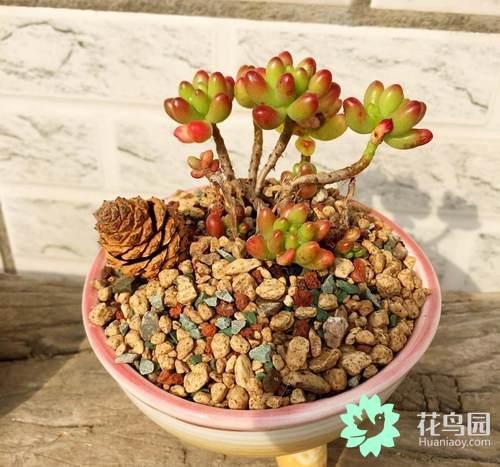
The vegetative organs of succulent plants are thick and enlarged, usually swelling at the roots, stems, and leaves. They are also called succulents and belong to different families and genera, among which the common ones are Crassulaceae and Cactaceae succulents. There are many varieties of succulent plants, and worldwide there are roughly ten thousand species. Most succulents on the Chinese market today are imported varieties, mostly from Japan and the Netherlands.
Succulents are generally appreciated for their leaves and rootstocks, and many succulent plants have thick, sturdy, aged and mottled rootstocks that form a sharp contrast with their evergreen leaves and petals. The market calls these small old stumps. The so-called small old stump has several characteristics: first, old, meaning a stump that requires many years of cultivation; for succulents, generally only after 4 or 5 years can it be called an old stump; second, small, meaning the stump is compact and not tall, with a rootstock that is not slender and messy but thick, short and swollen. These two together make a small old stump.
Although cultivating a small old stump requires time to accumulate, poor management will only produce messy rootstock growth that is long and uninteresting (some merchants give it the nice name of cliff, but in fact it is just a lack of proper management and letting it grow freely). Below I share my experience in cultivating small old stumps with everyone.
First, variety selection.Generally choose varieties with swollen rootstocks, mostly from Crassulaceae, such as Sedum, Rhodiola, Hylotelephium, Crassula, Sinocrassula, Echeveria, Aeonium, and so on.
Second, light.Most succulent plants have strong light in their native habitats, so to cultivate small old stumps, light must be increased. Place the succulents on a south-facing balcony, and if conditions permit, give them full-day light in a transparent greenhouse. Under direct sunlight, the rootstocks of succulents grow rapidly, and no shading is needed in summer.
Third, water.The cultivation of small old stumps lies in water control. Most succulent native habitats are arid with little rain, which is why they form swollen rootstocks to store nutrients for their own supply. We make use of this characteristic of succulents by withholding water more, keeping the growing medium mainly on the dry side, and not keeping it moist often. Do not water until dry, and even when dry, observe first, training the succulents' drought tolerance and letting them form a conditioned reflex to enhance their own nutrient storage ability. In this way, the rootstocks will gradually swell. If kept moist often, they will become dependent, the rootstocks will grow leggy and droop everywhere.
Fourth, fertilizing.The cultivation of small old stumps cannot be separated from fertilizer. The fertilizer elements that make succulents sturdy are generally mainly phosphorus and potassium fertilizers. Generally, in spring and autumn, about once every week to ten days, apply rotted cake fertilizer water and monopotassium phosphate solution once, alternating them, with light fertilizer applied frequently.
Fifth, pruning and shaping.Pruning is an artificial way to promote horizontal growth of succulents rather than upward growth. You can use the method of pinching off the top and removing leaves. In addition, according to different succulent varieties, prune for shaping so that the succulents grow according to your own design. Cut off useless branches, dead branches, and diseased branches, so that the succulent's shape is beautiful, and the small old stump is steady and sturdy.
Sixth, patience.The previous five measures are only daily management, while the formation of a small old stump requires a process of time accumulation, at least several years, at most more than ten years. This requires patience. Moreover, cultivating flowers and plants is itself a process of self-cultivation. Do not be impatient. As time passes and the succulent small old stump forms, your own character also becomes more restrained. This is a win-win process.
The above is a bit of my experience and insights. I hope it can help you. Succulent small old stumps are sturdy and beautiful, with mottled rootstocks and a contrast between the withered and the flourishing, highlighting the colors of life. Avoid slender rootstocks and leggy branches and leaves. As for the so-called cliff, waterside, and similar succulent small old stumps promoted by some merchants, it is best to stay far away from them.