5 steps to growing flowers: choosing flowers, choosing pots and care - learn these and you're an expert
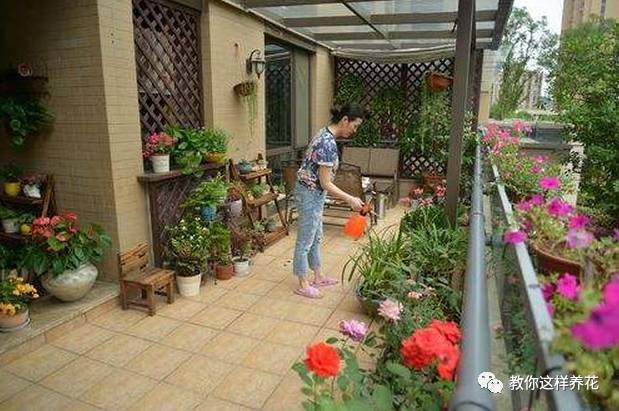
Growing flowers means treating them like friends. Flowers and plants are certainly beautiful, but they also need you to care for them properly and attentively. Growing flowers is about cultivating character: you must be patient, neither arrogant nor impatient, appreciate the flowers and plants, understand them, and only then will you cherish and care for them.
“
Basic knowledge of growing flowers
”
Understand the habits of flowers and plants
Flowers are classified by growth habits and morphological characteristics, and can generally be divided into herbaceous flowers, woody flowers, succulent flowers and aquatic flowers. Different flowers vary greatly in their needs for sunlight, water and temperature. So before buying flowers, you need to know whether the flowers you want to buy have a suitable growing environment. For example, if you have a north-facing balcony with very little light, it is not suitable for sun-loving flowers, otherwise they will grow poorly and bloom very little.
Most flowering and fruit-bearing ornamental flowers are sun-loving plants, such as magnolia, Chinese rose, pomegranate, plum blossom, crape myrtle and citrus. Among foliage plants there are also a few sun-loving ones, such as sago palm, palm and croton. Most aquatic flowers, cacti and succulents are also sun-loving plants. All sun-loving flowers like strong light and cannot tolerate shade. If sunlight is insufficient, branches and leaves tend to grow leggy, tissues become soft and weak, leaf color fades and turns yellow, flowering is difficult or poor, and they are prone to pests and diseases.
Flowers such as asparagus fern, camellia, azalea, hosta and pothos grow well in shaded conditions. Osmanthus, jasmine, white orchid and hydrangea are neutral flowers that grow well under conditions of sufficient sunlight, but need shading in summer when light intensity is high.
In addition, you should also understand whether the flowers like water and fertilizer, how often to water and fertilize, and what the suitable care temperature is in summer and winter. Flower lovers need to do their homework.
Choosing flower pots
Purple clay pots are beautiful in appearance and dignified, but their drainage and breathability are lower than those of earthen pots, and the price is relatively high. Porcelain pots are very beautiful in appearance, but the price is higher and drainage and breathability are very poor. Plastic pots are cheap, but drainage and breathability are very poor, and in dry northern regions they easily weather and become brittle over time. Wooden pots are suitable for planting large foliage plants and can be placed in larger halls and courtyards. Hydroponic pots have no drainage hole at the bottom and are special pots for aquatic flowers. Flower lovers can choose pots according to their actual budget and the types of flowers and plants.
Choosing flowers
As the saying goes: "An elegant room need not be large; fragrance of flowers need not be many." Placing some flowers and plants indoors, with green leaves and abundant blossoms, evergreen through the four seasons, is truly full of spring and vitality. Household flowers are generally grown mainly in pots. Due to limited conditions, do not grow too many; 10-15 pots is suitable. The flowers chosen are best able to cover foliage flowers, flowering flowers, fruit-bearing flowers, fragrant plants and ornamental-form flowers, so that the varieties are rich and diverse. Household flower growing should be few but fine in quantity, and in variety selection you should reasonably choose flowers and trees according to the family's environmental conditions and personal preferences.
When beginners buy flowers, it is best not to buy small seedlings, and also not to grow them from seeds, because care is more difficult; it is best to choose finished potted plants. Choose ones with a proper plant shape, dense, lush and glossy dark green leaves, and leaves without yellow spots or disease spots. Even a disease spot only the size of a grain of rice may eventually spread to the whole plant.
When buying flowers as a beginner, you can first try some easy-to-grow varieties. First, the price is relatively low; second, they are easy to keep alive and grow well, which can build up confidence. You can grow spider plant, aloe, snake plant, golden barrel cactus, pothos, Chinese rose, kalanchoe, narcissus, marigold, morning glory, petunia, balsam, busy lizzie, dianthus, Aglaia, jasmine, Christmas cactus and so on.
Watering methods
Whether the amount of water given to potted flowers is timely and appropriate is the key to success or failure in growing flowers. Based on experience from various places, the amount of water for potted flowers should be comprehensively judged according to the flower variety, plant size, growth and development stage, climate, soil conditions, pot size, placement location and other aspects, to determine the time, frequency and amount of watering.
Under normal circumstances, moisture-loving flowers should be watered more, and drought-loving flowers should be watered less; bulbous flowers should not be watered too much; herbaceous flowers have high water content and also high transpiration, so they should be watered more than woody flowers; flowers with large, soft, smooth and hairless leaves should be watered more, while flowers with small leaves and a waxy layer, fine hairs or leathery texture should be watered less; water more during the vigorous growth period and less during the dormant period; water more when the plant is large and the pot is small, and less when the plant is small and the pot is large; water more in hot weather and less in cold weather; water more in dry weather and less on cloudy days, and so on.
Generally speaking, there are five principles for watering:
Rather dry than wet: For five-needle pine, black pine and xerophytes, especially cacti and succulents, water according to the principle of "rather dry than wet." Water only when the soil has dried completely, and never allow waterlogging.
Water thoroughly when dry: For potted flowers such as orchids, wintersweet and geraniums that like dryness and fear waterlogging, water according to the principle of "water thoroughly when dry." Water only when the growing medium has dried. "Water thoroughly" means do not give half-hearted watering; make the whole pot soil wet through from top to bottom. If you do not water thoroughly, the root system will not be able to absorb water, which will affect its growth.
Alternating dry and wet: Alternating dry and wet lies between "water thoroughly when dry" and "water when the surface dries." Generally, water when the pot soil is basically all dry but still has a trace of moisture and has not completely dried out. The advantage of this method is that the flowers will neither rot roots because the soil is long damp and breathing is poor, nor wilt because of long-term drought. The disadvantage is that the timing is not easy to grasp, and it needs to be used after understanding the habits of different flowers through long-term practice in growing flowers. Clivia, pothos, green emerald and peace lily can use this method.
Water when the surface dries: For some moisture-loving flowers such as azalea, camellia, banana shrub, gardenia and Aglaia, water according to the principle of "water when the surface dries." Water when the surface of the growing medium turns white, and water until moist. The pot soil must not be too dry or too wet for a long time; just keep it "moist."
Rather wet than dry: Rather wet than dry applies to plants grown half in water and half in soil, such as copper money grass. Such plants are especially afraid of drought, so they must be watered frequently to keep the pot soil moist.
Watering methods
Watering is a routine management task in growing flowers, and whether the pot soil lacks water is difficult to judge, so many flower lovers often feel troubled by this. Generally speaking, look, listen and rub. Looking means checking whether the color of the soil surface has turned white; if so, it means water is lacking. Listening means tapping the flower pot with your hand and listening to the sound. Rubbing means picking up surface soil and rubbing it with your hand; for sandy loam, if it crumbles into fine powder as soon as you rub it and there is not the slightest moisture in the soil, it means the soil lacks water.
The above are some suggestions for new flower lovers
As long as you do these steps well, keeping flowers and plants alive will not be a problem!
Show it to flower lovers who need it!