How to rescue azaleas when their branches and leaves shrivel and the leaves drop off?
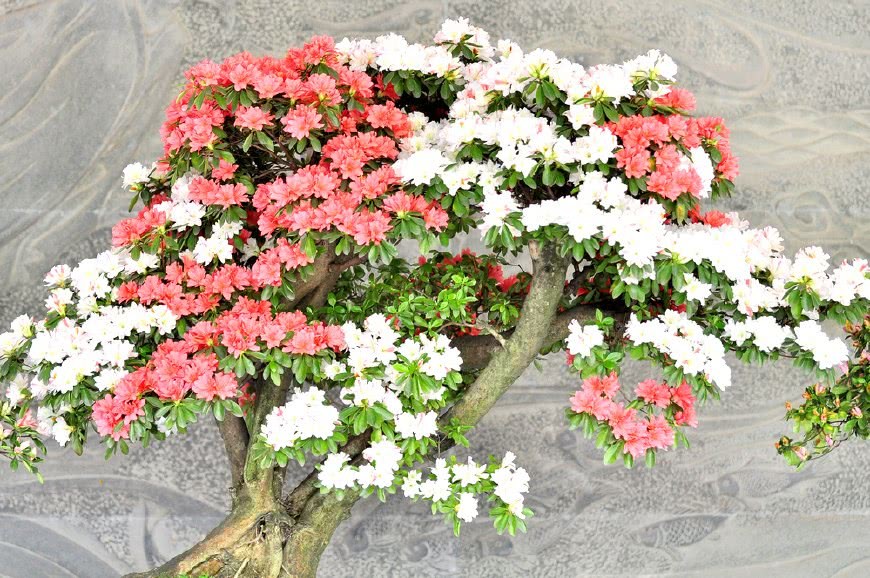
The azalea is one of China's top ten famous flowers. Among all ornamental flowering plants, the azalea ranks as the one that can be called beautiful in both flower and leaf, suitable for both open-ground planting and container growing, and the most widely used. Azaleas have always been a relatively popular flower, and surely many people have grown azaleas, but many people may not be very clear about the methods for growing azaleas.
Key points for growing azaleas
1. It likes coolness and fears intense heat, likes semi-shade and fears blazing sun, likes moisture and fears dryness, likes acidic soil and fears alkaline soil, likes light-textured soil and fears heavy clay soil, likes good drainage and fears waterlogging.
After being moved outdoors in spring, when the sunlight is relatively soft, azaleas should be shaded appropriately around midday. After summer begins, place the azaleas in a ventilated, shady spot; in the hot summer, shade them with reed curtains, bamboo curtains or shade netting, and open the curtains before 8 a.m. and after 5-6 p.m. Since the azalea is a semi-shade-loving flowering plant, its tender leaves are easily scorched under blazing sun. If it is kept in direct strong light for a long time in summer, the branches and leaves will turn yellow and withered and growth will stall, and in severe cases the whole plant will die.
In autumn, the intensity of sunlight gradually softens; before 9 a.m. and after 5 p.m., azaleas can be given more sunlight, and in late autumn place them in a sunny spot to promote flower bud differentiation. Azaleas are not cold-tolerant, so between the Cold Dew and Frost's Descent periods they should be moved indoors and placed in a sunny spot. In the early period after being brought indoors, take care to open the windows and doors for ventilation. If they are kept in a shady place for a long time, they easily drop their buds.
In winter, the indoor room temperature should preferably be around 10°C. For most varieties, the room temperature should not be lower than 5°C, but Western azaleas are sensitive to cold, and the overwintering room temperature must not be lower than 8°C. If the winter room temperature is too high, metabolism increases and nutrients are consumed, which is unfavorable for growth and development the following year. The soil for caring for azaleas can be acidic soil. Because azaleas like acidic soil, a pH of 4.5-6.5 is suitable. The potting soil should be loose, well-drained and contain humus. A commonly used mix is 6 parts leaf mold, 2 parts peat soil and 2 parts river sand blended evenly, or pine needle soil can be used.
To improve water quality, the water used for watering flowers is best mineral-free water, such as rainwater or snow water. Besides storing rainwater and snow water, acidified water can be used, that is, 100 jin of water plus 0.1% ferrous sulfate for year-round watering. If the acidity is insufficient, a few drops of vinegar can be added as a supplement.
Notes on cultivating azaleas
The fibrous roots of azaleas are as thin as strands of hair, and there are very few thick main roots. They fear both dryness and wetness, and especially fear heavy fertilizer. If watered too much, the roots soak in water; if too dry, the branches and leaves shrivel and the leaves drop off, posing a great threat to the plant. As for applying heavy fertilizer, that can endanger its life.
After the flowers fade, the spent flowers must be cut off to avoid seed formation consuming nutrients. After new branches sprout, thin the branches appropriately, deciding what to keep or remove according to the plant's growth vigor. Azaleas are most suitably planted in clay pots, because clay pots absorb water and breathe, which benefits root growth and development and makes the branches and leaves luxuriant. There are particular requirements for where potted azaleas are placed; generally they should be placed on a southeast-facing balcony, and they need ventilation, and should be moved as little as possible. Without ventilation, they easily suffer from black spot disease and drop leaves in large numbers. Azaleas also have moderate light requirements, and direct light should be avoided in summer. Thin buds and leaves in time, removing part of the overly numerous and dense flower buds and leaves so that air circulates and nutrients are concentrated in the flower buds. After the flower buds form, increase nutrition and apply a moderate amount of extra phosphorus and potassium fertilizer, otherwise the flower buds will turn into leaf buds. The main reasons for azaleas dropping leaves and failing to bloom are: too strong direct light in summer, frost damage from severe cold, too much watering, fertilizer applied too strongly, being kept indoors for too long, being placed in an unventilated or dark, damp place, being exposed to acid rain, and so on, so these situations should be avoided during care. Repotting and changing the soil does not need to be done every year; generally once every 2 to 3 years, damaging the fibrous roots as little as possible, and the time should be after the flowers fade or in autumn, while also spraying thiophanate to prevent disease. The main insect pests of azaleas are the azalea lace bug, the shoot tip leaf roller, red spider mites, aphids and so on, which can be sprayed with fenvalerate and the like, with good results; if they are not dead after three days, spray once more. For the azalea lace bug (also known as the azalea lace bug) during the period of damage, spray 40% dimethoate 1500-fold solution once every 7 days for 3 consecutive times. The main method of controlling the shoot tip leaf roller is to kill it by hand-catching; the larvae or pupae can also be killed by spraying 40% dimethoate emulsifiable concentrate 2000-fold solution or dichlorvos 1500-fold solution. The main propagation method for azaleas is cuttings. Around the time of Grain in Ear, choose new branches 5 cm to 10 cm long, cut them off at the branching point, strip off the lower leaves, keep 3 to 4 terminal leaves, insert 1/3 of the branch into the soil, spray with plenty of water, and cover with plastic film. Strengthen management at ordinary times, and transplant after one year.
The azalea is also known as yingshanhong and mountain pomegranate, and is an evergreen or semi-evergreen shrub. Legend has it that in ancient times there was a cuckoo bird that cried sadly day and night until it coughed blood, dyeing the flowers all over the mountains red, and so it got its name. Azaleas generally bloom in spring, with 2-6 flowers per cluster, and a funnel-shaped corolla, in colors including red, pale red, apricot red, snow blue and white, with luxuriant and gorgeous flower colors.
Soil selection: For soil selection in the methods and notes for growing azaleas, the azalea is a shade-loving plant, and direct sunlight is unfavorable to its growth, so an azalea specialty garden is best chosen in a place shaded by tree shadows, or when doing landscaping design this should be taken into account by deliberately arranging trees in the specialty garden. Azaleas like well-drained acidic soil, but because each specialty garden and landscape must use cement for paths and paving, the soil where azaleas are planted becomes compacted and seriously alkaline, so the soil at the planting site must be replaced and a certain amount of peat soil added.
Cultivation temperature: For temperature in the methods for growing azaleas, azaleas are most suitably planted in early spring or late autumn. When planting out, the root system and soil must be made even and firm, but not too compacted, and the soil surface near the root crown should be made arc-shaped; this both protects the plant's shallow root system from severe cold damage and benefits drainage. In mid-to-late April, move them out of the greenhouse, first placing them in a wind-sheltered, sunny spot; in summer provide shade, or place them in dappled shade under trees, avoiding direct strong sunlight. The suitable temperature for growth is 15-25°C. In winter, place them in a sunny spot and keep the room temperature at 5-10°C; the lowest temperature must not be below 5°C, otherwise growth stops.
How to fertilize: For fertilizing in the methods and notes for growing azaleas, at the end of winter and the beginning of spring each year, it is best to apply some organic fertilizer to the azalea garden as a base fertilizer. After azaleas bloom in April-May, since the plants consume a large amount of nutrients during the flowering period, as the leaf buds sprout and new shoots extend, a supplementary fertilizer can be applied about every 15 days. After the beginning of the dog days, most branch tips have stopped growing; this is the high-temperature season, when physiological activity weakens, so supplementary fertilizing can be stopped. After autumn, the climate gradually becomes cooler, and there are often continuous autumn rains; the temperature and humidity are suitable for azalea growth, and at this time the last supplementary fertilizing can be done. After winter begins, fertilizing is generally not advisable.
Pay attention to pruning: For pruning in the methods and notes for growing azaleas, pruning and shaping branches is an important measure in daily maintenance and management work; it can regulate growth and development, thereby making the plant grow vigorously. Daily pruning requires cutting off a small number of diseased branches and weak, old branches, and removing some overly dense branches in accordance with the shape of the canopy, increasing ventilation and light penetration, which benefits plant growth. Azalea gardens must be inspected frequently, and if dead branches or diseased branches are found, they should be removed promptly to reduce the spread of pests and diseases among the azaleas.