How to Grow Sedum rubrotinctum (Jelly Bean Plant)? A Detailed Guide to the Latest Care Methods
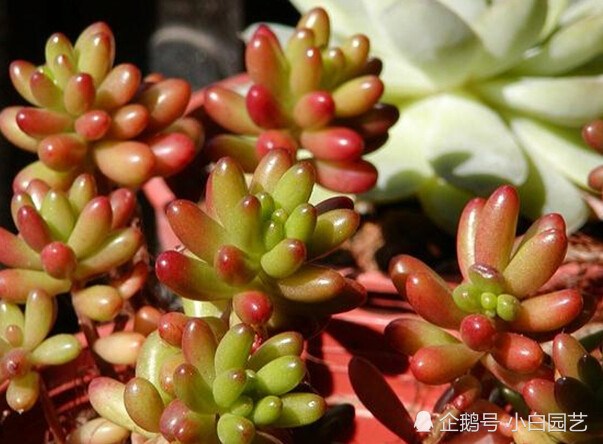
Sedum rubrotinctum is also called Christmas Cheer and Earring Grass. Because its leaves are red and green interspersed with bright colors, like a rainbow and like jade, it is named Hongzhiyu (Rainbow Jade). It has a cute appearance, is easy to care for, and is loved by everyone. It can be said to be a truly beautiful common variety, but it is also the one that most tests a succulent grower's skill. So how do you grow a master-level Sedum rubrotinctum?
How to Grow Sedum rubrotinctum
Temperature
Sedum rubrotinctum has a very strong adaptability to temperature. It likes environments with a large temperature difference between day and night. A growing temperature of around 10°C-28°C can let Sedum rubrotinctum survive very well. In autumn, artificial cooling can be used, which can keep the leaf surface of Sedum rubrotinctum emerald green and effectively improve its ornamental value. At the same time, in winter, the temperature can be controlled above 5°C.
Light
Sedum rubrotinctum likes sunlight. In winter, it can be placed on a balcony to absorb sunlight. In summer, it can be given half-day sun or half shade. At noon in summer, avoid direct sunlight to prevent leaf sunburn damage. During the growing season, make sure Sedum rubrotinctum gets enough sunlight.
Ventilation
Sedum rubrotinctum needs a certain ventilated environment to ensure it can grow well.
Soil
Sedum rubrotinctum does not have high requirements for soil. Generally, as long as the soil is loose and has good drainage, it is fine.
Watering
Sedum rubrotinctum has a certain drought tolerance, but during its growing season, a certain amount of water must be ensured so that it can grow better. Generally, if Sedum rubrotinctum grows slowly or its leaves show a sunny red color, it indicates a lack of water. At this time, water according to the plant watering principle of "do not water until dry, and when watering, water thoroughly."
Fertilizing
Sedum rubrotinctum has no great requirements for fertilizer. Applying a thin fertilizer once or twice during the growing season is enough.
Pruning
Sedum rubrotinctum generally becomes messy after being planted for more than three years, so it should be pruned in advance to maintain its shape.
Precautions for Growing Sedum rubrotinctum
Growing Sedum rubrotinctum is extremely ordinary, but to grow it very well, you still need to pay attention to the following points:
Sedum rubrotinctum needs sufficient sunlight. Even 5 or 6 hours of sun a day does not feel like too much.
Sedum rubrotinctum really likes a large temperature difference between day and night, so it is best to grow it outdoors.
Sedum rubrotinctum likes water, especially in summer, when it should be watered sufficiently. You cannot water it wildly in winter just because it likes water; it should be kept relatively dry.
Has this rainbow-and-jade-like Sedum rubrotinctum amazed you? But what should you do if you accidentally grow it all green?
Solutions for Sedum rubrotinctum Not Turning Red
Light + Temperature
Sedum rubrotinctum only looks more beautiful when its colors vary. However, during cultivation, it often appears green all year round, which does not feel so surprising. Basically, only by maintaining sufficient light and an obvious temperature difference will it change color.
Grasp the Coloring Season
The time when Sedum rubrotinctum changes color is from autumn to the spring of the following year, mainly starting in autumn, when the temperature difference between day and night is relatively large. If light is increased at this time, Sedum rubrotinctum will gradually turn red.
How about it? After reading the above growing methods for Sedum rubrotinctum, do you all feel confident about growing a master-level Sedum rubrotinctum?