When this flower blooms, it displays a rich variety of colors, with flowers covering the entire tree
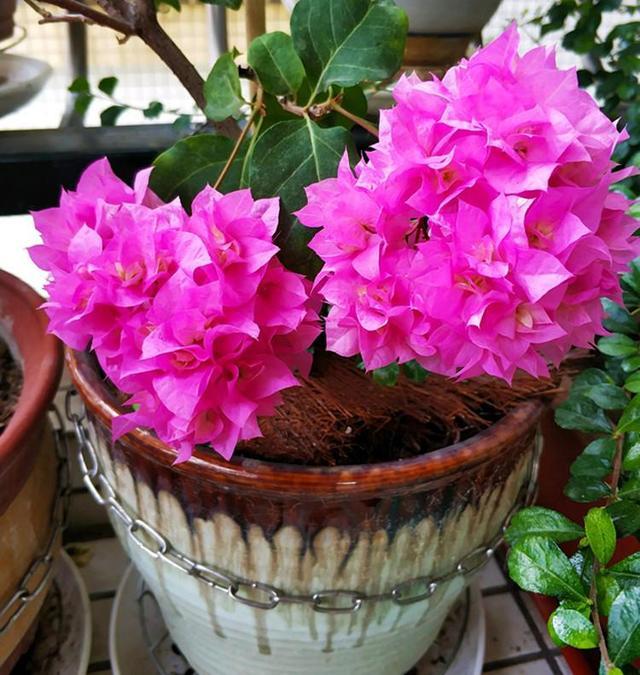
Bougainvillea, with strong vitality, offers both beautiful flowers and foliage, and comes in rich colors including red, yellow, and purple, with red being the most common. It has a long blooming period, with flowers covering the branches, making it an excellent potted plant. Moreover, there are many varieties of bougainvillea, and with good mastery of techniques, you can make it bloom profusely.
1. Potting soil
Bougainvillea is not demanding about soil, tolerating poor and dry conditions, but disliking waterlogging. Sandy soil rich in humus, loose, fertile, and with strong permeability is best; clay soil should be avoided. In addition, bougainvillea is a strongly sun-loving plant - sufficient light means more flowers and vivid colors, while insufficient light means lush foliage growth but no or few flowers, and dull flower colors. During the growing season, it must be placed in a sunny spot with all-day light; indoors it can only be placed briefly.
2. Temperature
Bougainvillea is a tropical plant. The optimal temperature for growth is 15-25°C, and the optimal temperature during the flowering period is 15-30°C. It prefers a hot and humid climate, is relatively tolerant of dry heat, but not cold, and fears frost. It grows normally in environments of 10-32°C. In winter, the temperature must not fall below 7°C, otherwise it will suffer frost damage or even die, so keep it warm during care.
3. Water
During the spring and summer growing seasons, water once a day to ensure branch and leaf growth. In May and June, carry out appropriate water control according to different varieties, repeating water control 3-4 times, to the extent that the tender shoots and leaves slightly wilt. At this time, spray water on the leaves 1-2 times a day, then after 2-3 days water thoroughly once. Repeating water control several times or watering every other day can promote flower bud differentiation.
When flower buds appear on new shoots, water thoroughly once each morning and evening, and spray water on the leaves 1-2 times. After October, water appropriately depending on how dry or moist the soil is. After bringing it indoors in winter, never water too much; follow the principle of "don't water if not dry, water thoroughly when you do." Wait until new buds and leaves emerge in spring, then gradually increase the amount of watering, otherwise it will cause root rot and death.
4. Fertilizing
Because bougainvillea grows vigorously and blooms heavily over a long period, it consumes a lot of nutrients. Combined with the limited root growth in a pot, regular fertilizing is very important. In early spring, apply an appropriate amount of base fertilizer when repotting. From late April it enters the vigorous growth period; apply a general-purpose organic liquid fertilizer for flowers once every 7-10 days. When tiny flower buds can be seen at the leaf axils, increase the application of a quick-acting phosphorus-potassium foliar fertilizer. During peak blooming, apply 0.5% monopotassium phosphate weekly.
5. Pruning
Pruning should follow the principle of "short and heavy thinning," that is, cutting back horizontal branches, heavily pruning new growth, and thinning out dense and weak branches. Red-flowered bougainvillea has weaker growth, so prune about once a year around March-April; purple-flowered bougainvillea needs comprehensive pruning twice a year, the first before sprouting in March-April, and the second after flowers fade and before new branches grow in November-December, to ensure vigorous blooming year after year.