Potted orchids need both roots and leaves well fed to bloom profusely
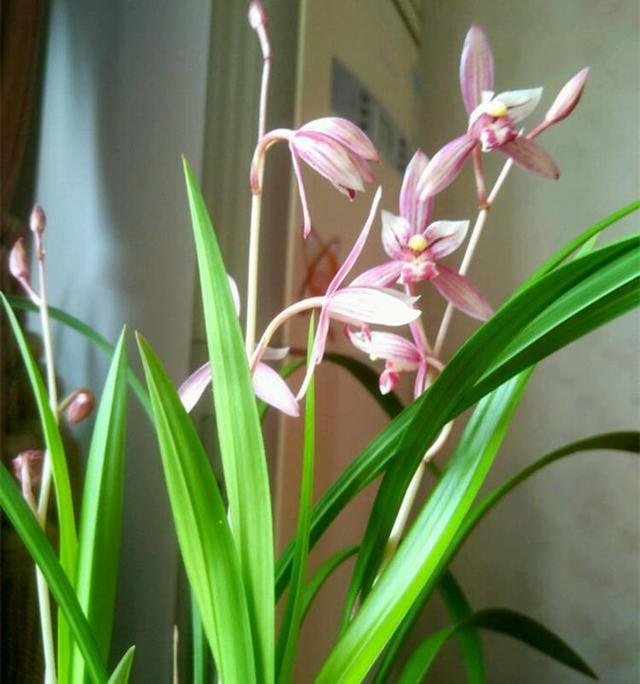
We have talked a lot before about the issue of watering orchids, and flower lovers all know that watering orchids has a bearing on whether orchids grow well or poorly. However, many flower lovers probably do not understand that when watering orchids, both the roots and the leaves need to be watered; only when the roots and leaves of the orchid are "well fed" can the flowering be profuse.
1. Feeding the roots well
Watering the roots of orchids means inserting a drip tube into the growing medium of each orchid pot and drip-irrigating into the orchid pot according to the moisture level of the medium. But the commonly used methods of supplying water to orchid roots are basically similar to the method of watering to settle the roots when potting up, namely the slow-pour-around-the-pot-rim method, the sprinkling method, and the soaking method. Flower lovers can use these three methods in combination.
(1) Slow-pour-around-the-pot-rim method
This means slowly pouring water along the edge of the pot with a watering can. The advantage of this method is that water will not get into the leaf crown; the disadvantage is that watering is slow, and it is hard to water thoroughly in one go, so you need to pour repeatedly several times to achieve the effect of watering thoroughly.
When fertilizing, you can use an organic liquid fertilizer specially made for orchids, diluted 500 times, and slowly pour it from the pot rim with a watering can, letting the fertilizer water slowly seep from the pot rim toward the center of the pot. When using this method, whether watering or fertilizing, you must water thoroughly, making the potting medium completely saturated, to prevent the potting medium from being uneven in tightness and uneven in moisture.
(2) Sprinkling method
This method means using a spray bottle or the shower head of a sprinkler to sprinkle water, wetting the entire orchid-growing environment, and it is most suitable for large-area open-air orchid nurseries. The advantage of this method is that it lets water seep from the soil surface to the orchid roots, moistening the orchid pot, and the water can soak through the entire orchid pot. The disadvantage is that water easily splashes into the leaf crown, so it must be used carefully, otherwise it will cause crown rot.
The water sprayed should be fine, and the amount should not be too much, with moistening as the standard. During the orchid's growing season, spraying can be done at the right time, but care should be taken not to let too many water droplets remain in the leaf sheaths and flower buds. Spraying should preferably be done in the morning and evening. If the temperature is especially high, you can spray the pot body and the surroundings, with the aim of lowering the temperature.
(3) Soaking method
This means soaking three-quarters of the orchid pot together with the growing medium into a water pool, large basin or bucket filled with water. However, when soaking, make sure the water surface does not go over the pot rim. At first the pot body absorbs water relatively quickly and the water level drops, so you need to patiently add water until the water level stabilizes, then soak for 2-4 hours. After taking the orchid pot out, it must be placed in a ventilated place to air for a while, and after the water droplets stop, put it back in its normal position.
3. Feeding the leaves well
Orchids have long lived in places with relatively high humidity, which has formed the physiological characteristic of leaves absorbing atomized water vapor. Especially for epiphytic orchids and orchids cultivated by aeroponics, even more attention should be paid to supplying water to the leaves. The commonly used methods of supplying water to the leaves are misting and humidifying.
Misting means using a sprayer to spray out fine mist that falls directly onto the orchid leaves, letting the orchid leaves absorb it into their bodies through the stomata. Humidifying means increasing air humidity; you can use a humidifier to spray mist, or set up a water reservoir or water basin under the orchid shelf to increase water evaporation.
The air humidity around orchids should normally be kept at about 75%. For open-air orchid nurseries, if tall trees with luxuriant branches and leaves are planted around the orchid pots and there is low vegetation on the ground, then in summer and autumn the air humidity around the orchid pots can basically reach the above humidity requirement.
When growing orchids on a balcony, the methods of increasing air humidity are similar to the cooling measures used in greenhouses. Common methods include building a water pool or water trough inside the balcony, placing water vats, buckets, basins and other water-holding containers on the balcony, and hanging cloth curtains or laying sponges and other water-retaining items, then pouring water on them to increase water evaporation.