These mini potted plants are especially suited to office desks and writing desks, healthy and easy on the eyes
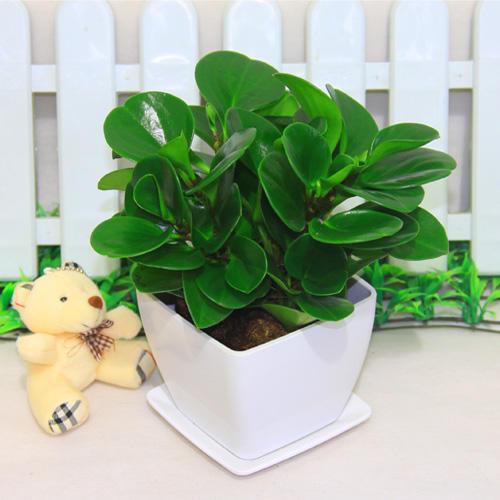
You do not have to grow large potted plants when growing flowers. Although large potted plants look nice, they take up a lot of space and are inconvenient to care for, so they are not suitable for placing on an office desk or writing desk. Some attractive mini potted plants are different: they take up little space and are easy to manage. Placing a few pots on a writing desk, office desk or coffee table makes them the perfect decoration.
1.Peperomia (Peperomia obtusifolia)
Peperomia is a perennial succulent clumping herbaceous plant. Grown in a small white plastic flower pot or a small porcelain flower pot and placed on a coffee table, writing desk or office desk, either standing upright or with its stems left to trail and hang down, it is very beautiful, fresh and pleasing to the eye.
Peperomia
Peperomia has a very noticeable air-purifying effect, especially in a space that has just been renovated, as it can absorb harmful gases very well. Peperomia also has a certain anti-radiation effect; it can quickly absorb the radiation emitted by mobile phones, computers and the like. Peperomia is known for its emerald-green leaves, so when your eyes are tired you can look at this little potted plant, and it can effectively relieve eye fatigue.
Peperomia
Caring for Peperomia is very simple; it can be grown in water or in soil. Generally, cutting off a section of stem and rooting it in a sand bed or culture solution is enough for it to take root and sprout. Peperomia has low nutrient requirements and basically needs no fertiliser. Over-fertilising will cause it to grow leggy and easily attract small insects, so it is recommended not to fertilise and simply water normally. Its sunlight requirements are not high either; indirect light is enough.
Peperomia
2.Air plant (Tillandsia)
Air plants are quite easy to keep alive. They do not need to be planted in soil or in water; simply misting the leaves is enough for healthy growth. During the day, air plants can absorb harmful gases such as formaldehyde and benzene, and at night they can absorb carbon dioxide and release oxygen, making them masters at purifying the air and beautifying the environment.
Air plant
Caring for air plants is very simple; you do not even need to buy a special container for them. Find a piece of wire and coil it into the shape you want, or use shells, discarded cups, bottles and so on to grow them.
Air plant
Air plants do not need soil; simply misting their leaf surfaces is enough for them to grow. In high summer temperatures they need to be misted once a day, but be careful not to let water accumulate, otherwise the leaves easily rot. When the temperature is lower, the frequency of misting can be appropriately reduced.
Air plant
Different varieties of air plants have somewhat different light requirements. Air plants with grey-white leaves need more sun, while varieties that tend to be green do not need too much sunlight; normal indoor indirect light is enough.
3.White flower tradescantia (Tradescantia fluminensis)
White flower tradescantia has attractive leaf colour, and especially its small white triangular flowers are very cute and charming. White flower tradescantia has extremely high ornamental value. It can also be grown as a hanging basket plant, placed on the top of a bookshelf and spread out, which is also extremely beautiful. White flower tradescantia can purify indoor air very well, and while pleasing the eye it can also create a good atmosphere for us.
White flower tradescantia
White flower tradescantia has relatively high light requirements. If sufficient light cannot be guaranteed, problems such as lodging, leggy growth, a short flowering period and flower drop easily occur.
White flower tradescantia
In the early stage of growth, white flower tradescantia has relatively high fertiliser requirements. A top dressing can be applied once every 15 days, and once the branches and vines have filled the flower pot, fertilising can be stopped.
White flower tradescantia
4.Parlour palm (Chamaedorea elegans)
Parlour palm, also called miniature bamboo palm or happy palm, is a fairly common and very popular mini desktop green plant. Its plant is short and cute, resembling a tropical coconut palm in appearance, beautiful and distinctive, and it is very shade-tolerant, so it is very suitable for placing on a desktop as an ornamental potted plant.
Parlour palm
Parlour palm likes semi-shade. Under strong light its leaves turn dry and yellow, while long-term insufficient light will cause deformed growth, so special attention needs to be paid to lighting.
Parlour palm
Parlour palm is a tropical plant and likes warmth; below 13°C it will enter a dormant period.
Parlour palm also has high water requirements. During the growing period it needs watering every morning and evening, and water can also be sprinkled on the leaves to maintain a certain humidity.
Parlour palm
Parlour palm can also be grown hydroponically; adding an inorganic fertiliser solution to clean water is enough for it to grow well.
5.Norfolk Island pine (Araucaria heterophylla)
Norfolk Island pine has a graceful form and lush branches and leaves, making it very suitable for growing in a small flower pot and placing on a desktop.
Norfolk Island pine
Norfolk Island pine likes warmth and humidity. Seedlings like shade and cannot be exposed to the sun, while mature plants need more sunlight. At noon when the sun is strong, shading is needed.
Norfolk Island pine
Norfolk Island pine is prized for being upright and straight, so appropriate pruning and shaping are necessary. When it is a seedling, a small upright stick can be used as a support to fix and support its shape; after it becomes a mature plant, the branches can be pruned according to your own preferences.
Norfolk Island pine
Norfolk Island pine has relatively low water and fertiliser requirements; normal fertilising and watering are enough to ensure its growth.