5 succulents that are easy to keep alive and beautiful when grown on the balcony in summer
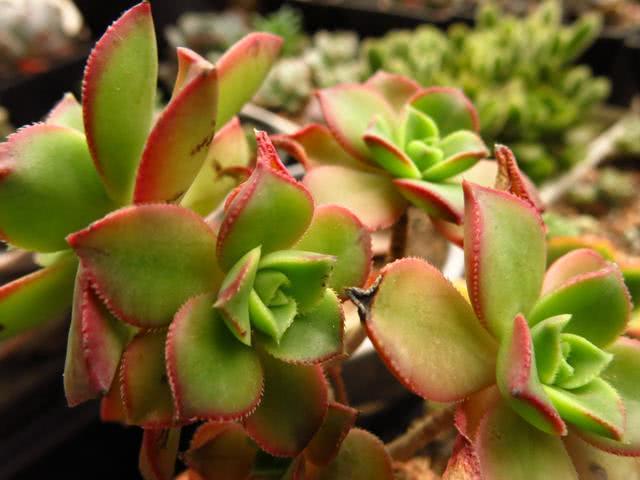
The following 5 succulents are very suitable for summer care and are not prone to root rot or black rot. The first is the succulent Aeonium decorum 'Sunburst', a perennial succulent herbaceous plant in the Crassulaceae family, Aeonium genus. It is a xerophyte, not cold-tolerant, and is also called a succulent plant. This plant needs to grow in a place with sufficient light. In summer, it can be kept out of direct sunlight, but it must not be too shaded; it needs enough light during the day to grow well. During the hot midday and early afternoon, we can place it in a shaded, ventilated spot for care, and it can receive sunlight at other times. In summer, good growth shows as a rich, deep green. In autumn and winter, with sufficient light, the leaf edges take on orange-red and peach-red tones, and the ornamental effect is also very good. The safe overwintering temperature is above 8°C.
The succulent Sedum rubrotinctum is a perennial succulent herbaceous plant in the Sedum genus. This is a succulent that does not need shading in summer care. The more it is exposed to blazing sun, the better it looks. Grown in partial shade, Sedum rubrotinctum has bright, emerald-green leaves; in a sunny spot, it becomes redder the more it is sunned, and the redder it is, the more beautiful. In particular, because of different angles of light exposure, the depth of its red varies, and sometimes red and green interlace, making the overall look full of beauty. Therefore, Sedum rubrotinctum is a succulent that is very suitable for growing in summer. Sedum rubrotinctum loves light, and it should receive full light throughout the growing period. However, sun exposure in summer can cause leaf sunburn, so it can be appropriately shaded or given half a day of sun, and direct blazing sun at noon should be avoided. Sedum rubrotinctum grows slowly and is drought-tolerant, so it should not be given heavy fertilizer or heavy watering. Water when the soil is dry and water thoroughly, while in winter when room temperature is lower, reduce the amount and frequency of watering.
Echeveria 'Chihuahuaensis' is a succulent that goes dormant in summer, and getting through summer is a bit difficult, so in summer special attention must be paid to ventilation and water control. It loves light and is not shade-tolerant; with insufficient light, the rosette easily becomes loose, the leaf color is paler, and it grows leggy. Under sufficient light, Echeveria 'Chihuahuaensis' looks like a closed lotus, the leaf color is bluer, the small red tips are obvious, and the leaf margins have a red blush. Echeveria 'Chihuahuaensis' grows at a moderate rate, and barring accidents, the lower leaves generally do not dry up, so the rosette can remain as neat as a lotus. During the spring and autumn growing seasons, Echeveria 'Chihuahuaensis' can be given enough water; when the soil mix is nearly dry, water thoroughly once. In the hot summer, pay attention to water control; when watering, give only a small amount, no need to water thoroughly. When watering, be careful to avoid water accumulating in the center of the rosette, as it easily causes sunscald and even rot. For watering time, you can choose the warmer period near noon in spring and winter, and the cooler period in the afternoon or evening in summer. For the soil mix, choose soil with good aeration and drainage, such as peat soil and granular soil mixed at a 1:1 ratio.
The succulent Echeveria glauca is also very suitable for summer care. It needs sufficient sunlight for the leaf color to be vivid and for the rosette to be more compact and attractive. With too little sunlight, the leaf color is pale, the leaves are loosely arranged and elongated, and the leaves become thinner. Echeveria glauca is a medium-to-large plant, and depending on its growth, it can be repotted once every 1-3 years; the pot diameter can be 1~2 cun larger than the plant diameter, which promotes plant growth. The medium must be dry before watering, and a slow-release fertilizer can be applied. Propagation uses beheading and offsets, and it can also be grown from seed. Beheading can be done all year round; Kite basically propagates by offsets. This succulent has no obvious dormancy period, and even in the high temperatures of summer it will not stay dormant for long. It is drought-tolerant, likes warmth, and likes light, and grows best in a well-ventilated place.
The succulent Sedum morganianum, also known as 'Jiuwan' and 'Wang Yuzhu Lian', is in the Crassulaceae family, Sedum genus, and has no obvious dormancy period. The flowers of Sedum morganianum are very distinctive. At first they are wrapped and protected by green leaves, and only when the leaves open are the flower buds revealed. The flowers are yellow and mostly open in spring and summer. The suitable growing temperature for Sedum morganianum is generally 18-25°C, and in winter it should not go below 5°C. For watering, just follow the principle of watering thoroughly when dry (it is very drought-tolerant, so water as little as possible). For soil, a succulent-specific mix is the most convenient, such as peat (sphagnum peat) plus gravel plus perlite. Sedum morganianum loves light and can take full sun. It is a very distinctive succulent, especially when it blooms in spring and summer, and it is also a succulent that many succulent enthusiasts like to grow.
The above are the ten succulents introduced to you by the Succulent Plant Gathering Place that are relatively easy and also quite popular to grow in summer. These succulents are not only beautiful plants, but also relatively heat-tolerant, drought-tolerant succulents with good environmental adaptability. Succulents are not very hard to grow, and they are very drought-tolerant plants. As long as we do not water randomly, keeping them alive is generally not difficult. If you want to grow them well, some experience is still needed. For example, the timing of succulent care, which succulents are suitable for summer growing, which succulents are suitable for winter growing, and so on.
This is the gathering place for succulent lovers, sharing succulent care tips. You are welcome to follow and exchange ideas.