Rose plants are known as "medicine jars," but black spot disease can be easily dealt with using these techniques
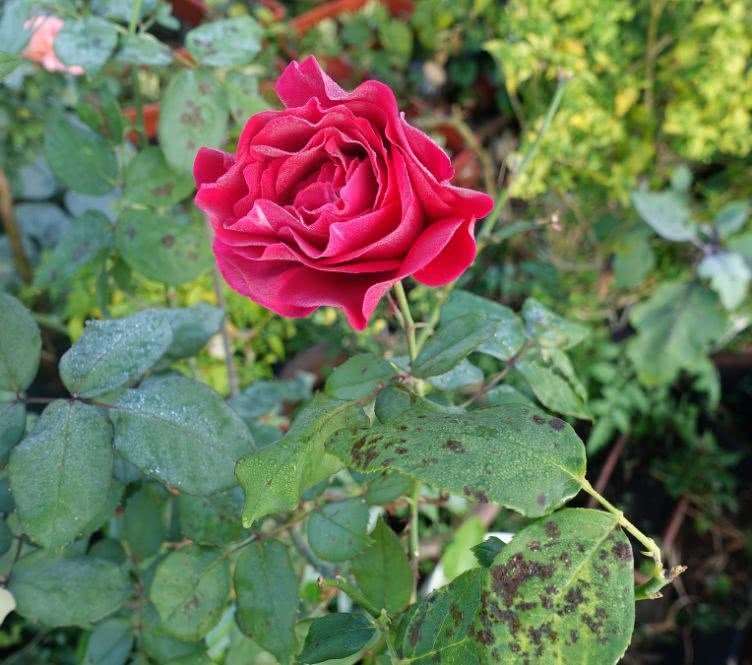
If you plan to grow roses on your balcony or in your yard at home, you need to be prepared to spray pesticides frequently. Roses have the nickname "medicine jar" because they are prone to fungal infections and easily attract pests. If not dealt with in time, the entire rose plant will suffer.
The fungal disease that roses are most prone to is black spot disease. It is particularly easy to trigger in summer, especially in seasons with high temperature and high humidity, making them especially susceptible to this fungal disease.
This situation is generally caused by overwatering or poor environmental ventilation. Of course, it may also be brought about by fungal spores carried in water. Solving this problem is not difficult, but you must deal with it in time, otherwise the disease will worsen and the entire plant will be damaged.
After being infected with black spot disease, black spots will appear on the leaves of roses, some of which are brown. Afterward, the spots will gradually expand, and the leaves will also show yellowing at the same time.
At this point, if you touch its leaves slightly, you will find that the leaves drop easily. If not dealt with in time, these spots can easily spread to the entire plant. If there are healthy plants nearby, they are also easily infected.
What you need to do at this point is promptly cut off diseased leaves and diseased branches. If there are withered branches nearby, they should also be cut off in time. In addition, pay attention to promptly cleaning up fallen leaves on the flowerpot or soil to avoid diseased leaves or diseased branches remaining on them. These diseased leaves and branches carry pathogens, and if not cleaned up thoroughly, they can easily cause secondary infection.
Improve the ventilation and light penetration of the environment. If there are crossing branches on the rose stems, or if there are overly dense branches and leaves growing at the base of the stems, these should all be cut off in time to maintain good ventilation and light penetration and minimize the breeding of fungal diseases.
The surrounding environment should also be kept clean. Another key point is to spray fungicide in time. The best is to spray chlorothalonil or Topsin, or a zineb solution can also be used. Generally, spray once every 5-7 days, and after about 3-4 consecutive sprays, black spot disease can be completely eliminated.
When gardeners grow roses, they must check them regularly and keep the environment suitable. The cultivation location should receive more than 6 hours of direct sunlight every day to maintain sufficient light. In addition, keep the environment well ventilated and well lit, and avoid growing them in enclosed spaces. When it is hot and stuffy in summer, potted roses need appropriate shading.
Roses are very afraid of excess water. The soil cannot remain constantly moist, let alone waterlogged. Before watering normally, check whether the soil has dried out. At night, do not pour water on the leaves, otherwise they are prone to black spot disease or other fungal diseases.
Roses still need the soil to maintain good drainage and avoid water accumulation in the soil. Be sure to wait until the soil is completely dry before watering. Also, pay attention to regularly applying fungicide.