Roe deer picture gallery: see what a roe deer looks like
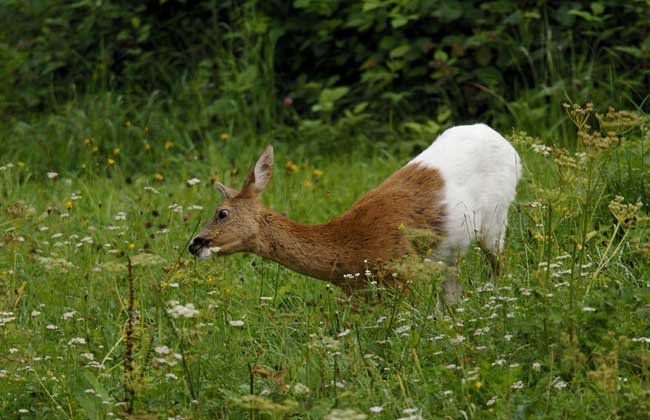
The roe deer is also known as the dwarf deer, wild sheep, roe, and roe deer, among other names. It is a herbivorous animal of the genus Capreolus in the subfamily Odocoileinae of the family Cervidae. It is one of the common wild animals in Northeast China and has relatively high economic value. It has been included in the "List of Terrestrial Wild Animals under State Protection That Are Beneficial or of Important Economic or Scientific Research Value." It is mainly distributed in Northeast China, Outer Northeast China, Siberia, Europe, and other places.
The roe deer has a body length of 100-140 cm, a tail length of only 2-3 cm, and a body weight of 50-80 kg. Males are slightly larger. The nose and muzzle are bare and hairless, the eyes are large, and there are infraorbital glands. The ears are short, broad, and round, and are covered with hair inside and out. The neck and limbs are both relatively long, and the hind limbs are slightly longer than the forelimbs. The hooves are narrow and long, and there are interdigital glands. The tail is very short and hidden within the body hair. Males have antlers. The antlers are short, with only three tines and no brow tine. The main beam splits into two branches about 9 cm from the base, with the front branch pointing upward, and the rear branch further dividing into two small branches, one pointing upward and one pointing backward and slightly inward. There is a ring of rough-surfaced nodules at the base of the antlers, and there are likewise many small nodules on the main beam.
The roe deer's winter coat is uniformly grayish-white to light brown. The muzzle is brown, the tip of the nose is black, the cheeks are yellow-brown, the base of the ears is yellow-brown, the back of the ears is gray-brown, the inside of the ears is pale yellow and nearly white, and the ear tips are black. The forehead, neck, and back are dark brown with a slight yellow-brown tinge, the lower jaw is pale yellow, the throat is gray-brown, the abdomen is pale yellow, and the outer sides of the limbs are sand-yellow. The inner sides are lighter, the tail is pale yellow, and there is a distinct white patch on the rump. The summer coat is short and thin. From the mouth to the tail and along the dorsal sides of the limbs, it is pure yellow-brown, darker near the dorsal midline, while the ventral surface from the chest and groin to the inner sides of the limbs is pale yellow.
Roe deer mostly inhabit open woodland zones and are often active in river valleys and on gentle slopes (generally at an altitude not exceeding 2400 m). They are timid by nature. During the day they mostly rest in dense forests, and only at dawn and dusk do they become active in open grasslands or shrub thickets. Their traces are widely distributed across the three northeastern provinces of China.