What are the effects and actions of pangolin scales?
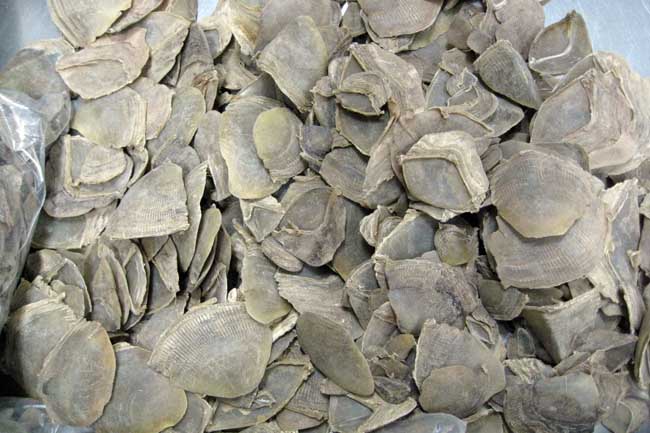
Pangolin scales are the scales of the pangolin, an animal of the Manidae family. They are mainly produced in Guangxi, Guangdong, Yunnan and Guizhou, and are also produced in Zhejiang, Fujian, Hunan, Anhui and other places. The scales from the tail have the strongest medicinal effect, and the product from Guangxi is considered the best. They can be captured throughout the year. After capture, the animal is killed and briefly scalded in boiling water, the scales are removed, washed, sun-dried and used raw. Alternatively, they are scalded with sand until they puff up, washed and dried. Or they are stir-fried and then quenched with vinegar before use, and crushed when needed.
[Medicinal properties]Salty, slightly cold. Enters the Liver and Stomach meridians.
[Actions]Invigorates blood and eliminates abdominal masses, unblocks menstruation, promotes lactation, reduces swelling and discharges pus.
[Applications]
1. Abdominal masses, amenorrhea. This product is good at moving and dispersing, and its nature is specifically to move and disperse. It can both invigorate blood and remove stasis, and eliminate masses and unblock menstruation. To treat abdominal masses, it can be combined with turtle shell, rhubarb, red peony root and other medicines, such as Chuanshanjia San (Complete Compendium of Gynecology). To treat amenorrhea due to blood stasis, it can be combined with angelica, safflower and peach kernel, such as Huayu Tang (Empirical Formula).
2. Wind-dampness arthralgia pain, apoplexy and paralysis. This product is good at moving and dispersing by nature, reaching the internal organs and unblocking the meridians externally. It has a strong ability to invigorate blood and remove stasis, and can unblock the meridians and penetrate the joints. To treat wind-dampness arthralgia pain, joint stiffness, numbness and contracture, it is often combined with chuanxiong, notopterygium, white-banded snake and other medicines. To treat apoplexy and paralysis with inability to raise the hands and feet, it can be combined with large aconite and other medicines, ground into powder and applied, such as Chenfeng Gao (Treatise on Three Categories of Pathogenic Factors and Formulas).
3. Failure of lactation after childbirth. This product invigorates blood and moves and disperses, and is especially good at unblocking menstruation and promoting lactation, making it an important medicine for treating failure of lactation after childbirth. It can be used alone, ground into powder and taken with wine, called Yongquan San (Compendium of Materia Medica). Clinically it is often used together with cowherb seed, akebia stem and astragalus, such as Shanjia Xiaru Tang (Zhongshan Medical College, Clinical Application of Chinese Materia Medica). If combined with astragalus, codonopsis, angelica, white peony and other products that tonify qi and blood, it can treat scanty milk due to deficiency of qi and blood. If combined with angelica, bupleurum, chuanxiong and others, it can treat failure of lactation and breast distension and pain caused by liver qi stagnation, such as Xiaru Yongquan San (Qing Imperial Medical Academy Formulas).
4. Carbuncle swelling and sore toxin, scrofula. This product can invigorate blood and eliminate carbuncles, reduce swelling and discharge pus. It can cause those without pus to disperse, and those with pus to rupture quickly, making it an important medicine for treating sores and ulcers with swelling and pain. At the early stage of sore and carbuncle, it is often combined with honeysuckle, trichosanthes root, Chinese honeylocust spine and others to clear heat and resolve toxin, invigorate blood and eliminate carbuncles, such as Xianfang Huoming Yin (Annotated Complete Effective Formulas for Women). To treat sore and carbuncle with pus formed but not yet ruptured, it is combined with yellow qi, angelica and Chinese honeylocust spine to support toxin and discharge pus, such as Tounong San (Orthodox Manual of External Medicine). To treat scrofula, it can be combined with prunella, fritillary and scrophularia to dissipate nodules and eliminate scrofula.
[Usage and dosage]Decocted for oral use, 3-10g. Ground into powder and swallowed, 1-1.5g each time.
[Precautions]Use with caution in pregnant women. Contraindicated in those whose carbuncle swelling has already ruptured.
[Modern research]
1. Chemical constituents: Contains stearic acid, cholesterol, tricosanoylbutylamine, two aliphatic amides with 26 and 29 carbon atoms, L-ser-L-tyr cyclic dipeptide and D-ser-L-tyr cyclic dipeptide, as well as volatile oil, water-soluble alkaloids, 18 elements, 16 amino acids and inorganic substances.
2. Pharmacological effects: The water decoction can significantly prolong clotting time in mice and rats and reduce blood viscosity. The water extract and alcohol precipitate preparation can directly dilate blood vessel walls, reduce peripheral resistance, and significantly increase femoral artery blood flow. The water extract and alcohol extract have anti-inflammatory effects, and the water extract also has effects against myocardial hypoxia and in elevating white blood cells.
3. Clinical research: Chuanshanjia San (stir-fried pangolin scales, vinegar-stir-fried zedoary, vinegar-stir-fried sparganium, vinegar-stir-fried trogopterus dung, vinegar rhubarb, musk, etc.) was used to treat 8 cases of ovarian tumors and achieved satisfactory results. A compound formula based on pangolin scales (pangolin scales 12g, ginseng 9g, dendrobium 12g, raw oyster 30g) combined with other Chinese medicines for expelling stones and relieving strangury was used to treat 29 case-times of urinary stones, with stones expelled in 13 cases, a stone expulsion rate of 65%. A powder called Longbi San made from pangolin scales and cinnamon in a 6:4 ratio was used to treat urinary retention, twice daily, 10g each time, taken with honey water, with 20 days as one course of treatment. A total of 45 cases of urinary retention (benign prostatic hyperplasia) were treated, with 29 cases cured in the short term, and an overall effective rate of 93.8%. In addition, pangolin scales can also be used clinically to treat idiopathic hematuria, postoperative bleeding, recurrent aphthous ulcers, acute mastitis and so on.
4. Adverse reactions: In isolated patients without an indication, self-administered prepared pangolin scales 15—20g caused abdominal distension and poor appetite a few minutes later, followed by yellow eyes, yellow body and abnormal liver function the next day.
[Summaries from ancient texts]
1. Compendium of Materia Medica: “Eliminates phlegm, malaria, cold and heat, wind arthralgia with rigidity and pain, unblocks the meridians, promotes milk, reduces carbuncle swelling, discharges pus and blood, unblocks the orifices and kills parasites.” “Pangolin scales were rarely used in ancient formulas. In recent times, for wind malaria, sores, and unblocking menstruation and promoting lactation, they have been used as an important medicine.„ „As the saying goes: ‘Pangolin scales and cowherb seed, once a woman eats them, her milk flows freely.’”
2. Materia Medica with Commentary: “Its nature is to move, and it can move stasis blood and unblock the meridians, therefore it also has uses in eliminating carbuncle toxin, discharging pus and blood, promoting lactation, harmonizing injuries, and promoting eruption of pox.”
3. Records of Chinese Medicine with Reference to Western Medicine: “Pangolin scales are bland in flavor and neutral in nature, fishy in odor and dispersing. Its dispersing nature reaches everywhere without exception, therefore it can free the internal organs, penetrate the meridians, and reach the joints and orifices. All diseases caused by blood congealing and gathering can be opened by it.