Pangolin Farming Techniques
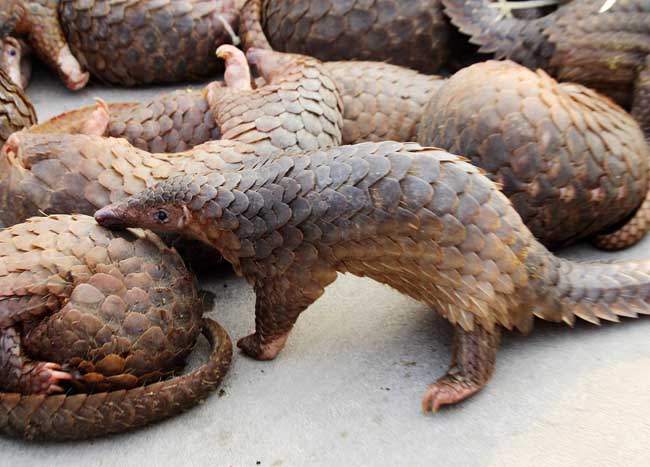
The pangolin is a medicinal animal of the class Mammalia, family Manidae, and a key protected wild animal in China. Also known as the scaly anteater or stone pangolin, it is distributed in the provinces south of the Yangtze River in China, including Anhui, Zhejiang, Fujian, Guangdong, Guangxi, Taiwan, China, Yunnan, Guizhou and Sichuan. In recent decades, China has exported pangolin scales every year, selling them to Hong Kong, China, Macao, China, Taiwan, China, Southeast Asia and other regions and countries. At present, artificial breeding of pangolins has been successful. Farming pangolins requires relatively little investment but yields handsome profits, and can earn the country a large amount of foreign exchange, making it a farming industry with great prospects.
Farming Value
Both the scales and the meat of the pangolin can be used medicinally. The scales are salty in taste and cool in nature. They have the effects of reducing swelling and draining abscesses, dispelling wind and activating collaterals, and promoting menstruation and lactation. They are mainly used to treat carbuncles, sores and swellings, wind-cold-dampness arthralgia, amenorrhea, insufficient lactation and other conditions. Its meat is sweet and astringent in taste and warm in nature. It has the effects of killing parasites, promoting blood circulation, and resolving hard masses and dispersing stasis, and is mainly used to treat arthralgia, amenorrhea and other conditions. Its blood is a specific remedy for gastric and duodenal ulcers.
In addition, pangolin meat is edible; the meat is fine and delicious, making it a delicacy at banquets.
Living Habits
The pangolin has a long, narrow body, 50—100 cm in length, and weighs about 3—6 kg. The head is small and conical. The eyes are small, the snout is pointed, and it has no teeth. The tongue is slender and worm-like. The ears are small. The tail is 10—30 cm long, flat, slightly raised on the dorsal side, and thick at the base. The limbs are thick and short, with the forelimbs longer than the hindlimbs. Each foot has 5 toes with strong claws; the claws of the forefeet are longer than those of the hind feet, and the claws of the middle 3 toes of the forefeet are especially long. The scales are a striking feature: from the head, back and sides of the body to the tail, it is covered with imbricate keratinous scales, dark brown or grayish brown in color. On the cheeks, around the eyes and ears, on the chest and abdomen, on the outer sides of the limbs and at the base of the tail, there are sparse long bristles in white and brownish yellow, with very little down. The female has 2 pairs of teats on the chest.
The pangolin lives in tropical and subtropical regions, dwelling in moist areas of mixed woods in foothills, hills or plains, and especially favors earthy hills and muddy ground mixed with small stones. It digs burrows to live in, often building them in muddy ground, with burrows 2—4 m deep and a nest at the end. It usually hides in the burrow by day and comes out to move about at night. When walking, the back of the forefoot rests on the ground, and it walks on the backs of its claws. It can climb trees, often using its tail as a grasping organ. Its eyesight is relatively weak, and when frightened by an enemy it rolls into a ball, using its scales to protect its head and abdomen, which makes it very easy to catch. The pangolin mainly eats small insects such as termites, ants and bees. When foraging, it first uses the long claws of its forefeet to break open part of the nest, then inserts its snout into the ant hole and licks up the ants with its sticky, highly extensible tongue.
Pangolins usually live as male and female together, mate in April—May, give birth in December or January, reproduce once a year, and have 1–2 young per litter.
Farming Conditions
The farm should be warm in winter and cool in summer, with an optimal temperature of 16°C to 32°C. In the high-temperature summer season, pay attention to shading and cooling, and in winter provide timely cold protection and warmth. Depending on the situation, farming methods such as pond type, closed type, burrow type and wooden box type can be selected.
1. Pond-type farming: Build multiple brick or stone ponds of 20 to 40 sq m and 50 cm high in a quiet part of the courtyard, rectangular or square in shape. The bottom and walls of the pond should be plastered with cement to make them firm and smooth so as to prevent pangolins from escaping. Inside the pond, build several pangolin burrows with stones, pile a large amount of soil on top of them, and keep each burrow separated and not connected to the others. Leave a 5 to 10 sq m activity area in the center of the pond, pile a large amount of soil on it and plant weeds and small trees to create a good activity area. Plant a large number of trees around the site for shade. In the summer rainy season, there should be something for rain shelter, and a special drainage channel should be left to prevent rainwater from soaking the burrows.
2. Closed-type farming: Composed of an indoor small house of 2 to 4 sq m and an outdoor activity area of 4 to 6 sq m. Both indoors and outdoors have cement floors. Indoors there are burrows for pangolins to hide and rest in. The activity area is surrounded by walls or wire netting, and the top of the cage is enclosed with wire netting. Each cage can house 2 to 4 pangolins.
3. Burrow-type farming: The area can be 20 to 50 sq m, surrounded by walls. The walls should be hard and smooth, about 2 m high, with sandy muddy ground, artificial burrows, and a natural living environment such as rockeries and grass clumps. More than 10 pangolins can be kept.
4. Wooden box cage housing: Make 1 rectangular wooden board box. The size of the wooden box should preferably exceed 2 times the body length of the pangolins to be raised. It is divided into inner and outer rooms, connected by a round hole, for the animals to freely enter and leave for activity and rest.
Breeding Techniques
The natural pairing of pangolins is generally 1 male to multiple females. When raising them, it is advisable to mainly use 1 male to 3—4 females. When selecting them for raising, sex identification can be carried out first: females have two pairs of teats on the chest, while males do not. Artificially farmed pangolins can reproduce throughout the year, but most actively in spring and summer. They produce at least two litters a year, with 1—2 young per litter, and can still conceive during the nursing period.
Newborn young have white skin and no scales. They rely on mother's milk for rearing and have poor self-defense ability, so they should be prevented from crawling out of the burrow. At 1 month of age, the young weigh about 200—250 g, and their scales gradually become keratinized and turn dark brown. At 2 months of age, they can go out with the mother to forage. After 6 months of age, when they reach a body weight of about 2 kg, they begin to live independently. Pangolins raised for 1 year can then be sold.
Daily Management
1. Pangolins that have just arrived at the farm generally refuse food. At this time, the method of forced feeding should be used. Sometimes they will eat after only 2-3 days of forced feeding, and sometimes it takes as long as 7-10 days before they will eat. Forced-feeding foods include glucose water, salt water, pig liver (which should be crushed) soup, stream fish (which should be crushed), egg (which should be beaten) soup, etc., changed at the appropriate time each day.
2. Forced feeding and fattening of pangolins, and commercial pangolins awaiting sale, can all be raised in cages. The cage-raising method is 1 pangolin per cage, with forced feeding 1-2 times a day. After one month, place the bait in the cage and let them eat freely. The bait should be fresh and tasty, and should not be too salty. A water trough should be set in the cage.
3. Appropriately add to the feed: ① various vitamins, ② trace elements such as zinc, iron, manganese, selenium, etc., ③ fragrant feeding attractants and Chinese herbs for inducing estrus, etc. These can increase appetite and speed up growth and reproduction.
4. Normally, the amount of feed provided can be increased day by day as long as the feed put in is finished.
5. Pay attention to diversifying the feed, and change the feed at the appropriate time.
6. During the breeding process, prevent prolonged noise from the outside, prevent escape, and keep flowing water in the water pool.