What Do Pangolins Eat? A Comprehensive Analysis of Their Main Diet
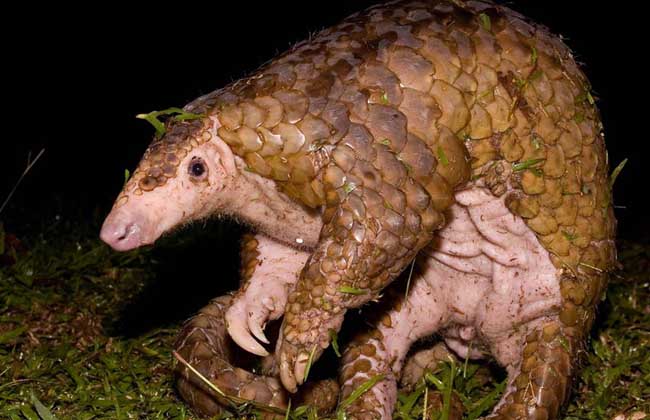
The pangolin is the collective name for the genus Manis in the family Manidae, also known as the scaly anteater, lingli, longli, shilingyu, and others. It is a ground-dwelling mammal that mostly lives in subtropical deciduous forests. During the day it often hides in burrows and plugs them with earth, and at night it mostly comes out to forage. It is nocturnal, and when it encounters an enemy it curls up into a ball. Let us take a look below at what pangolins eat!
What Do Pangolins Eat?
Its main food is termites. In addition, it also eats ants and their larvae, bees, wasps, and the larvae of other insects. It has a very large appetite: the stomach of one adult pangolin can hold up to 500 grams of termites. According to scientists' observations, in 250 mu of forest land, as long as there is one adult pangolin, termites will not cause harm to the forest. This shows that pangolins play a great role in protecting forests and embankments and in maintaining ecological balance and human health.
The Distribution Range of Pangolins
Pangolins are mainly distributed in various parts of Africa and Asia. In China they are mainly distributed in Hunan, Jiangsu, Zhejiang, Anhui, Jiangxi, Guizhou, Sichuan, Yunnan, Fujian, Guangdong, Guangxi, Hainan, and in the mountainous areas of Taiwan, China from the foothills at low and medium elevations up to about 1000 m above sea level.
The Living Habits of Pangolins
1. Burrow building: Pangolins usually live alone in caves, and only live in pairs during the breeding season. Adapted to cave life, pangolins have a habit of loving cleanliness, and the structure of the cave is also very particular, often varying with the seasons and food. There are generally two main forms: one is the one lived in during summer, called a summer cave, and the other is the one lived in during winter, called a winter cave.
2. Activity: Pangolins mostly dig burrows and live in the grass of foothill areas or in the relatively damp places of hilly mixed thickets. They hide by day and come out at night, and when they encounter an enemy they curl up into a ball. The hard shell makes it difficult for fierce beasts to bite it apart or swallow it. The outer shell of the pangolin is composed of an organic skeletal structure called keratin, accounting for about 20% of the pangolin's total body weight.
3. Reproduction: The pangolin is a viviparous animal. Its estrus and mating period is mainly from April to May. During the estrus period the male and female live together, and after mating they separate. The birthing period is from December to January of the following year, and the gestation period is about 5-6 months. Male pangolins remain in estrus for a relatively long time; males are in estrus continuously during the estrus period and do not show periodicity. Females have 2-5 estrous cycles during the estrus period, and the estrous cycle is 12-25 days. After the female conceives, she no longer goes into estrus. During the estrus period the male searches everywhere for the female. During the estrus and mating period the male and female live together, and after mating they separate. There is 1 litter per year, and under artificial breeding conditions, 3 litters can be produced in 2 years.