What are the living habits of pangolins? A comprehensive guide in one article
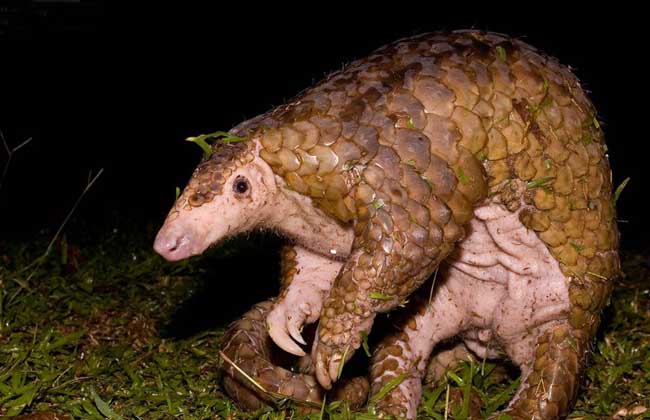
The pangolin is also known as the scaly anteater, lingli, longli, shilingyu, and so on. It mostly lives in subtropical deciduous forests, often hides in burrows during the day and blocks them with soil, and mostly comes out at night to forage. It is nocturnal, and when encountering enemies it curls up into a ball. Its numbers in the wild are scarce, and private hunting and eating are prohibited in China. Now let us take a look at the living habits of pangolins!
The feeding habits of pangolins
The pangolin's main food is termites. In addition, it also eats ants and their larvae, bees, wasps, and other insect larvae. It has a very large appetite; the stomach of one adult pangolin can hold up to 500 grams of termites. According to scientists' observations, in 250 mu of woodland, as long as there is one adult pangolin, termites will not cause harm to the forest. This shows that pangolins play a great role in protecting forests and embankments and in maintaining ecological balance and human health.
The reproductive habits of pangolins
The pangolin is a viviparous animal. Its estrus and mating period is mainly from April to May. During estrus, males and females live together, and after mating they separate. The birthing period is from December to January of the following year. The gestation period is about 5-6 months. Male pangolins remain in estrus for a longer time; males are in estrus continuously and do not show periodicity, while females have 2-5 estrous cycles during the estrous period, with an estrous cycle of 12-25 days. After a female becomes pregnant, she no longer goes into estrus. During the estrous and mating period, males roam everywhere searching for females. During the estrous and mating period, males and females live together, and after mating they separate. There is 1 litter per year. Under artificial rearing conditions, 3 litters can be produced in 2 years.
The burrowing habits of pangolins
1. Summer burrow: The one lived in during summer is called a summer burrow. It is built on a well-ventilated, cool hillside at relatively high elevation to prevent rainwater from flowing in. The tunnel inside the burrow is relatively short, about 30 cm or so, and the internal structure is relatively simple.
2. Winter burrow: The one lived in during winter is called a winter burrow. It is built in a place sheltered from the wind and facing the sun, at relatively low elevation, with a vertical height of more than 4 m from the ground. The internal structure of the burrow is relatively complex, with winding tunnels shaped like a gourd. At intervals there is also an earthen wall piled up with soil, and the length can reach more than 10 m. It also passes through two or three termite nests, which become its winter “granary”. At the end of the burrow there is a relatively spacious recess, lined with fine, soft weeds to keep warm. This is its “bedroom” for overwintering and is also used as a “nursery”.