Bougainvillea: Master this method and it will bloom profusely all year round
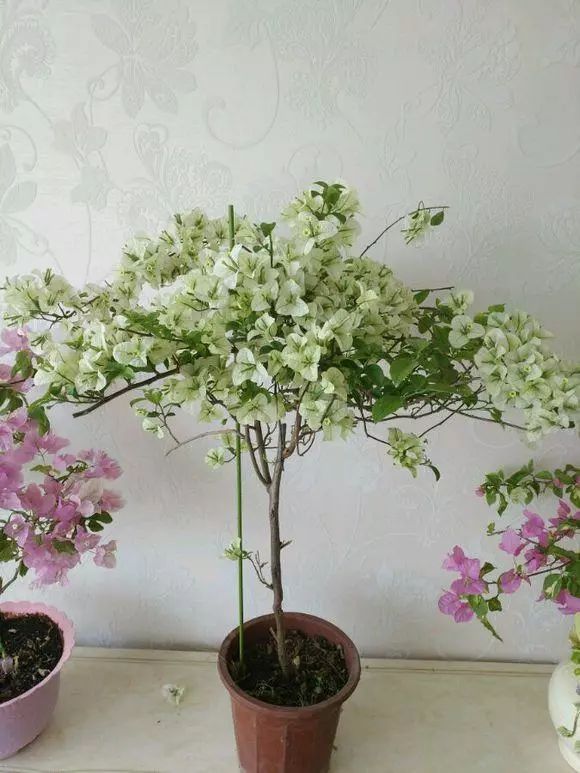
Bougainvillea stands out among potted plants for its unique flower shapes and delicate fragrance. Bougainvillea, also known as paperflower, is native to Brazil and is cultivated throughout China. It is a flowering plant that has only recently become popular in recent years.
Bougainvillea loves warm, sunny environments. The flowers grow at the tips of new shoots, usually in clusters of 3 within 3 larger bracts, with the flower stalk fused to the midrib of the bract. The bracts are leaf-like, oval, and bright red, with varieties also available in white, brick red, and orange.
Bougainvillea blooms continuously from June to December, and some varieties can even bloom year-round. Especially in northern winters, as long as the temperature is suitable, it will bloom. It is a festive and beloved winter flowering plant.
Bougainvillea is very common in the south, often used as greening material for trellises and hedges. Bougainvillea is quite hardy and resilient; in the south it needs little management and can bloom across walls, courtyards, and even entire cities. In the north it is mostly grown as a potted ornamental, and affected by climate and temperature, it requires strengthened management and care.
To make potted bougainvillea bloom frequently and for long periods, and to bloom on schedule according to one's needs, water control to promote flowering is the simplest method.
Water control generally takes three weeks, and from bud formation to full bloom also takes about 20 days. Based on the calculated flowering time, start water control 40 days in advance. If you want bougainvillea to bloom in October, start water control at the end of August.
Bougainvillea after water control
The water control method is very simple. Depending on the size of the pot, do not water during the water control stage. Wait until the leaves wilt from lack of water for one or two days, then water with half the usual amount, or sprinkle some water. Then wait until the leaves perk up, and repeat the previous step. Repeat this cycle for about two to three weeks. The purpose of water control is to make the bougainvillea's leaves wilt, preventing it from sprouting new leaves, so that all the plant's nutrients are supplied to the old leaves, promoting branch maturation and flower bud differentiation. Note that you should not fertilize during water control; in a drought state, fertilizer absorption is poor and can damage the roots. Also, water control should be moderate; just wilting the leaves is enough. Never over-control water to the point of killing the plant.
For flower lovers, bougainvillea water control is a technical issue and even more a test of psychological endurance. At this time, the entire bougainvillea plant wilts, leaves droop, looks listless and lacking vitality, appearing as if dried up and dead, and looks very unattractive. So for those who love bougainvillea, you must be ruthless and willing to make sacrifices, and remember that only this way can the flowers bloom according to your expectations. When the bougainvillea blooms in full glory as scheduled, that sense of achievement and joy is unmatched by anything else.
After three weeks of water control, water thoroughly, then loosen the soil and cut the roots, and apply fertilizer three times, usually once a week, twice before flowering, and once more at full bloom, to promote flower bud emergence. During flowering, to control the inflorescence from growing too long, keep the flowers concentrated and the plant compact, and when resuming watering, use paclobutrazol once at a concentration of 2 in 10,000.
Because bougainvillea has a long flowering period and consumes a lot of nutrients, plus the limited pot soil, you must pay attention to fertilizer application. When repotting in spring, apply sufficient base fertilizer, and after bringing it outdoors in winter, apply nitrogen fertilizer. During the vigorous growth period, apply decomposed cake fertilizer water every 7 days to accelerate flower bud differentiation. When flower buds appear at the leaf axils, you can apply more fertilizer and heavier fertilizer, mainly phosphorus and potassium fertilizer. During flowering, control water and fertilizer use to ensure the flowers can stay open for a long time. Between each flowering and after flowering, apply heavy fertilizer and heavy water, using fertilizer instead of water.
In addition, to grow bougainvillea well, you must ensure long sunshine hours and strong light. If there are 10 to 12 hours of sunlight per day, with strong light and good ventilation, the flowering period can even reach 180 to 200 days. Potted bougainvillea also requires attention to pruning. When pruning bougainvillea, grasp the principle of "short, heavy, sparse," that is, short-cut horizontal branches and heavily prune new branches. Thin out dense branches and weak branches. It is best to prune twice a year, the first time before sprouting in March to April, and the second time before new branch growth after flowers fade in November to December, to ensure vigorous blooming year after year.
As long as you follow the above methods well, making bougainvillea bloom continuously all year round will not just be a beautiful idea. Take action now; bougainvillea is in full bloom right now. If your bougainvillea shows no sign of blooming yet, why not try water control, pruning, and moving it to a sunny spot!
For more tips, please follow Tips Sister!
??????????END??????????
Thank you all for reading, and thank you to my followers for your attention.
If you think the article is good, share it with your friends too.
Don't forget to give mea likeoh
Reply with "e-book" to get a professional flower-growing e-book!
Follow on WeChat [Yangzhiriji】JiumeiTeaches you to grow flowers
Reply: plant name (such asmoney tree): to view cultivation methods