Want your pothos to grow into a big column? You can't do it without pruning
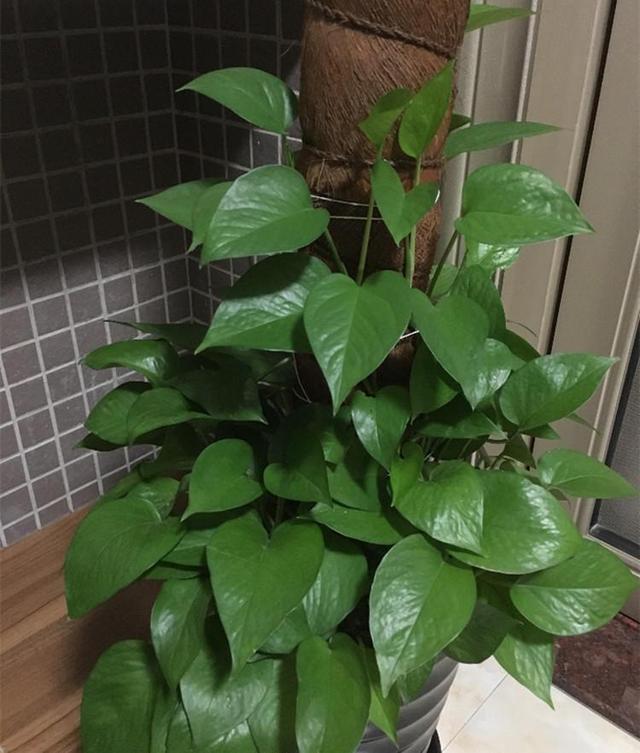
Pothos is a very elegant foliage plant, and many gardening enthusiasts love growing it. But the pothos they grow always has small leaves and a weak, spindly plant that just won't grow. What's going on? In fact, if pothos is never pruned for a long time, it simply won't grow into a "big column," so only by learning to prune pothos can it grow strong.
For potted pothos, plant or insert 4~5 cuttings directly per pot, and set up a moss pole in the middle of the pot so the pothos can twine upward as it grows. Shaping and pruning are done in spring. When the pothos vines have covered the moss pole and the tips extend about 20 cm beyond the moss pole, cut 40 cm off the stem tips of 2-3 of the plants. After new buds and new leaves sprout from the cut-back stems, cut the stem tips of the remaining plants.
In addition, for potted plants whose pothos has lost all its leaves or the leaves on its lower half due to winter cold damage or other reasons, gardening enthusiasts can cut back half of the plant's vines by 1/2 and the other half of the vines by 2/3 or 3/4, so that the cut points are staggered at different heights. This way, the new leaves growing below the cuts will quickly grow strong and fast, covering the moss pole.
Once the pothos has been pruned, the next step is normal care and management, and gardening enthusiasts should also master the techniques well:
1. For planting pothos, plant and repot with fresh soil in spring, or insert cuttings directly into pots during the growing season, planting 4~5 per pot. For the potting soil, choose a mix of leaf mold, garden soil and river sand. Young plants should be repotted once a year, and mature plants once every 2~3 years. After planting, water thoroughly once and keep in a shaded spot for care; once growth resumes, move to a spot with dappled shade for normal management.
2. For potted pothos, ensure a steady water supply during the growing season and keep the potting soil consistently moist. Especially in summer, the peak growing season, when temperatures are high, water once a day and keep the potting soil consistently moist. If the weather is dry and the air is dry, also regularly spray water on the leaves, the moss pole and the surrounding ground to raise air humidity and wash dust off the leaves; generally keep air humidity above 70%.
In addition, fertilize during the growing season, generally applying a dilute liquid fertilizer specially formulated for pothos 2-3 times a month. If fertilizing is timely and sufficient, the leaves can become large and thick, and the leaf color deep green and glossy. If fertility is insufficient, the internodes become long and thin, and the leaves become small and thin, losing their gloss, which reduces their ornamental value.
3. The suitable growing temperature for pothos is 15~25°C. In winter it should be moved into a greenhouse; for households with heating, it can be placed in a sunny spot indoors, and it can still grow normally if the temperature is kept above 15°C, but the lowest temperature must not fall below 10°C, otherwise yellowing and leaf drop easily occur. In summer, when sunlight is intense, shade is essential; place it under a shade frame or in a spot with dappled shade under a large tree to avoid direct strong sunlight.
Pothos can be grown indoors for viewing year-round, but it should be placed in a bright spot indoors. If it is left in a dark place for too long, the leaves become smaller, the internodes lengthen, and growth becomes weak; the leaf color patterns of some varieties will gradually fade, become lighter, or even disappear completely, reducing their ornamental value. Therefore, after placing it in a dark spot for 20~30 days, it should be moved to a bright spot for care for a period; by rotating it this way, it can always keep its variety's original characteristics.