How to rescue a succulent that has developed black rot after being rained on for several days in a row?
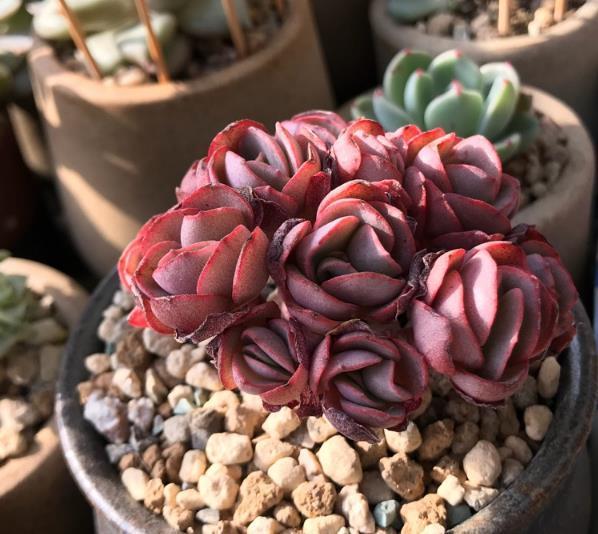
Giving succulents several days of rain in summer takes real courage. Summer brings high temperatures along with dampness, and succulents themselves need to be kept on the dry side. Even succulents grown outdoors will do anything to avoid this kind of rain, so black rot is only to be expected. As for whether a succulent with black rot can still be saved, it first depends on the extent and the location of the black rot. Mild black rot can still be dug up, have its roots trimmed, and be re-propagated; with severe black rot, you can only wait to collect the pot. Summer is the peak season for succulent black rot. Succulent black rot is caused by a fungus called Fusarium oxysporum; professionally it is known as Fusarium wilt. The pathogen is Fusarium oxysporum, a fungus of the subdivision Deuteromycotina, which specifically causes vascular bundle diseases in ornamental plants. The main symptoms are root rot, stem rot, stem base rot, flower rot, and so on.
Causes of black rot in succulents: black rot caused by parasites. Some insects, such as mealybugs, can also cause black rot/decay, especially root mealybugs. The wounds these pests create when they suck plant sap can lead to fungal infection. Black rot caused by exposure to strong sun after watering. This is the most intuitive cause of most black rot, and it often occurs in late spring and in summer and autumn. When the temperature is too high, the potting soil turns into a hot pot after watering, and if ventilation is poor and the temperature cannot be brought down in time, the black rot pathogen will seize the opportunity. Physical wounds can also cause black rot in succulents. If wounds caused by repotting or by pulling leaves off for leaf propagation have not healed properly, plus dampness encourages black rot fungi to multiply, black rot occurs.
Black rot is always acute and develops very quickly. Either the stem turns completely black and the leaves drop all over the place (a typical example is the succulent Paeoniaceae, or Pachyphytum 'Pale Beauty'), or the whole plant turns to mush and dies, too fast even for leaf propagation. So when you find black rot on a succulent, you must deal with it immediately, without hesitation, and behead it decisively. Once a succulent has black rot, we should start by checking the moisture of the potting soil. If you discover it right after watering, pull the plant out at once and behead it if the case is severe; otherwise, within the next few hours Fusarium will travel through the whole succulent along with the water you poured in, and by then it will be too late and the entire plant will die.
After discovering black rot on a succulent, cut away all the black rot-affected parts cleanly at the first opportunity, then apply carbendazim to the remaining part and let the wound dry in a ventilated place without direct sunlight, and then either do leaf propagation or plant it out as appropriate. For leaf propagation, choose leaves free of pathogen infection and keep them separate from the leaf-propagation leaves of other succulents, to prevent leaves carrying black rot pathogens from infecting more plants. Planting out must involve disinfection. In addition, succulents growing close to the black-rotted one should also be disinfected to prevent the black rot from spreading. Note: before and after cutting, wash and disinfect your hands, and disinfect the knife and scissors too, to eliminate any transmission.
What should you do about succulent black rot? What should you apply after beheading? When beheading for black rot, you must cut down to a position where the stem is not infected, otherwise it will keep spreading upward. After beheading, apply some carbendazim to the cut surface; if you do not have any, you can apply cigarette ash, then let it dry for two days before taking cuttings. If half of the succulent's stem has already turned black, and the cause of the black rot was a sudden drop in temperature and leaves turning to mush that were not dealt with in time, so the mushy leaves infected the stem and caused the stem to turn to mush, then when you see leaves turning to mush you need to clean them off from the growth point in time and not just hope for the best.
It is best not to rashly water with a carbendazim solution in an attempt to cure black rot; at this point, taking up water can only cause the black rot to spread even faster. Drenching the roots with carbendazim is generally used to treat fungal infections on leaf surfaces; once black rot has already occurred, its curative effect is not good, and at this point digging the plant out to check the roots and beheading it is the correct approach. When a succulent shows symptoms suspected of black rot, such as dropping leaves or leaves turning to mush for no reason, if the potting soil is completely dry, you can keep observing. If the potting soil is damp, you should resolutely dig the plant out, cut off the water supply from the roots, and stop the black rot from spreading further.
This is a gathering place for succulent lovers, sharing succulent care tips. You are welcome to follow and join the conversation.