Succulents growing slowly? Choose to repot for better growth and faster rooting
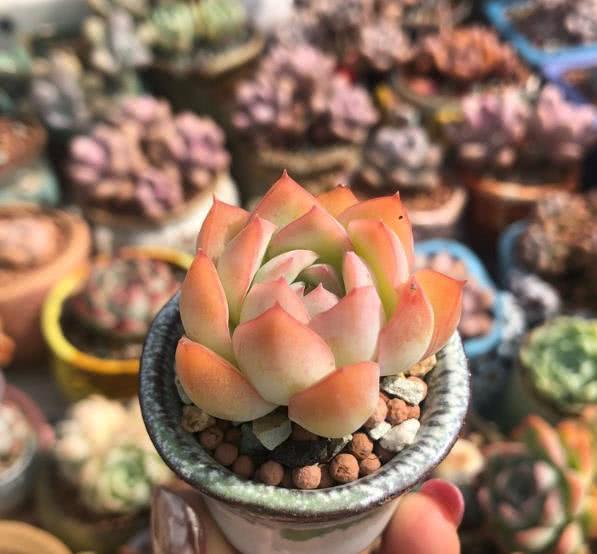
Succulent growth becomes slow or stops altogether, roots poke out of the drainage holes at the bottom of the pot, when loosening the soil the plant's roots clearly get in the way of the loosening tool, and water dries up quickly after watering - these signs indicate that the pot is too small, affecting the normal growth of the succulent. The soil has become compacted and its air permeability has worsened; when watering, water does not penetrate easily and tends to overflow, which indicates the soil has deteriorated and the plant should be repotted. The most suitable time for repotting is during April and May, when the weather is warmer in early spring, or in autumn.
Do succulents need root trimming when repotting? If a succulent is repotted because of poor growth, then root trimming must be done. With some old plants, the roots at the base have completely died off. Take Aeonium arboreum 'Zwartkop' (Black Aeonium) as an example: after summer dormancy, the roots at the base sometimes all die off completely. At the base where roots grow, shaving off part of the epidermis can stimulate root growth. The last case is repotting at an unsuitable time, such as summer: if the succulent is in normal condition, you can consider keeping its root system and medium as intact as possible and moving it into a new pot. If the base has root rot or the stem is rotting, then it is necessary to carry out a complete root-trimming procedure.
You can remove the soil stuck to the roots. Use your hands to shake off the soil clinging to the roots; this soil is all old soil with no nutrients, so throw it away. After removing the soil, you will find that it actually had so many roots. Use scissors or similar to cut the roots shorter so they look cleaner and neater. Add large-grain akadama soil, roughly to about one-third the height of the pot, which allows drainage to be smoother. Then put in a layer of potting soil, with just enough to cover the akadama below, and finally add a small pinch of fertilizer.
Fertilizer can be added or not; succulents do not need much fertilizer. If it really bothers you, you can apply a little fertilizer. Choose a fertilizer high in phosphorus and potassium and low in nitrogen. For convenience, just buy some granular slow-release fertilizer and sprinkle it on the potting soil, or mix it into the soil. It is not compound fertilizer; slow-release fertilizer generally does not burn roots, while compound fertilizer will burn roots. Fertilizer should be dilute rather than concentrated; it is best to use it below the labeled concentration. As for chemicals, if potting is well controlled, generally no fungicide is needed; just buy some insecticide for prevention, or wait until pests appear and then buy it. I will not go into detail here, as there is too much content; we can talk about it when pests appear.
Newly purchased succulents are best bought without soil, which has several advantages: you can observe whether the roots are good or bad; prevent the introduction of soil-borne pests and diseases; provide your own growing medium; and it is convenient for transport, etc. It is best not to buy finely finished potted ornamental succulents, because not all planting media are correct, the pot is too expensive and inconvenient, and the plant's appearance is generally not good either. Also do not let the shop owner pot it for you and then take it home, because the damaged roots of plants potted this way have not been dried, and planting them directly, plus the bumps of transport on the way, makes them very prone to rot and death.
The type of pot depends on your own preference, but the size must be suitable. In principle, a pot whose diameter is about 2-3 cm larger than the diameter of the succulent is enough. For tree-shaped succulents, the pot diameter only needs to be 5-6 cm larger than the diameter of the root-stem part. The larger it is, the harder it is to grow, unless it is a common variety that just will not die. At the bottom of the pot, it is best to first lay some large-grained stones, or tear foam board into small pieces and put them in. If the pot hole is relatively large and you are worried about soil leaking out, lay a piece of window screen mesh over the hole, then add soil.
This is a gathering place for succulent lovers, sharing succulent care tips. Welcome to follow and exchange ideas.