Prevent chrysanthemum powdery mildew early, and only after the Start of Autumn can a hundred flowers be killed
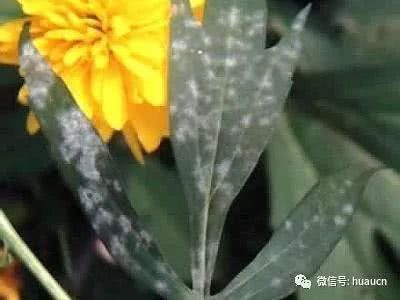
Chrysanthemum powdery mildew is one of the common diseases of flowers, and it is distributed in both southern and northern China. Chrysanthemum powdery mildew can cause poor plant growth, dead leaves, and even failure to bloom, seriously affecting greening, beautification effects and flower production. Chrysanthemum powdery mildew mainly harms cineraria, pot marigold, coneflower, African daisy, cosmos, China aster, dahlia, zinnia, rose, Chinese rose, garden balsam, verbena, okra, poinsettia, hollyhock, phlox, begonia, wisteria, etc.
Chrysanthemum: Four methods to prevent leaf drop and yellowing in chrysanthemums
Damage symptoms
In the early stage of chrysanthemum powdery mildew infection, yellow translucent small powdery spots appear on the leaves, mostly on the upper surface. It mainly harms the leaves, and leaf stalks and young tender stems and leaves are more easily infected. When temperature and humidity are suitable, the lesions can expand rapidly and connect into large areas of white powdery spots or gray powdery mold layers. In severe cases, the affected leaves lose green color, turn yellow, tender shoots curl, become deformed and age prematurely, stems bend, new shoots stop growing, flowers are few and small, plants become dwarfed and sterile or fail to bloom, and even death occurs.
Pathogen and occurrence pattern
The pathogen causing powdery mildew belongs to the powdery mildew fungi, specifically Oidium chrysanthemi, whose sexual stage is Erysiphe cichoracearum. Generally, the pathogen overwinters in diseased plant residues or in the soil. When temperature and humidity are suitable in the following spring, the ascocarps split open, releasing ascospores, which spread and disperse through airflow and wind and rain. Powdery mildew is most likely to occur under high humidity, weak light, poor ventilation, and a day-night temperature difference above 10°C. Generally, August to October is the period of frequent powdery mildew occurrence, and September to October is the period of severe disease.
Control methods
In cultivation, attention should be paid to pruning overly dense and withered yellow plant leaves, pulling out diseased plants and burning them in a centralized manner or deeply burying diseased residual fallen leaves, which can greatly reduce the source of infection. Planting should not be too dense, soil moisture should be controlled, ventilation and light transmission should be increased, and phosphorus and potassium fertilizers should be applied more to enhance the disease resistance of plant leaves. Avoid excessive application of nitrogen fertilizer, and pay attention to keeping leaves dry when watering. Pot soil, seedbeds and soil should be sterilized with chemicals. Spraying pot soil, seedbeds or soil with a 600-700 times dilution of a mixed agent of 50% thiophanate-methyl and 50% thiram 11 can achieve a sterilizing effect.
Chrysanthemum: Hydroponic cultivation techniques and methods for chrysanthemums
In the early stage of disease, you can use a 1000 times dilution of 50% Kasugamycin-copper wettable powder or 75% tridemorph emulsifiable concentrate, spraying once every 10 days, and 3 consecutive sprays can control the occurrence and spread of the disease. You can also use 20 ml of 25% propiconazole emulsifiable concentrate added to 100 kg of water for spraying, once every 10-15 days, for 2-3 consecutive sprays, with good control effects. During the disease period, you can use 32-48 g of 70% thiophanate-methyl wettable powder added to 70 kg of water, stir evenly and spray, once every 7-10 days, for 2-3 consecutive sprays. You can also use a 1500 times dilution of 15% triadimefon emulsifiable concentrate or an 800-1000 times dilution of 70% thiophanate-methyl wettable powder for spraying, once every 7-10 days, and 3-4 consecutive sprays can achieve good control effects.
·END·
An interactive platform for flower growing, flower planting and green plant enthusiasts to exchange ideas, show off and have fun. An online home for sharing flower cultivation methods and household flower growing tips. A fresh flower subscription platform.
Fresh flowers: hyacinth|stock|plum blossom|carnation|camellia|kalanchoe|jasmine|gardenia|peach blossom|balloon flower|osmanthus|calla lily|lily|forget-me-not|clivia|apricot blossom|honeysuckle|milan|peony|sunflower|chrysanthemum|serissa|crown of thorns|tulip|narcissus
Green plants: poinsettia|money tree|pothos|spider plant|alocasia|lucky bamboo|asparagus fern|aloe|ivy|anthurium|monstera|bougainvillea|silk tree|peace lily|schefflera|boxwood|sago palm|rubber plant|maidenhair fern|snake plant|
huau.cn
……
Search the public account "Flower Friends" or "huaucn" to get the latest information
Business cooperation, promotion. Please contact WeChat private ID:ihuaucn