Lupine is Lupinus, grown in gardens for ornamental viewing; its flower meaning is maternal love, happiness, and a greedy heart.
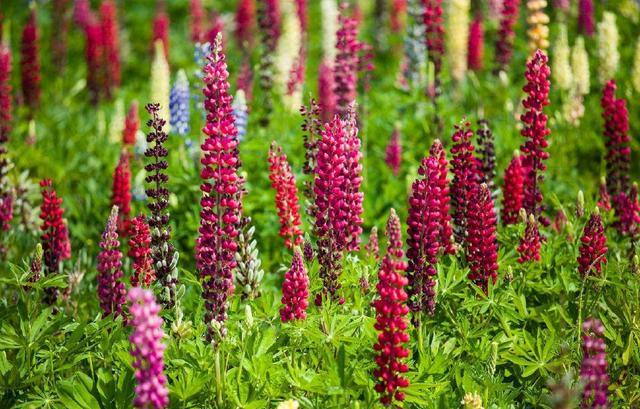
Lupine (herbaceous plant)
Lupine (Latin scientific name: Lupinus micranthus Guss.), also called "Lupinus," is a plant of the order Rosales, family Fabaceae, genus Lupinus. The stem is ascending or erect, branching from the base, the whole plant covered with brown or rusty stiff hairs. The raceme is terminal and relatively short; the infructescence axis thickens, its length still not exceeding the compound leaves. The flowering period is March to May, and the fruiting period is April to July.
Like many leguminous plants, lupine bears root nodules and can fix nitrogen from the air into the soil; its seeds are rich in nutrients, especially protein. During the Japanese occupation period, the Japanese introduced lupine to Taiwan, China, for use as green manure. Because the Japanese cultivated yellow lupine the most in their home country, yellow lupine is also the most widely cultivated in Taiwan, China today. Tea farmers in the mountainous areas of Taiwan, China plant "lupine" near the tea plants as green manure when growing tea. Lupine can also be grown in gardens for ornamental viewing.
Morphological characteristics
The stem is ascending or erect, branching from the base, the whole plant covered with brown or rusty stiff hairs. Palmately compound leaves, with 5-8 leaflets; the petiole is much longer than the leaflets; stipules are subulate, lanceolate to oblanceolate, up to 1 cm long; leaflets number 10-17, the leaf texture is thick, mostly borne at the base, the lower half connate with the petiole; leaflets are obovate, oblanceolate to spatulate, 15-70 mm long, 5-15 mm wide, the apex blunt or acute, with a short point, the base gradually narrowed, the leaf surface smooth, the underside bearing coarse hairs.
Petals
The raceme is terminal, relatively short, 5-12 cm long, its length not exceeding the compound leaves; the inflorescence axis is slender, densely composed of up to a hundred small papilionaceous flowers, the lower flowers alternate, the upper flowers irregularly whorled, the flowers 10-14 mm long; bracts subulate, 3-4 mm long, hairy; pedicels very short, 1-2 mm long; the calyx is two-lipped, covered with stiff hairs, the lower lip longer than the upper lip, the lower lip with 3 deep lobes, the upper lip shallower, persistent in fruit; the corolla is blue, the standard petal and keel petal with white markings. Besides the common goose-yellow and red, there are also light blue, pink, brick red, white and bicolor colors, giving off a strong, refreshing fragrance.
Fruit
The infructescence axis thickens, its length still not exceeding the compound leaves; the pod is oblong-linear, 2.5-5 cm long, 0.8-1.2 cm wide, densely covered with brown stiff hairs, the apex with a downward-pointing short beak, constricted between the seeds; containing 3-4 seeds. The seeds are ovate, flat, yellow, with brown or red markings, smooth. The flowering period is March to May, and the fruiting period is April to July.
Growing environment
It prefers cool conditions and full sunlight, dislikes intense heat, and tolerates slight shade. It is deep-rooted and rarely bears root nodules. It grows in sandy soil and requires deep, fertile, loose, well-drained acidic sandy loam (pH 5.5); plants grow poorly in neutral and slightly alkaline soil.
Distribution range
Annual wild types are distributed in Mediterranean countries such as Italy and Spain. It is cultivated more extensively in the Soviet Union, the Netherlands, Belgium, the United States, New Zealand and elsewhere.
Propagation methods
Propagation by sowing
Propagation by sowing is carried out in autumn, and germination is uniform at high temperatures of 21-30°C. In lupine production, propagation is mostly by sowing, and both spring and autumn sowing are possible; spring sowing in March, but after spring sowing the growing period coincides with summer, and under the influence of high temperature and heat, some varieties may fail to flower or the proportion of flowering plants may be low and the flower spikes short, giving a poor ornamental effect. Under natural conditions, autumn sowing flowers earlier and grows better than spring sowing; sow from September to mid-October, and the flowering period is April to June of the following year. Sow in 72-cell or 128-cell plug trays, dibbled and covered. The seedling-raising soil should be loose and uniform, breathable and water-retentive; specialized seedling soil or a mixture of peat soil and perlite is best. The seeds are relatively large, plain or coated, about 40 seeds/gram. The optimum germination temperature is about 25°C; keep the medium moist, and the seeds emerge and germinate in 7-10 days, with a high germination rate.
Pruning
Please click to enter an image description
Propagation by cuttings
For propagation by cuttings, in spring cut shoots sprouting from the rhizome into 8-10 cm lengths, preferably with a little rhizome attached, and insert them in a cold frame. In hot, rainy summer regions, lupine often cannot survive the summer and dies, so it can be grown as a biennial; it should be planted in the cultivation site in early spring at a spacing of 40 cm; early planting leads to early establishment and earlier flowering and seed setting. After setting seed before summer begins, the aboveground part withers, and new plants sprout again in autumn, or the seeds can be harvested before withering. In North China, protection is needed to overwinter.
Cultivation techniques
Cultivation management
The lupine seedling stage is 30-35 days; after the true leaves have fully unfolded, transplant and divide the seedlings. Lupine has a well-developed root system; keep the original soil when transplanting to promote recovery. Before planting out, repot 1-2 times depending on growth conditions; it is best to choose tall barrel-shaped pots to meet the growth needs of the taproot system, and determine a reasonable planting and placement density. For autumn-sown plantings, corresponding cold protection measures should be taken for overwintering, with the temperature preferably above 5°C, to avoid frost damage to the leaves that would affect early vegetative growth and the ornamental effect. Lupine prefers cool conditions, and since it is itself a perennial plant, special attention should be paid to management during high summer temperatures, preventing yellowing of leaves, stunted growth or even death caused by high temperature, excessive moisture and scorching sunlight. In garden applications, flowering lupines can also be planted directly among trees in groves or in cool, ventilated spots to facilitate summer management. After potted ornamental display, promptly prune away residual flower spikes and withered old leaves, control fertilizer and water, and do a good job of shading protection during the high-temperature period to ensure safe summering.
Soil adjustment
According to the growth habits of lupine, controlling and adjusting the pH of the growing medium during cultivation is crucial for the normal growth and flowering of lupine. In general, a relatively simple and effective adjustment method is to apply sulfur powder to the growing medium. Since sulfur requires a certain amount of time to decompose in the medium (about 40 days or more) before it takes effect, application should be carried out as early as possible. Generally, it is started after transplanting when 2-3 true leaves appear, and the application rate depends on the original pH of the growing medium. In addition, although acidic fertilizers such as ferrous sulfate and aluminum sulfate have the effect of lowering pH in the short term, excessively high salt ion concentrations can poison plant roots, so they should be used less in production.
Species classification
Yellow lupine
The root system penetrates more than 1.5 m into the soil; the stem is hairy, solid, 50-80 cm tall. Palmately compound leaves, with 7-11 leaflets, lanceolate, oblong or oblanceolate, with stiff hairs. Raceme, flowers yellow, fragrant; the upper lip of the calyx is two-cleft, the lower lip has three teeth. The pod is oblong, flat, 5-6 cm long, containing 1-5 seeds. The seeds are gray, white or black, with a 1000-grain weight of 120-160 g. It is strongly drought-tolerant, grows well in sandy soil, and is relatively sensitive to calcareous soil, prone to chlorosis. The fresh grass at flowering contains about 20% crude protein, and the seeds are especially rich in protein. The stems and leaves contain alkaloids and taste bitter. The alkaloid content varies by variety, generally 0.025-0.1%; varieties with a content exceeding 0.3% should not be used as feed.
Narrow-leaved lupine
The stem is 1-1.5 m tall, with many branches. Flowers purple or white. The pod is downy, each pod containing 4-6 seeds, with a 1000-grain weight of 160-200 g. The alkaloid content is highest at flowering, generally 0.005-0.04%.
White-flowered lupine
Hairy. Leaflets 5-7, obovate-oblong, with ciliate margins. Flowers white or slightly bluish, the calyx not cleft. Seeds white, round. The alkaloid content is between that of the above two species.
Gallery
A compact dwarf variety, also the latest early-flowering variety bred on the market, 50-60 cm tall, with neat and robust flower spikes, producing up to 12 flower spikes, with rich flower colors (red, pink, yellow, blue and white, five colors); sown in January or February, it can flower the same year, and both spring and autumn sowing are possible, suitable for potted ornamental viewing.
Libusita
A tall variety, 100-130 cm tall, late-flowering, vigorous in growth, with many flower colors, suitable for open-field planting and perennial ornamental viewing.
Main value
1. Potted ornamental viewing
The emergence of dwarf varieties with well-proportioned plants and lush leaves has broadened the market promotion range of lupine, giving it the chance to enter ordinary households; together with the special meaning attached to it, it is believed that people will favor it all the more.
2. Use in flower arranging
Rich plant materials have always been important material for floral masters' creations; as lupine cultivation continues to increase, its value for use as a cut flower is gradually being noticed and discovered by people, realizing the cultivation and production of cut flowers.
3. Landscape use
Lupine's distinctive plant form and rich inflorescence colors make it a relatively rare configuration material in garden plant landscaping; used as a flower border background and for mass planting and group planting along forest edges and riversides, it gives people an exotic and distinctive visual enjoyment, which is increasingly accepted and praised by professionals.
Plant culture
The flower of Saint Eugenius, bishop of Carthage in the 5th century
Since ancient times, Christianity has had the custom of linking saints with specific flowers, following from the church's practice of decorating the altar with blooming flowers when commemorating saints! And in the Catholic monasteries of the Middle Ages, various flowers were planted almost like in a gardening center; over time, the church associated the 366 days' saints with different flowers respectively, forming the so-called flower calendar. At that time most monasteries were located in Southern Europe, and Southern Europe has a Mediterranean climate, extremely suitable for growing flowers and plants. Lupine was chosen as the flower for honoring Saint Eugenius, bishop of Carthage in the 5th century. It is an annual herbaceous plant of the Fabaceae family, native to the Mediterranean. Lupine mostly grows in sandy areas where other plants cannot survive.
Meaning of the scientific name
"Lupin" means "bitter" in Greek. The seeds of lupine are extremely bitter when held in the mouth, making one frown, and it seems to look very painful. Therefore its flower meaning is "bitterness." People born under the blessing of this flower are always considered unable to say anything nice, liking to speak the plain truth and not knowing how to read the occasion. This blunt personality is best changed, otherwise one will suffer silent losses. The flower meanings of lupine: maternal love, happiness, a greedy heart, bitterness, sorrow, and vain fantasy.
There is also a saying that the name "lupine" comes from Hakka, and "lupine" comes from the Hakka "roadside flower," because in Hakka "lupine (lu ben fa)" is homophonous with "roadside flower." The famous TV drama "Lupine" was adapted from Zhong Zhaozheng's social realist novel; Zhong Zhaozheng was a Hakka from Taiwan, China, and lupine is regarded by the Hakkas of Taiwan, China as the "mother's flower."