11 Free Parks in Wuxi You Must Visit
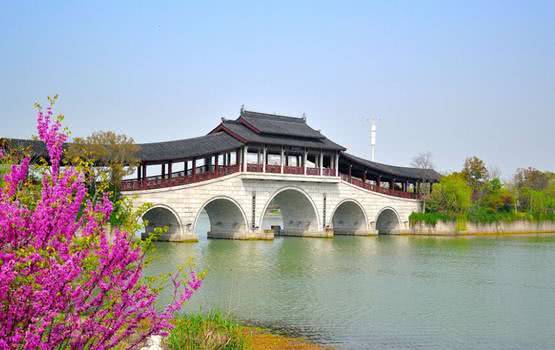
Wuxi is a national historical and cultural city and has been a land of fish and rice since ancient times, long known as the cloth wharf, money wharf, kiln wharf, silk capital, and rice market. Wuxi is the cradle of China's national industry and township industry, and the birthplace of the Sunan model. Wuxi culture belongs to Wu-Yue culture, and the people of Wuxi belong to the Jiangsu-Zhejiang ethnic group and speak the Wu language. Today, the editor will take you through 11 free parks in Wuxi that you must visit. These parks are not only free but also have exquisite facilities and beautiful scenery. Come and take a trip right at your doorstep!
1. Changguangxi Wetland Park
Changguangxi Wetland Park is located in the southwestern suburbs of Wuxi, Jiangsu Province, and is an ecological corridor connecting Li Lake and Tai Lake. It leans against Junzhang Mountain to the west, connects to Li Lake to the north, borders the University Town to the east, and backs onto Tai Lake to the south. Nestled among mountains and beside the lake, it enjoys an excellent geographical location and natural environment. It is one of the ten national urban wetland parks in the country.
Changguangxi is an ancient river channel with a long history and was the earliest area where residents of the Wuxi region gathered, accumulating a rich historical and cultural heritage. To date, many historical sites and numerous ancient relics have been discovered along both banks of Changguangxi. Walking into Changguangxi Park is like arriving at a gathering place of lake and mountain scenery, where the rippling blue waves of Li Lake and the large stretches of reed flowers along the shore interweave into a stunning late-autumn picture.
Address: Near the (Southeast Gate) of Changguangxi National Urban Wetland Park, Jinshi Road, Wuxi
2. Guansheshan Wetland Park
Guansheshan Wetland Park is located between East China Sanatorium and Bogong Island, at the junction of Tai Lake, Li Lake, and Liangxi River. Mountains and water complement each other, and the cultural atmosphere is rich. Several viewing platforms along the lake extend into the water, wooden boardwalks wind and stretch across the lake, and the shore is lush with vegetation. In late autumn, reed flowers veil the shallow islets and the setting sun reflects on the cold stream. Mooring on the lake, one still hesitates; thinking of where you are, it is already late autumn - truly a feast for the eyes.
Address: Intersection of Xiangxue Road and Huanhu Road
3. Canal Park
Canal Park faces Huishan Mountain to the west and is surrounded by water on three sides. The park site was originally the concentration area of Wuxi's rice market and, after the founding of New China, of grain and oil transportation, storage, and processing. Now, combined with the protection of 20th-century industrial heritage, the park will become a comprehensive open large-scale urban garden integrating rice market culture, canal culture, sports culture, entertainment culture, ecological greening, and tourism and leisure.
Address: Beside Yunhe East Road under Jiangjian Bridge in the former Beitang District (near Ronghu Bridge)
4. Jinkui Park
As a landmark project of Taihu New City, Jinkui Park is located south of Gaolang Road, west of Suxi Road, north of Guanshan Road, and east of Lide Road. The entire park's construction highlights the characteristic of mountains and water blending, with large-scale afforestation, flower and grass planting, and the introduction of aquatic plants suited to local conditions, making it the "green lung" of Taihu New City. At the same time, the park is also appropriately equipped with public facilities for sports, culture, history, and business leisure to meet the leisure needs of citizens.
Address: Guanshan Road, Binhu District, Wuxi, Jiangsu Province
5. Li Lake Park
Li Lake Park is located on the shore of Tai Lake, also known as the "World Wonders European City", and is a film and television shooting base of China Central Television. The main attractions include the ancient Greek "Altar of Zeus", the French "Arc de Triomphe", the British "Prehistoric Stone Circle", the Portuguese "Belém Tower", the Norwegian "Country Church", a German castle, a Russian manor, the Italian "Water Courtyard", and "European Street".
Address: Huanhu Road, Binhu District
6. Gaozi Shuiju
Gaozi Shuiju is the place where Gao Panlong, one of the leaders of the Donglin Party in the Ming Dynasty, lived in seclusion and studied for 27 years. In 1598, Gao Panlong resigned from office and returned home, building a small tower in the water at Yuchitou by the shore of Li Lake. The small tower had windows on all four sides, allowing one to gaze at mountains, observe the water, enjoy the cool breeze, bask in the sunlight, and companion with the bright moon, so Gao Panlong named it "Ke Lou" (The Pleasing Tower). A winding embankment was built around its outer perimeter, and beyond the embankment was Li Lake. Today it has been built into a commemorative garden integrating cultural and natural landscapes.
Address: North shore of East Li Lake in the southwest
7. Jiangjian Park
The original site of Jiangjian Park in Wuxi was Jiangjian Zhu, with a long history, profound cultural heritage, and rich remains of ancient architecture. It is a rare geomantic treasure spot among cities along the Beijing-Hangzhou Grand Canal. The long triangular Jiangjian Park has a perimeter of about 800 m and is surrounded by water on all sides. The "Nostalgic Wharf" decorated with overturned small boats, wooden oars, fishing lamps, and wine jars reminds people of the glorious history of this place as a famous Chinese pottery and rice market. The "Wu Customs and Chu Charm" scenic area's vignettes and waterscapes interpret the unique water town charm of the ancient canal and Jiangjian Zhu.
Address: Diagonally opposite the Beidajie Subdistrict Office
8. Bogong Island - Li Causeway
Bogong Island, also known as Bogong Island Ecological Park, was enclosed and built on the east side of the original Dushan Dam in conjunction with the project of returning fish ponds to the lake. It faces Guansheshan to the west and confronts Chongshan at its southern end. Bogong Island Ecological Park integrates water conservancy engineering, natural scenery, and cultural landscapes, and is another free themed park on the 36 km Li Lake lakeside sightseeing belt after Li Lake Park. It is named in memory of the water-management sage Zhang Bo.
Address: Located at the junction of the south side of Daxuan Bridge on Huanhu Road and Yuantouzhu Park
9. Jinchengwan Park
Jinchengwan Park mainly improves the ecological environment of the Jinchengwan area through the implementation of ecological projects to return land to the lake and the regulation of rivers, carefully creating several major functional areas including the park entrance plaza area, the lively garden area, the colorful waterfront area, the Li Lake Water Village area, the water town dream-seeking area, the childlike innocence releasing area, and the retained building renovation area. The completion and opening of Jinchengwan Park has connected all 38 km of shoreline of the open scenic area around Li Lake, allowing the new and old urban areas to communicate better and maximizing the tourism effect of Wuxi city, truly embodying the grand concept of "Li Lake embraces the city, the city draws close to Li Lake".
Address: Southeast end of Li Lake, Binhu District, Wuxi, southwest end of the intersection of Jincheng West Road and Gonghu Avenue
10. Yufu Island - West Causeway
Lakeside beach, West Lake beauty. Yufu Island is a small island jutting into Li Lake. Fan Li, after achieving success and retiring, brought Xi Shi to live in seclusion at Wuli Lake, raising fish and farming, and wrote China's first monograph on fish farming, "Classic of Fish Farming". The common people honored him as the Fisherman Father, and the island was named Yufu Island.
Address: Junction of Huanhu Road and Wangshan Road
11. Baojieshan Forest Park
Baojieshan Forest Park is located at the southern foot of Baojie Double Rainbow Bridge, adjoining the mountain body of Yuantouzhu Scenic Area to the west and reaching the west shore of Li Lake to the east, forming with the lakeside area another lakeside scenic spot where mountains and water depend on and blend with each other. To meet future tourism and sightseeing needs, a landmark of Wuxi New City has been built at the top of Baojie Mountain. At the excellent position of two lakes flanking one mountain, it forms a twin-peak standoff with Luding Yinghui. To the north it looks toward Yuantouzhu, to the south it overlooks Huibu Mountain, to the west the vast Tai Lake is fully in view, and overlooking Li Lake and the cityscape is completely unobstructed, adding a new highlight to the south side of Baojie Double Rainbow Bridge. Baojieshan Park is also Wuxi's first mountain-feature park, a great place for the whole family to camp and hike.
Address: Southwest side of Baojie Bridge, Binhu District, Wuxi, the original freshwater fishery center area