Detailed Explanation of Key Points of Organic Cauliflower Cultivation Techniques
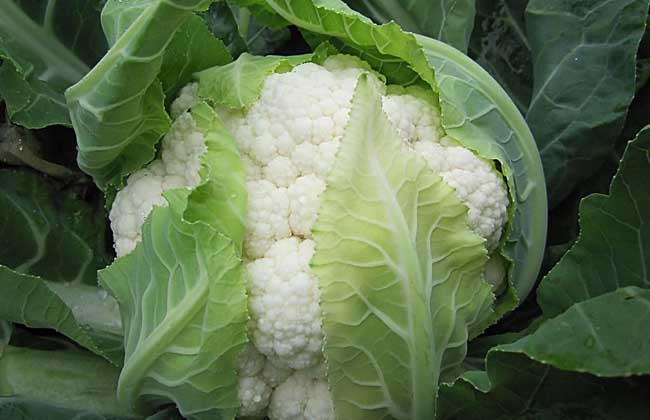
Cauliflower is also known as cauliflower, flowering cabbage, and cauliflower, among other names. It is a variety of Brassica oleracea in the Brassicaceae family, native to the Mediterranean coast. Its head is a white inflorescence, similar to the head of broccoli. Its product organ is a curd formed by the aggregation of pure white, shortened, tender flower buds, flower branches, and flower stalks. Let us now take a look at the cultivation techniques for organic cauliflower!
Cultivation Conditions for Organic Cauliflower
Cauliflower has a well-developed root system and strong regeneration ability, making it suitable for seedling raising and transplanting. It is susceptible to freezing damage below 0°C, and it is difficult to form curds above 25°C. Leaf rosette growth and bolting and flowering require warmth, with an optimum temperature of 20-25°C. Curd formation must go through a low-temperature vernalization stage. It has low requirements for light conditions but relatively strict requirements for moisture, being neither tolerant of waterlogging nor drought. It has strong adaptability to soil, but sandy loam soil with high organic matter and deep soil layers is best. The suitable soil pH is 5.5-6.6. It has strong salt tolerance and can still grow normally in soil with a salt content of 0.3-0.5%.
Seedling Raising Techniques for Organic Cauliflower
1. Planting time: Cauliflower is mostly planted in spring and autumn each year. Most areas of North China are very suitable for autumn planting of organic cauliflower. For autumn planting, sowing can be done in mid-July, transplanting in August, and harvest in late October and early November. If spring planting is chosen, sowing should be done in late January, transplanting in late March, and harvest in late May and early June.
2. Seed treatment: Seed disinfection is a relatively economical and effective method for preventing cauliflower pests and diseases. Natural substance disinfection and hot water seed soaking techniques should be used to treat seeds. For natural substance disinfection, soak in 300 times diluted potassium permanganate solution for 2 hours, 200 times diluted wood vinegar solution for 3 hours, 100 times diluted lime water for 1 hour, or 100 times diluted copper sulfate solution for 1 hour, then soak in hot water for 4 hours after disinfection.
3. Seedbed disinfection: For organic cauliflower planting sites, physical or natural substances are generally used for soil disinfection. Soil disinfection substances can include 3-5 degrees Baumé lime sulfur mixture, 100 times diluted crystalline lime sulfur mixture, 30-50 kg quicklime, or 100 times diluted potassium permanganate or 50 times diluted wood vinegar solution for spray disinfection of the seedbed.
4. Cultivating strong seedlings: For autumn planting, rainproof and shaded sheds can be used for sowing and seedling raising. First prepare the nutrient soil, water the seedling bed thoroughly, broadcast or spot-sow the seeds, cover with soil and plastic film. 20-25 grams of seeds are needed per mu, and the seedbed should be 4-5 sq m. After emergence, keep the bed surface moist, and pay attention to rain protection, weed control, and thinning. When seedlings are weak, apply 30% biogas slurry 2-3 times. For spring planting, cold frames can be used for seedling raising. From sowing to emergence, the seedbed should not be ventilated, with daytime temperature around 25°C and nighttime temperature around 15°C. After emergence, ventilate appropriately, with daytime temperature of 20-25°C and nighttime temperature of 10-15°C. Harden the seedlings 1 week before transplanting.
Cultivation Techniques for Organic Cauliflower
1. Land preparation and transplanting: Apply 5000 kg of fully decomposed organic fertilizer per mu, deep plow, rake level, and make beds. In North China, flat beds are generally used, with a bed width of 1.4-1.5 m, and two rows of cauliflower planted per bed. For early-maturing varieties, plant spacing is 32-37 cm; for mid-maturing varieties, 40-45 cm; for late-maturing varieties, 50-60 cm. Autumn planting density is lower, and spring planting density is higher.
2. Temperature management: Temperature should be managed according to seasonal climate changes, room temperature changes, and cauliflower growth requirements for daily management such as heat preservation, cold protection, and ventilation, and the timing and amount of ventilation should be controlled. From transplanting to seedling recovery, keep warm and moist, with daytime temperature at 25°C and nighttime temperature at 15-20°C. From seedling recovery to the appearance of small curds is the leaf rosette growth stage, with daytime temperature maintained at 20-25°C and nighttime temperature at around 15°C. The curd formation stage requires cool climate conditions, with daytime temperature of 20-22°C and nighttime temperature of 10-15°C.
3. Water and fertilizer management: The principle of water and fertilizer management after cauliflower transplanting is to promote seedlings in the early stage, encouraging early seedling recovery and early rosette formation; control water and fertilizer in the middle stage to promote root development; and promote curd development in the late stage to encourage curd expansion. Generally, 3 key topdressings are applied: the first 7-15 days after transplanting, the second 30-40 days after transplanting when plants have 15-17 true leaves, and the third when plants begin to form curds. Each time, apply 1000 kg of high-quality organic fertilizer per mu or drench with 25% biogas slurry. During curd formation, 30% biogas slurry can be used for foliar topdressing.
4. Moisture retention and branch pruning: The soil should be kept moist throughout the cauliflower growing period, especially during the curd enlargement period when water must not be lacking. However, cauliflower is also afraid of waterlogging, so drainage should be noted during the growing period. Cauliflower tends to produce side branches. Before harvesting the main curd, side branches should be removed, or when most main curds have grown to 12-16 cm, 3-4 side branches can be appropriately retained. Frequently remove dust from the plastic film to keep it clean, improve light transmittance, and ensure normal growth of cauliflower.
5. Pest and disease control: Organic cauliflower can also suffer from some pests and diseases during the growing period. If not treated in time, yields will be reduced and the quality of organic cauliflower will be affected. Cabbage caterpillars and diamondback moths are common pests and diseases when growing organic cauliflower. After they occur, farmers should use Bacillus thuringiensis for control. If aphids appear on organic cauliflower, 1% soap solution can be used for control. In addition, when growing organic cauliflower, to reduce the occurrence of pests and diseases, net house cultivation can also be used.
6. Timely harvest: The harvest period for organic curds is relatively strict, and harvesting must be timely and prompt. The harvest standard is that the curd has fully grown, the surface is round and neat, the edges have not yet spread open, the curd is relatively firm, and the color is deep green. For some varieties, after harvesting the main curd, side curds can also be harvested 2-4 times.