Differences Between Sedum pachyphyllum 'Yachiyo' and Sedum pachyphyllum 'Otome Kokoro' and a Detailed Guide to Their Care
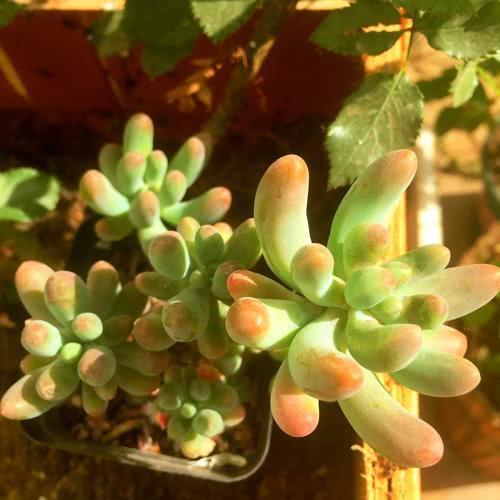
Sedum pachyphyllum 'Yachiyo' and Sedum pachyphyllum 'Otome Kokoro' are extremely similar, but among outside vendors, many use 'Otome Kokoro' to stand in for 'Yachiyo', which has led many inexperienced gardening enthusiasts to be cheated. So the editor is taking this opportunity to tell everyone about their differences and care methods. First, let's talk about what distinguishes the two. First, their stems are different: the stem of 'Yachiyo' is a woody stem, older and more yellow. That of 'Otome Kokoro' is a fleshy stem, a bit more tender green.
'Otome Kokoro' more easily sprouts side shoots, while 'Yachiyo' does not sprout side shoots at all, and this is also one way to tell the two apart; when 'Otome Kokoro' is newly produced, its small plant appears big at the head and small at the tail, while 'Yachiyo' is small at the head and big at the tail. Next, let's analyze the care methods for both 'Yachiyo' and 'Otome Kokoro'.
Light: Since both are succulents, and generally speaking succulents like sunlight, when caring for these two you should provide them with plenty of sunlight. And if the temperature outside is decent, we can all take the succulents outside to absorb enough sunlight. But one thing to note: in summer, the temperature is relatively high, and at this time we need to shade these two to prevent sunburn.
Water: 'Yachiyo' has low requirements for water; because its internal water content is relatively high, watering too much can easily cause 'Yachiyo' to develop root rot, so when growing 'Yachiyo' you should choose a flower pot with relatively good drainage; while 'Otome Kokoro' has relatively high requirements for water, and 'Otome Kokoro' is a rather special plant: if watered too much, 'Otome Kokoro' will grow better and better, and grow taller; if not watered much, 'Otome Kokoro' will also continue to grow, just not as tall. 'Otome Kokoro' has two forms of growth, so it depends on which look you gardening enthusiasts prefer.
Fertilizer: Both have a certain need for fertilizer; when growing succulents, you should not use a flower pot with overly good drainage, as it easily causes the plant's water and fertilizer to be lost. Moreover, 'Otome Kokoro' is a succulent that likes fertilizer, so when growing it you should add a bit more fertilizer, that is, when growing it you need to increase the fertilizer; generally speaking, cultivating 'Otome Kokoro' requires fertilizing once a week. Of course, using too much fertilizer is not a good thing either, and fertilizer should be applied appropriately.
Temperature: Succulents have different temperature requirements, but on the whole they are fairly similar, roughly as follows: when below 5°C, the plant will suffer frost damage and immediately stop growing, and in more serious cases it may even die. And once the temperature is above 30°C, the plant will also stop growing; once too high a temperature causes growth to stop, at this time we should immediately stop watering, and only start restoring the watering frequency after the temperature comes down.
Actually, there are certain differences between the two, and as long as we pay a little attention, we can quickly tell them apart. At the same time, I hope that after reading what the editor has said, you will no longer be cheated by outside vendors.