Low import volume and high price for Japanese flounder; Fisheries Research Institute spent four years developing cold-water aquaculture technology
The Fisheries Research Institute of the Council of Agriculture spent four years developing domestic technology for farming Japanese flounder, hoping that this high-economic-value fish can increase income for domestic aquaculture operators. Japanese flounder is a type of fish broadly known as "flatfish," mainly used for sashimi and nigiri sushi in high-end Japanese restaurants. Due to its high unit price, it costs over one thousand yuan per kilogram, and currently only a small amount is imported domestically.
Taiwan imports over eight thousand tons of flatfish annually; Japanese flounder imports are roughly estimated at less than one hundred metric tons
Taiwan imports over eight thousand tons of flatfish annually, but "flatfish" is merely a common name encompassing many species, generally including the commercially sold "halibut" (Atlantic halibut), turbot, and Japanese flounder used for sashimi in high-end Japanese cuisine.
Xu Chengyu, General Manager of Yong Sheng Ocean, pointed out that the over eight thousand tons imported annually is the commonly known "halibut" (Atlantic halibut), while other imported flatfish are very small in quantity. Shao Guangzhao, a research fellow at Academia Sinica, explained that all flounders and soles are commonly known as flatfish, with several hundred species. "Halibut and Japanese flounder are completely different species, with huge differences in body size."
He Yuanxing, Director of the Eastern Marine Biology Research Center of the Fisheries Research Institute, Council of Agriculture, stated that the Bureau of Foreign Trade figures do not separate Japanese flounder independently, so the exact import number cannot be known. The import volume is indeed not that high, and roughly estimated imports may be less than one hundred metric tons.
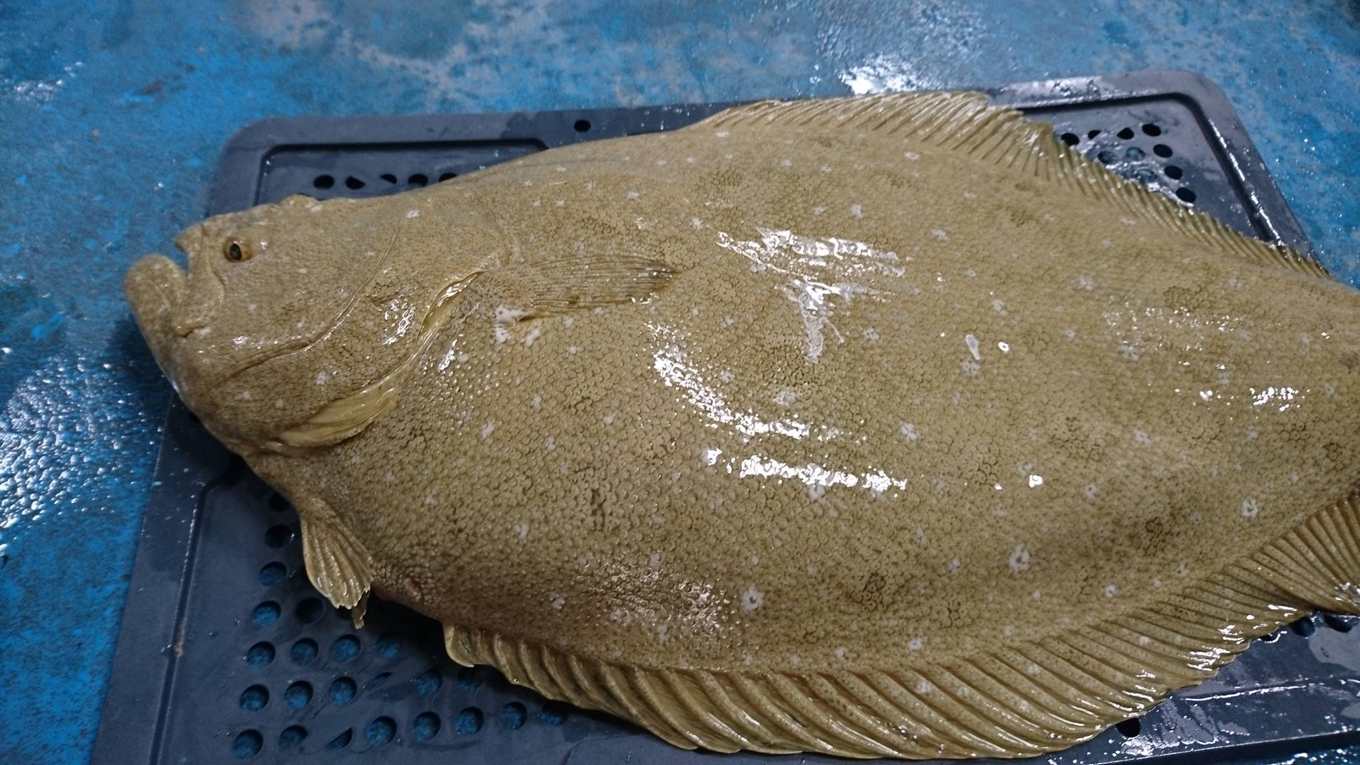
Japanese flounder can serve as a new aquaculture strain for Taiwan, providing diversity
Currently, domestic imports of Japanese flounder are low. He Yuanxing believes this is because the price is too high, but if Taiwan begins farming Japanese flounder in the future, it could bring prices down and make it affordable to the general public. In the future, it might be available even at ordinary seafood stores. "When prices drop, demand increases." Becoming a new aquaculture species would diversify the market, giving fishermen new options and allowing more consumers to enjoy Japanese flounder.
In addition, Taiwanese aquaculture operators would be better able to secure Japanese flounder fry. Because importing 3 cm fry from Japan and South Korea costs seventy to eighty yuan each, if produced domestically in the future, the price could drop to ten yuan.
With such low volume in use, is there economic benefit to farming it?
Since only a small amount is imported, would farming Japanese flounder domestically really be profitable? Xu Chengyu, General Manager of Yong Sheng Ocean, questioned: although the technology for farming Japanese flounder in Taiwan can be achieved, "but is there economic benefit?" Xu stated that Japanese flounder is already an overdeveloped technology in Japan and South Korea. Taiwan did not do it in the past precisely because the country is not suitable for farming cold-water species. "Not farming Japanese flounder was originally the correct choice. Why should a non-cold-water country develop cold-water fish?"
Calculated at 500 yuan per kilogram and a volume of 100 metric tons, the domestic output value is roughly estimated at only fifty million. "Is this output value worth it compared to developing a new species?" Xu stated that given Taiwan's production conditions or market potential, "farming Japanese flounder domestically really has no competitiveness."