Appreciating Wang Zhijun's Bird-and-Flower Paintings: A Hundred Flowers in the Heart, Splendour on the Brush
Chang'an Ancient Melody
Kong
Ma Di
00:00/08:53
If there are no hundred flowers in the heart, how can the brush be splendorous?
-- Appreciating Wang Zhijun's Bird-and-Flower Paintings
Text by Danya Ruoxue
Image selection by Beijing @Kou Zhen'an
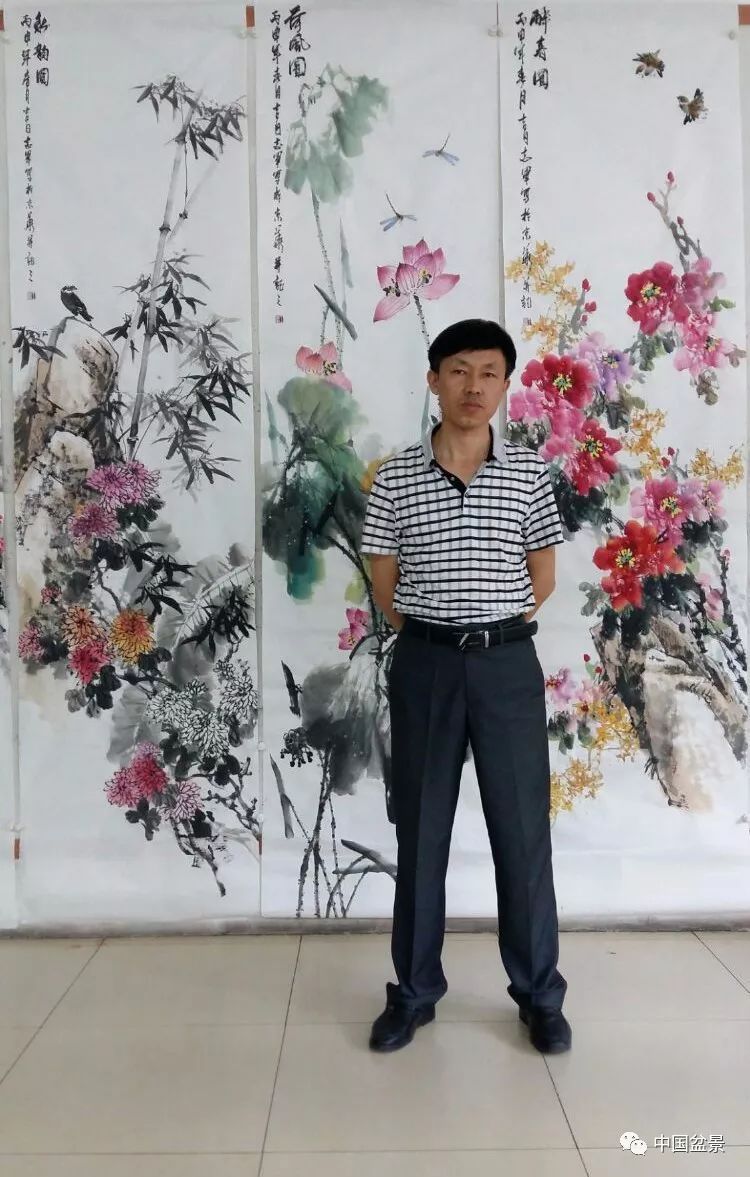
The qi of heaven and earth differs according to region, and people differ accordingly. The painter Wang Zhijun, courtesy name Zhujun, was born in 1969 in Baicheng City, Jilin Province. He is currently a member of the Jilin Province Artists Association, vice chairman of the Baicheng City Artists Association of Jilin Province, and vice chairman of the Taobei District Artists Association. He has loved calligraphy and painting since childhood. In 2011 he resigned his job and went to Beijing to study modern freehand bird-and-flower painting under the renowned painter Mr. Liu Cunhui, and he continues to this day. His works are mainly in the grand freehand style, and he is especially skilled at the maple-vine series of panoramic bird-and-flower paintings. His works have been exhibited in various art exhibitions many times and have won numerous awards. Some of his works are collected by museums, institutions, units and individuals.
Among the countless plant species in nature, Boston ivy is a common climbing vine, also known as maple vine; in summer its branches and leaves are dense, and it often clings to walls or rocks. On one occasion, while sketching in the mountains, Mr. Wang Zhijun discovered a large patch of Boston ivy climbing among the mountain rocks, its leaves swaying in the wind, its branches densely tangled, as if it were a beautiful landscape painting. With a painter's discerning eye, he drew creative inspiration from experiencing the workings of nature, and so he began to choose the maple vine as his artistic breakthrough.
Each time we appreciate Mr. Wang Zhijun's maple-vine series, it is as if we are placed in a tropical rainforest, amid mountain flowers in full bloom, breathing in nature's intimate and enchanting breath, truly feeling a great impulse to devote oneself to it and be eternal within it. Wang Zhijun is a diligent creator and cultivator in the world of birds and flowers. His works are known for their exquisite and rigorous composition, full and dense yet not chaotic, and their dazzling, splendorous feeling.
From his works, we can feel that the painter integrates the perspective effects of landscape painting into his bird-and-flower painting creation. His works not only express emotion through objects, as bird-and-flower painting does, but also possess the beauty of artistic conception that expresses feeling through scenery, as landscape painting does. Using the expressive form of panoramic bird-and-flower painting, he integrates the spatial relationships of landscape painting's "distant view, near view and middle view", making the content of the works richer and more grand and unrestrained! Everyone knows that bird-and-flower painting emphasizes charm and interest, while landscape painting emphasizes artistic conception; Wang Zhijun introduces the artistic conception of landscape painting into bird-and-flower painting. This gives the works new vital energy in the expansion of visual space. He habitually adopts a full and rich compositional approach, with scenery spread everywhere, like the visual range of a "middle view", full of visual tension. He is also skilled at using overlapping techniques and the like to reproduce the rich variations of natural spatial layers, pushing space into depth by means of alternating solid and void, so that the works form the beauty of artistic conception with the "profound" effect possessed by landscape painting.
For many years Mr. Wang Zhijun has wholeheartedly captured the most "charming" scenes in nature, devoting himself to the green-shaded, lush and verdant scenery of the natural world. It is as if what is placed before our eyes are plant communities shining with the splendour of life. He either uses rocks to set off flower branches, or dots the scene with flying birds, insects and grass to add vitality, or uses babbling streams and gurgling springs to create one enchanting artistic conception after another. For a painter, brush and ink are a lifelong matter; only by perfecting them through constant trial and tempering can they suit the aesthetics and needs of the times. The subjects we are familiar with in life usually attract no attention, and only when the seasons change do we feel their beauty, and only different forms of expression can convey different connotations.
For example, in the work "Clear Rhyme of the Morning Wind", a graceful approach expresses a mysterious and unfathomable effect of light and shadow, using different inks and colours to form a subtle space. The vines change endlessly, and the picture is rich and lively; the mountain rocks are plain and natural, deep and luxuriant; the growth of the vines is orderly, with solid and void, gathering and scattering, handled appropriately; the vine leaves rise and fall with measure, and the atmosphere rendered by the environment is just right. He is skilled at using the low brightness of branches and trunks to set off the high brightness of vine leaves, so that the heavy becomes heavier and the delicate becomes more delicate. In texture, the jaggedness of the mountain rocks and the tenderness of the mountain flowers form a sharp contrast, fully expressing the painter's independent painting language and artistic style.
And in the work "Autumn Rhyme of the Maple Vine", the whole work is dominated by red and yellow, with brilliant colours, fully embodying the rich colours of autumn, and then using the ink tones of mountain rocks to set off the natural environment that autumn should have. He seeks the rhythm of life, and the taste and joy of life, from dense, intricate and verdant growth. Thus we cannot but marvel at his unique vision and wisdom in the field of painting. He can find the support of each life among those plant communities that twine, climb, parasitize and grow mutually, thereby expressing their spirit of vigorous vitality and that kind of harmonious and beautiful relationship. The ever-changing brushwork, the composition with well-judged density, the delicacy of outlining, dyeing, texturing and rubbing, the bright and lucid use of colour, fresh and elegantly simple, with tones rich within unity, further reveal the work's freshness, steadiness, brightness and clarity, forming a style of its own. From Mr. Wang Zhijun's works we can read the painter's deep attachment to nature. He can express the most common and ordinary maple vine in nature so perfectly and so vividly, which shows that the painter's unique observational vision was gradually worked out through countless failures into his distinctive form of expression.
Looking comprehensively at Wang Zhijun's bird-and-flower works, in composition he does not fully extend the traditional methods and structural relationships of bird-and-flower painting. He takes fragments of the natural world and paints fragmentary scenes, rather than the routine of two or three birds in a horizontal scene expressing fragrance. Mr. Wang Zhijun uses techniques such as dotting, outlining, texturing and rubbing to increase the colour thickness, layering and spatial sense of the picture. Compared with tradition, his works have a greater sense of the times, especially splashed colour and splashed ink with freehand brushwork, mutually blending and penetrating with the combined meticulous-and-freehand approach, making the works dripping with vitality, the picture abundant and full of life.
In the use of colour, pure colour use highlights his own individuality, especially in the use of environmental colour. In works with a cool colour tone, although the whole work is based on grey, dark or solemn cool colours, the grey-white that commands the picture not only has no sense of dullness or oppression, but instead reveals a kind of ethereal, poetic beauty, while a few green fruits faintly visible at the lower part of the painting represent the vitality of spring and give people infinite reverie. In works with a warm colour tone, the whole work is dominated by red and yellow, giving a strong warm feeling while also producing the artistic effect of forests dyed in layers. Appreciating Wang Zhijun's paintings not only gives a simple pleasure, but more importantly contains implication and thought. The white's holiness, the grey's elegant simplicity, the red's blazing intensity, the black's weightiness, and the small birds on the works, whether raising their heads and looking back or flying freely, are all yearnings for hope and peace. All of these leave endless overtones beyond the painting.
In the use of lines, he emphasizes different line forms, whether long or short, thick or thin, or twisting or crossing arrangements. He is good at organizing various shapeless lines and from these evolving irregular shapes, combining line with form, enhancing the richness and expressive power of lines, and also making the plants appear in a thousand postures, infinitely profound. This gives the works a sense of deep and broad realm and ethereal quality, and the handling of the relationships among ink, line and colour is appropriate, adding vitality to the imagery. All of the above constitutes the individual style of Wang Zhijun's bird-and-flower painting today.
Ink dances through life, and there is splendour. I think this saying could not be more apt when applied to Wang Zhijun. In rich layers he interprets dots, lines and planes, as well as the beauty of rhythm and rhyme of colour and ink, thereby forming a new lyrical method and aesthetic value. While offering poetic praise of nature, he also builds up his own aesthetic thought. Such works break free from traditional formula, give off a rich breath of life, and are filled with a fresh style like sunshine and rain, making the works closer to the aesthetic needs of contemporary people and arousing resonance in the viewer.
Profile of Wang Zhijun:
Wang Zhijun, courtesy name Zhujun, male, born in 1969 in Baicheng City, Jilin Province. In 2010 he studied under the renowned painter Mr. Liu Cunhui and was accepted as an indoor disciple. He is currently a member of the Jilin Province Artists Association, vice chairman of the Baicheng City Artists Association, vice chairman of the Taobei District Artists Association, vice president of the Taobei District Calligraphy and Painting Academy, a painter of the Calligraphy and Painting Academy of CETV China Education Television, and a contracted painter of Kachuo Network.
In June 2012, participated in the exhibition marking the 20th anniversary of the establishment of Taobei District, Baicheng City.
In July 2012, participated in the first Calligraphy and Painting Channel teachers' and students' works exhibition held by the Central Digital Calligraphy and Painting Channel.
In August 2012, held the Wang Zhijun and Yu Huizi Freehand Bird-and-Flower Painting Report Exhibition in his hometown Baicheng.
In 2013, participated in the Baicheng City Spring Festival Calligraphy and Painting Exhibition.
In November 2014, participated in the works exhibition of the Changbai Mountain Artists Association.
In 2015, was appointed as a contracted painter of Kachuo Network.
In August 2016, his works were included in the themed stamp album "Celebrating the 95th Anniversary of the Founding of the Communist Party of China" and published and issued.
In December 2016, was appointed as a painter of the Calligraphy and Painting Academy of CETV China Education Television, and participated in the education television station's 2017 calligraphy and painting Spring Festival Gala.
On March 3, 2017, participated in the Liu Cunhui Modern Freehand Bird-and-Flower Painting Teaching Achievement Exhibition at Beijing 798 Art Center.
In June 2017, participated in the calligraphy and painting exhibition for the renovation of the old urban area of Taobei.
In February 2018, participated in the New Era, New Baicheng, New Atmosphere Spring Festival Calligraphy, Fine Arts and Photography Works Exhibition.
Wonderful replay:
Chinese bonsai welcomes you!
Enjoy any timethebonsai exhibition hall
Promote bonsai culture, exchange bonsai skills!
Appreciate bonsai art, share a happy life!